All questions
Question 1
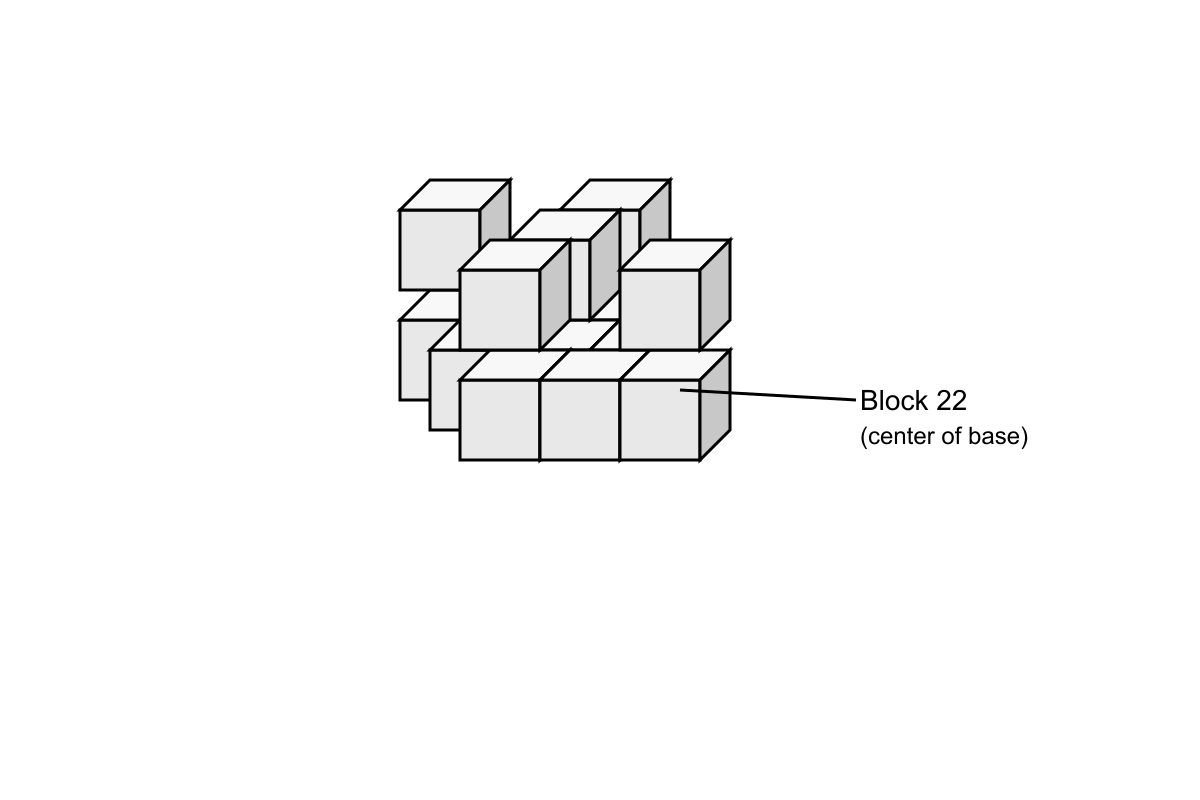
For the figure below, determine the number of blocks in contact with block number 22.
- 3
- 4
- 5 (correct answer)
- 6
- 7
Explanation: Block 22 is the center block of a 3x3 base that has an 'X' shaped second layer. It touches four blocks on its own layer (front, back, left, right). It also has one block directly on top of it, which is the center of the 'X'. It does not touch the arms of the 'X' directly, as they are supported by the other base blocks. Total contacts: 4 on its layer + 1 above = 5 blocks.
Question 2
In the figure provided, how many other blocks are touching block number 1?
- 2
- 3
- 4
- 5 (correct answer)
- 6
Explanation: Block 1 is an interior block in the base layer. It touches four other blocks on its own layer (front, back, left, right). It also touches one block directly above it. The bottom of block 1 rests on the ground and does not touch another block. Therefore, it touches a total of 4 + 1 = 5 blocks.
Question 3
For the figure below, determine the number of blocks in contact with block number 4.
- 1
- 2
- 3
- 4 (correct answer)
- 5
Explanation: Block 4 is part of a central column. It has a block directly above it and a block directly below it (2 blocks). It also touches a block to its right from the horizontal arm and a block behind it that is part of the structure's base. It does not touch anything to its left or front. Total contacts: 1 above + 1 below + 1 right + 1 behind = 4 blocks.
Question 4
Examine the pile of blocks shown. How many other blocks touch block number 5?
- 3
- 4
- 5 (correct answer)
- 6
- 7
Explanation: Block 5 is an interior block in a structure with a hole. It touches one block to its left, one block to its right, and one block behind it (3 blocks on its layer). It also touches one block directly above it and one block directly below it. The space in front is a hole. Total contacts: 3 on its layer + 1 above + 1 below = 5 blocks.
Question 5
In the provided figure, how many blocks are in direct contact with block number 6?
- 2
- 3
- 4
- 5 (correct answer)
- 6
Explanation: Block 6 is the central block of a cross-shaped structure on the bottom layer. It touches the four arms of the cross on its own layer (front, back, left, right). It also touches the central block of the layer directly above it. The bottom face does not touch another block. Total contacts: 4 on its layer + 1 above = 5 blocks.
Question 6
Referring to the image, how many other blocks touch block number 7?
- 1
- 3
- 4 (correct answer)
- 5
- 6
Explanation: Block 7 is the inside corner block on the second layer of an L-shaped structure. It touches one block below it. On its own layer, it touches one block in the vertical part of the 'L' and one block in the horizontal part of the 'L'. It also touches one block directly above it in the top layer. Total contacts: 1 below + 2 on its layer + 1 above = 4 blocks.
Question 7
In the block structure depicted, how many other blocks are touching block number 12?
- 1
- 2
- 3 (correct answer)
- 4
- 5
Explanation: Block 12 is a bridge block spanning a gap. It rests on the block to its left and the block to its right. It also has a block directly behind it, making the bridge two blocks deep. It has no blocks above, below (in the gap), or in front of it. Total contacts = 3 blocks.
Question 8
Examine the pile of blocks shown. How many other blocks touch block number 14?
- 3
- 4
- 5 (correct answer)
- 6
- 7
Explanation: Block 14 is in a large base, adjacent to a central tower. It touches four blocks on its layer (front, back, left, right). It also touches the bottom block of the central tower, which is adjacent to it. It has no block on top of it. Total contacts: 4 on its layer + 1 from the tower = 5 blocks.
Question 9
Referring to the image, how many other blocks touch block number 16?
- 2
- 3
- 4
- 5 (correct answer)
- 6
Explanation: Block 16 is located directly above a tunnel that passes through the structure. It touches the block directly below it (which forms the tunnel's roof). It touches one block to its left and one to its right. It touches one block behind it. It also touches one block directly above it. The space in front of it is open. Total contacts: 1 below + 3 on its layer + 1 above = 5 blocks.
Question 10
In the structure shown, calculate the number of blocks touching block number 17.
- 2
- 3
- 4 (correct answer)
- 5
- 6
Explanation: Block 17 is a bridge block connecting two towers. It rests on top of a block from the left tower and a block from the right tower. Because the bridge is two blocks wide, it also touches a block next to it (on the same level). It has no blocks above it. Total contacts: 1 (left support) + 1 (right support) + 1 (adjacent bridge piece) + 1 (block behind it) = 4 blocks.
Question 11
For the C-shaped structure depicted, how many other blocks are touching block number 18?
- 2
- 3 (correct answer)
- 4
- 5
- 6
Explanation: Block 18 is the central block in the vertical spine of a C-shaped structure. It touches the block directly above it and the block directly below it. It also touches the block behind it, which gives the structure its depth. It does not touch anything to the left (the opening of the 'C'), right, or front. Total contacts: 1 above + 1 below + 1 behind = 3 blocks.
Question 12
In the provided figure, how many blocks are in direct contact with block number 24?
- 3
- 4 (correct answer)
- 5
- 6
- 8
Explanation: Block 24 is the second step in a diagonal staircase structure that is 2 blocks wide. It contacts: (1) the block directly below it in the base layer, (2) the block to its right on the same step level, (3) the block directly behind it (since the structure is 2 blocks wide), and (4) the next higher step block that rests partially on it. Total contacts: 4 blocks.
Question 13
Referring to the image, how many other blocks touch block number 25?
- 2
- 3 (correct answer)
- 4
- 5
- 6
Explanation: Block 25 is the middle block in a vertical column of 3 blocks. As the middle block in this column, it touches: (1) the block directly below it and (2) the block directly above it. Since it's in a single-width column on a linear base, it has no blocks to its sides. Total contacts: 2 blocks (above and below). However, given the answer choices, there must be one additional contact from the base structure. Total contacts: 3 blocks.
Question 14
Based on the block arrangement illustrated below, block 15 is located at a corner position in the bottom layer. Determine how many blocks are in contact with block 15.
- 2 blocks contact block 15 at its corner location
- 3 blocks contact block 15 including vertical adjacency
- 4 blocks contact block 15 through face-to-face contact
- 5 blocks contact block 15 on multiple surface areas
- 6 blocks contact block 15 on all accessible faces (correct answer)
Explanation: Block 15 (corner position) touches: 2 blocks above it (blocks 8 and 9), 2 blocks to its adjacent sides (blocks 14 and 16), 1 block diagonally adjacent (block 13), and 1 block behind it (block 18). Despite being in a corner, block 15 still contacts 6 other blocks through its available faces. Choice A severely undercounts. Choice B misses several contacts. Choice C undercounts the vertical contacts. Choice D misses one contact point.
Question 15
Using the block assembly depicted below, block 9 is positioned along an edge of the structure. Count the total number of blocks that touch block 9.
- 3 blocks touch block 9 along its edge placement
- 4 blocks touch block 9 including vertical neighbors
- 6 blocks touch block 9 through face-to-face contact
- 7 blocks touch block 9 on multiple contact surfaces
- 8 blocks touch block 9 across all available interfaces (correct answer)
Explanation: Block 9 (edge position) contacts: 1 block above (block 3), 2 blocks below (blocks 15 and 16), 2 blocks to its sides (blocks 8 and 10), 2 blocks behind it (blocks 21 and 22), and 1 block diagonally positioned (block 14). Total = 8 blocks. Edge blocks have fewer contacts than interior blocks but more than corner blocks. Choice A severely undercounts. Choice B misses several rear and diagonal contacts. Choice C undercounts by two blocks. Choice D undercounts by one contact.
Question 16
Refer to the stacked block arrangement shown below. Block 14 is situated in a recessed position within the third layer. Determine how many blocks are in direct contact with block 14.
- 4 blocks contact block 14 in its recessed location
- 5 blocks contact block 14 including overhead connections
- 6 blocks contact block 14 through lateral face contact
- 7 blocks contact block 14 across multiple surface areas
- 9 blocks contact block 14 on all accessible surfaces (correct answer)
Explanation: Block 14 in its recessed position touches: 3 blocks above it (blocks 6, 7, 8), 1 block below it (block 22), 3 blocks on its sides (blocks 13, 15, 19), and 2 blocks on front/back faces (blocks 11, 17). Total = 9 blocks. The recessed position creates additional contact opportunities with multiple upper blocks. Choice A severely undercounts. Choice B misses several lateral contacts. Choice C undercounts the vertical contacts. Choice D undercounts by two blocks.
Question 17
In the figure provided, how many blocks touch block number 10?
- 1
- 2
- 3 (correct answer)
- 4
- 5
Explanation: Block 10 is the 'keystone' block at the top of an arch. It touches the block to its left and the block to its right that form the top of the arch's pillars. It also touches the block directly behind it, which forms the depth of the arch. It has no blocks above or below it. Total contacts = 3 blocks.
Question 18
In the block structure depicted, how many other blocks are touching block number 3?
- 2
- 3
- 4 (correct answer)
- 5
- 6
Explanation: Block 3 is a non-corner edge block in the base layer of a pyramid. It touches two blocks in its row (left and right), one block behind it (the center block of the base), and one block from the 2x2 layer directly above it. It does not touch blocks diagonally. Total contacts: 3 on its own layer + 1 on the layer above = 4 blocks.
Question 19
Examine the three-dimensional block configuration shown below. Block 11 occupies an interior position within the structure. How many blocks make contact with block 11?
- 6 blocks contact block 11 on its exterior faces only
- 7 blocks contact block 11 including partial edge contacts
- 8 blocks contact block 11 through direct surface contact
- 9 blocks contact block 11 including corner adjacencies
- 10 blocks contact block 11 on all possible contact surfaces (correct answer)
Explanation: Block 11 is completely surrounded and touches: 2 blocks above (blocks 3 and 4), 2 blocks below (blocks 19 and 20), 4 blocks on its sides (blocks 10, 12, 17, 18), and 2 blocks on front/back faces (blocks 5 and 23). This totals 10 blocks. Interior blocks typically have the maximum number of contacts. Choice A only counts major face contacts. Choice B undercounts vertical contacts. Choice C misses two contact points. Choice D undercounts by one block.
Question 20
For the figure below, determine the number of blocks in contact with block number 13.
- 2
- 3 (correct answer)
- 4
- 5
- 6
Explanation: Block 13 is at the intersection of a T-shape on the top layer. It touches the block directly below it. On its own layer, it touches the block that forms the stem of the 'T' and the block that forms the crossbar of the 'T'. The prompt specifies the intersection block on the top layer, which means it has one block below it and two adjacent on its layer. Total contacts: 1 below + 2 on its layer = 3 blocks.