All questions
Question 1
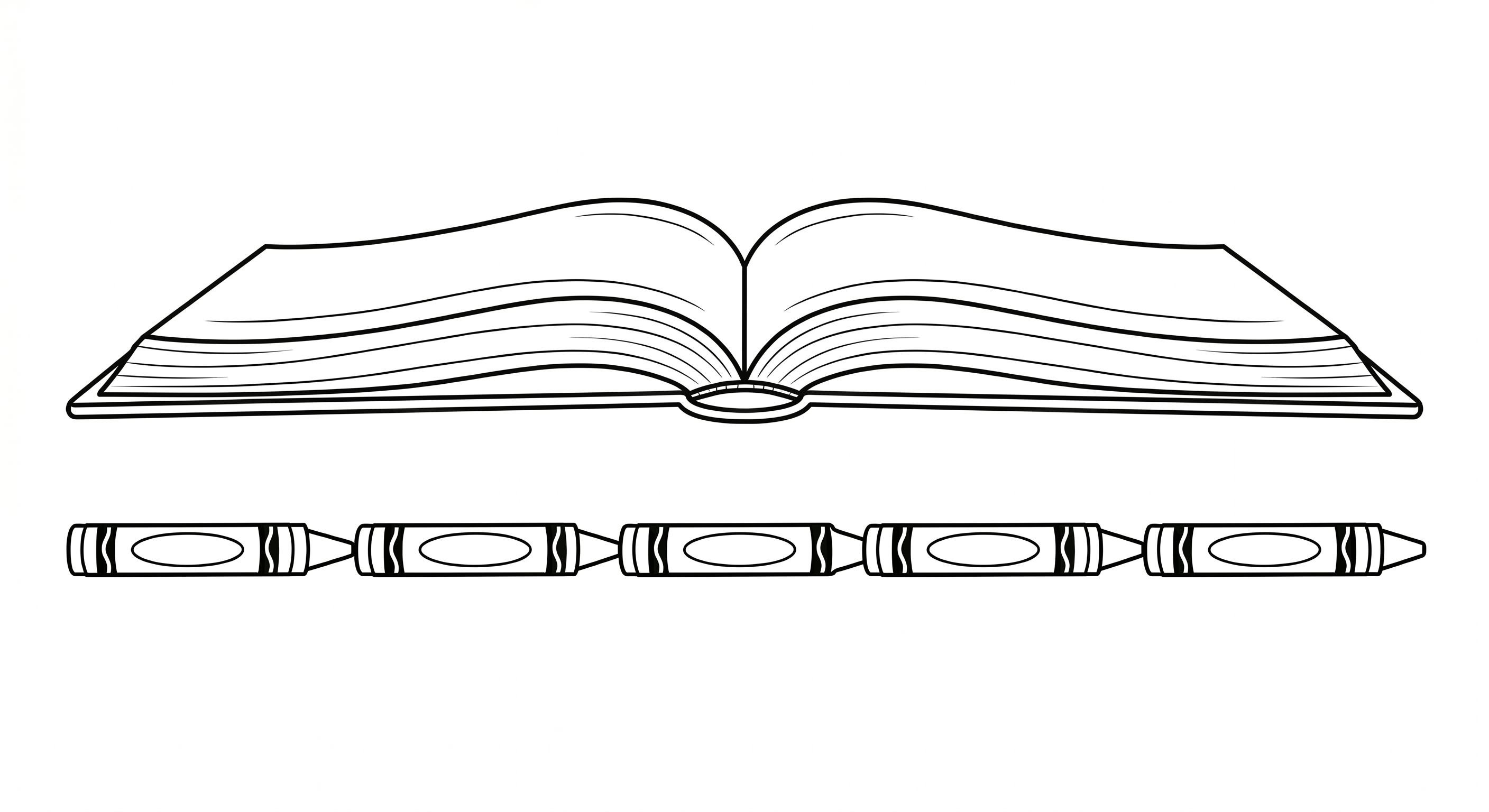
Louis measured a book with crayons. What is the length?
- 4 crayons long
- 5 crayons long (correct answer)
- 8 crayons long
- 7 paper clips long
Explanation: This question tests 1st grade understanding of measuring length using non-standard units (CCSS.1.MD.2). To measure the length of an object, lay multiple copies of a shorter object, like tiles, end to end along the object being measured, with no gaps or overlaps. Count how many of the smaller objects fit—that number expresses the length as a whole number of units. The stimulus shows a book with crayons laid end to end along its length. Choice B is correct because there are exactly crayons laid end to end along the book's length with no gaps or overlaps.
Question 2
Carlos has a collection of identical toy blocks. He discovers that his pencil case is exactly as long as 7 blocks placed end to end. His notebook is exactly as long as 5 blocks placed end to end. How many more blocks long is the pencil case compared to the notebook?
- 12 blocks more
- 2 blocks more (correct answer)
- 7 blocks more
- 5 blocks more
Explanation: To find how many more blocks long the pencil case is, subtract the notebook length from the pencil case length: 7 blocks - 5 blocks = 2 blocks more. Choice A incorrectly adds the lengths together. Choice C gives the total length of the pencil case instead of the difference. Choice D gives the total length of the notebook instead of the difference.
Question 3
Use the diagram to answer the question. Jake measured two ribbons using the same size buttons. The red ribbon measured 4 buttons long. The blue ribbon measured 6 buttons long. If Jake puts both ribbons end to end to make one long ribbon, how many buttons long will the combined ribbon be?
- 11 buttons long
- 10 buttons long (correct answer)
- 9 buttons long
- 12 buttons long
Explanation: When combining the ribbons end to end, add their lengths: 4 buttons + 6 buttons = 10 buttons long. Choice A adds an extra button, possibly from double-counting where ribbons connect. Choice C subtracts one button incorrectly. Choice D represents a common error of adding extra length.
Question 4
Kaylie measured her bicycle with shoes. How long is it?
- 7 shoes long (correct answer)
- 8 shoes long
- 9 shoes long
- 12 shoes long
Explanation: Kaylie's bicycle measures 7 shoes long. 8 shoes long overcounts by one shoe. 9 shoes long overcounts by two shoes. 12 shoes long is far more than the bicycle actually measures. Only 7 shoes long matches the correct measurement.
Question 5
Look at the measurement shown in the figure. Lisa used identical paper clips to measure a marker. The first paper clip starts exactly at the beginning of the marker. If each paper clip represents 1 unit of length, what is the length of the marker?
- 3 paper clips long (correct answer)
- 4 paper clips long
- 2 paper clips long
- 5 paper clips long
Explanation: Counting from where the marker begins to where it ends, there are exactly 3 complete paper clips spanning the marker's length with no gaps or overlaps. Choice B counts beyond the marker's end. Choice C undercounts the paper clips. Choice D significantly overcounts.
Question 6
Observe the figure. Maria used identical dominos to measure her rectangular placemat. Each domino is exactly the same size. Based on what you see, how long is the placemat?
- 4 dominos long (correct answer)
- 5 dominos long
- 3 dominos long
- 6 dominos long
Explanation: Counting the dominos placed end-to-end that span the placemat's length, there are exactly 4 dominos with no gaps or overlaps. This represents the length measurement of the placemat. Choice B overcounts by one domino. Choice C undercounts by one domino. Choice D overcounts by two dominos.
Question 7
Refer to the diagram shown. Anna measured her crayon box using small squares of paper, all the same size. The squares are placed with no gaps or overlaps. What is the length of the crayon box?
- 6 squares long (correct answer)
- 5 squares long
- 7 squares long
- 4 squares long
Explanation: Counting the squares from left to right that span the crayon box completely, there are 6 squares total. Each square represents one unit of length, and they are placed end-to-end with no gaps or overlaps. Choice B undercounts by one square. Choice C overcounts by one square. Choice D significantly undercounts.
Question 8
Look at the diagram. Tom measured his toy car using small blocks. Each block is the same size. Based on the measurement shown, how long is the toy car?
- 5 blocks long (correct answer)
- 6 blocks long
- 4 blocks long
- 7 blocks long
Explanation: Counting the blocks from left to right that span the toy car with no gaps or overlaps, there are exactly 5 blocks. Choice B counts an extra block beyond the car's end. Choice C miscounts by missing one block. Choice D includes blocks that extend past the car's length.
Question 9
Maggie measured a pencil with paper clips. How long is it?
- 5 paper clips long
- 6 paper clips long
- 7 paper clips long (correct answer)
- 6 cubes long
Explanation: This question tests 1st grade understanding of measuring length using non-standard units (CCSS.1.MD.2). To measure the length of an object, lay multiple copies of a shorter object, like paper clips, end to end along the object being measured, with no gaps or overlaps. Count how many of the smaller objects fit—that number expresses the length as a whole number of units. The stimulus shows a pencil with 7 paper clips laid end to end along its length. Choice C is correct because there are exactly 7 paper clips laid end to end along the pencil's length with no gaps or overlaps. Choice A is a common error where students miscount the units by starting from zero or skipping one, which happens because counting accuracy is still developing.
Question 10
Maya measured a scarf with paper clips. How long is it?
- 7 paper clips long (correct answer)
- 8 paper clips long
- 9 paper clips long
Explanation: This question tests 1st grade understanding of measuring length using non-standard units (CCSS.1.MD.2). To measure the length of an object, lay multiple copies of a shorter object, like paper clips, end to end along the object being measured, with no gaps or overlaps. Count how many of the smaller objects fit—that number is the length measurement, such as a scarf being 7 paper clips long if 7 align perfectly. The stimulus shows a scarf with paper clips placed end to end along it. Choice A is correct because there are exactly 7 paper clips with no gaps or overlaps, accurately expressing the length. Choice B is a common error where students overcount by one, perhaps due to double-counting an overlap, which happens because counting precision is developing.
Question 11
Emma measured a car with shoes. How long is it?
- 8 shoes long
- 9 shoes long
- 10 shoes long (correct answer)
- 8 wheels long
Explanation: This question tests 1st grade understanding of measuring length using non-standard units (CCSS.1.MD.2). To measure the length of an object, lay multiple copies of a shorter object, like shoes, end to end along the object being measured, with no gaps or overlaps. Count how many of the smaller objects fit—that number expresses the length as a whole number of units. The stimulus shows a car with 10 shoes laid end to end along its length. Choice C is correct because there are exactly 10 craft sticks laid end to end along the notebook's length with no gaps or overlaps.
Question 12
Kevin uses identical stamps to measure two different envelopes. The large envelope measures 8 stamps long. The small envelope measures 3 stamps long. If Kevin places the small envelope on top of the large envelope, starting from the same end, how much of the large envelope will not be covered by the small envelope?
- 11 stamps worth of length
- 5 stamps worth of length (correct answer)
- 8 stamps worth of length
- 3 stamps worth of length
Explanation: The uncovered portion of the large envelope equals the difference between the two lengths: 8 stamps - 3 stamps = 5 stamps worth of length will remain uncovered. Choice A incorrectly adds the lengths. Choice C gives the total length of the large envelope. Choice D gives the length of the small envelope.
Question 13
Maya uses paper clips to measure the length of her pencil. She places 4 paper clips end to end with no gaps or overlaps, and they exactly match the pencil's length. Then she uses the same paper clips to measure her eraser. The eraser is as long as 2 of those paper clips placed end to end. How many paper clips longer is the pencil than the eraser?
- 2 paper clips longer (correct answer)
- 6 paper clips longer
- 4 paper clips longer
- 3 paper clips longer
Explanation: The pencil measures 4 paper clips and the eraser measures 2, so the pencil is 2 paper clips longer. 6 paper clips longer would mean adding the two measurements instead of finding the difference. 4 paper clips longer repeats the pencil's own length instead of comparing it to the eraser. 3 paper clips longer is close but doesn't match the actual difference. Only 2 paper clips longer correctly compares the two lengths.