For the function f(x)=x2−x, what is the value of f(9)−f(7)?
Answer: 30
When you're given the definition of a function as you are here, f(x)=x2−x, your job to calculate a function is to take the value in parentheses and plug that in for x wherever it appears in the definition. Here, qualitatively, you're being told "whatever x is, square it and then subtract x from that square." That means that:
f(9)=92−9
So:
f(9)=81−9=72
And for f(7) you'd have:
f(7)=72−7
So:
f(7)=49−7=42
This means that f(9)−f(7)=72−42=30 so the correct answer is 30.
Over five different years, the total rainfall in Brooks County was, in ascending order, 15 inches, 24 inches, x inches, 45 inches, and 60 inches. If the average annual rainfall was equal to the median annual rainfall for those five years, what was the average rainfall?
Answer: 36
Since the five values are given in ascending order, you know that the median - which is defined as the middle value for an odd-numbered set - is the third value, x. For the median to then equal the mean, you'll calculate the mean. The mean is the sum of the values divided by the number of values, or here: 515+24+x+45+60. So you know that:
Median \= Mean
x=515+24+x+45+60.
Now you can solve for x. To eliminate the denominator, multiply both sides by 5 to get:
5x=15+24+x+45+60
Then combine like terms:
5x=144+x
Then subtract x from both sides:
4x=144
Then you can solve for x=36.
Riley and four friends went to dinner and agreed to split the bill evenly. If the bill came to b dollars and the group left a 20% tip, which of the following represents the amount that each person paid?
Answer: 51.2b
One important thing to identify in this problem is that Riley and her four friends went to dinner, meaning that there were 5 total people at dinner, not 4. Then you can see that the price of the dinner, b, plus 20% as a tip, would come out to $1.2b$. Because each person only pays their equal share, we divide that total amount of money, $1.2b$ by 5 to get our answer for what each of the five people had to pay:
Newland County is tracking the number of public schools in the county from 1920 to 2010. In which years did the county shut down schools?
I) 1940
II) 1970
III) 2010
Answer: II and III only
According to the graph, the number of schools decreased from 1960 to 1970 (13 to 9) and 2000 to 2010 (17 to 15). From 1930 to 1940, a new school was added.
Upon discovering a new tree virus in British Columbia, scientists created a model to predict the tree population in a certain forest. T=x(0.73)m where T represents the number of trees after m months since the virus's discovery, and x represents the original number of trees that existed in the forest when the scientists made the discovery. Assuming that the model is correct, which of the following best describes the impact of the virus on the forest?
Answer: The number of trees in the forest is decreasing by 27% each month.
The decimal taken to the exponent in the given equation, T=x(0.73)m, tells us that this is an exponential decay problem: exponential because of the exponent and decay because the number in parentheses is less than 1. That means that the higher the number of months (m), the less the total number gets.
Remember that in exponential change problems, the formula for exponential change is Total=initialvalue(1+rate)time. So to end up with 0.73 in parentheses that means that the rate is -0.27, or -27%.
A mile is 5,280 feet. Susan is able to walk a consistent pace of 4 miles per hour. How many feet will she walk in 40 minutes?
Answer: 14,080
This is a classic unit conversion / dimensional analysis problem, where you can stack the units in a multiplication problem to eliminate the units like you would reduce fractions and end up with the units (feet) you need. You have the following inputs:
1 mile \= 5,280 feet
Rate \= 4 miles / 1 hour
Time \= 40 minutes
And you know that 1 hour \= 60 minutes. so to get from 4 miles/hour to "feet" just line up your units so that they cancel:
1hour4miles×1mile5280feet×60minutes1hour×40minutes=14,080
And since all the units cancel except for feet in the numerator, you can be sure that your answer is in the right units: 14,080 feet.
A local city's recreation department is looking into whether its residents support adding more playground equipment at a local park. A survey of 50 local parents showed that over 70% of individuals surveyed were in favor of the expansion. Which of the following can be concluded about the survey and its results?
Answer: No conclusions can be drawn from the survey because the sample may not be representative of all residents
No conclusions can be drawn from the survey because the sample may not be representative of all residents. Because only parents were surveyed, and parents are presumably more likely than nonparents to take advantage of playground equipment at a park, it is likely that the data is skewed.
What is the vertex of the parabola formed by f(x)=(x−7)2−3??
Answer: (7, -3)
The equation of a parabola is f(x)=(x−a)2+b where a is the location of the x-coordinate of the vertex and b is the location of the y-coordinate of the vertex. Using this information and the equation of our quadratic, we can see the vertex of this quadratic is (7, -3)..
What is the volume of a cylinder with a radius of 4 and a height of 5?
Answer: 80π
volume = πr2h = π⋅42⋅5 = 80π
A basketball team's current roster consists of g guards and f forwards. If 2 guards join and 1 forward leaves, what is the probability that a player chosen at random is a guard?
Answer: g+f+1g+2
To find the chances of picking a guard, our formula should be the number of guards divided by the total number of players. We start with g guards and f forwards, and then add 2 guards and subtract one forward. So after the roster changes, we have g+2 guards, and we have g+2+f−1 total players. Since the probability of an outcome is the number of options that give you that outcome (guards) divided by the number of total options (all players), our probability is then g+f+1g+2.
In the figure above, AC is the diameter of a circle with center O. If the area of the circle is 81π, what is the length of minor arc BC?
Answer: 3.5π
To calculate an arc length, such as the length of minor arc BC here, your job is to find the proportion that that arc represents out of the total circumference. So you'll need to find 1) the circumference and 2) the measure of the central angle of that arc.
Here since you know that the area is 81π, you can use the formula Area=πr2 to determine that the radius measures 9.
Then you can plug in that radius into the circumference formula,Circumference=2πr, to find that the circumference measures 18π
From this point, you need to find the measure of angle BOC. Since angle AOC measures 180 degrees (you know that it's a straight line, because it's defined as a diameter), and angle AOB \= 110, that means that BOC measures 70 degrees. So minor arc BC will be 70/360 of the total circumference, setting up the calculation:
36070(18π)
That reduces to 27π which equals 3.5π.
What is the sum of all solutions to the equation x3+7x2=−12x?
Answer: −7
To find the solutions of a quadratic or polynomial, begin by setting the equation equal to zero. Therefore x3+7x2=−12x becomes:
x3+7x2+12x=0
From here, you can factor out an x:
x(x2+7x+12)=0
That means that one solution is x=0. You can then factor the quadratic in parentheses to:
x2+7x+12=(x+6)(x+1)
So we now have:
x(x+6)(x+1)=0
Remember in quadratic problems to always set each term to zero to find your solutions, so the solution set here is:
x=0,−6,−1
Therefore the sum of solutions is -7.
(kx+2)(3x−1)=12x2+2x−2
Answer: k=4
While this problem is certainly doable with pure algebra, many complicated polynomial questions like this one are much more quickly solved by picking numbers. There are lots of x terms in this problem, but the problem specifically states that the equation must hold true for ALL values of x so you can turn a lot of complicated algebra into some rather quick arithmetic by picking an easy value for x. If you pick an easy number to work with like x=1 you will have very small numbers to calculate. Doing so will leave you with:
(k+2)(3−1)=12+2−22(k+2)=12k+2=6k=4
Pro tip: when a question says that an equation holds true for all values of a variable, you can then choose a simple number to stand in for that variable and turn several steps of algebra into a few steps of basic arithmetic.
If 3x=27, what is the value of 2x+1?
Answer: 19
The first step on this problem is to take the equation you're given, 3x\=27, and solve for x To do that, divide both sides by 3 to arrive at x \= 9. Importantly, recognize that the question is not asking for the value of x, but rather for the value of the expression 2x + 1. To find that answer, plug in x \= 9 and the expression will look like 2(9) + 1. This then equals 18+1, making the correct answer 19.
In the reptile house at a zoo, the ratio of snakes to lizards is 3 to 5. After the zoo adds 15 more snakes to the exhibit, the ratio changes to 4 to 5. How many lizards are in the reptile house?
Answer: 75
In order to maintain a proportion, each value in the ratio must be multiplied by the same value:
Before and after the snakes arrive, the number of lizards stays constant.
Before new snakes — Snakes : Lizards \= 3x : 5x
After new snakes — Snakes : Lizards \= 4x : 5x
Before the new snakes arrive, there are 3x snakes. After the 15 snakes are added, there are snakes. Therefore, 3x + 15 \= 4x. Solving for x gives x \= 15.
There are 5x lizards, which makes 5 \* 15 \= 75 lizards.
If 7x+y=25 and x+7y=31, what is the value of x+y?
Answer: 7
When you're facing systems of equations, the SAT often provides you a shortcut if you recognize it. When a systems of equation question asks you to solve for a combination of variables (e.g. x+y) and not just a single variable, there's often a faster way to solve directly for the combination.
Here, recognize that if you simply add the two equations together - much like using the "Elimination Method" but without actually trying to eliminate a variable - you can get x andy together with the same coefficient.
7x+y=25x+7y=31
sums to:
8x+8y=56
If you then divide both sides by 8, you can get to exactly the answer they're looking for:
x+y=7
If a>−2, which of the following is equivalent to a2+5a+6?
Answer: a+21−a+311
When the SAT asks "equivalent expression" questions like you see here, it is almost always faster and easier to pick numbers to test the answer choices against the original; the algebra can be time-consuming and a bit abstract, but since two equivalent expressions will produce the same number in both forms, you can get away with testing numbers.
When you do pick numbers, it's best to pick numbers that are easy to calculate. Here you might pick a=−1 so that you can easily set some of the a+2 denominators in the answer choices equal to 1, making for quicker arithmetic. If you do that, you'll find that the original expression works out to:
(−1)2+5(−1)+6=1−5+6=2
Now your job is to test the answer choices using a=−1 to see which answer choice produces the value 2. Only a+21−a+311 does. When you plug in a=−1, this expression becomes:
−1+21−−1+311=1−211=211=2
The other three choices give 32, −2, and 21, so they are not equivalent.
You can also confirm it algebraically: a+21−a+31=(a+2)(a+3)(a+3)−(a+2)=(a+2)(a+3)1, so its reciprocal is (a+2)(a+3)=a2+5a+6.
Which of the following describes the set of all real numbers that are 8 units away from -2?
Answer: ∣x+2∣=8
Even if you're unsure of where to start on this problem, you should have a head start. The problem is testing absolute values, and you should know that the result of any absolute value is always nonnegative ≥0. So the answer choices that include an absolute value equaling a negative number must be incorrect: that just cannot be possible.
To test the remaining choices, consider that the numbers that are exactly eight units away from -2 are −2+8=6, and −2−8=−10. When you plug these numbers in for x in the answer choices, only one is valid:
∣x+2∣=8
For x=6, ∣6+2∣=∣8∣=8
For x=−10, ∣−10+2∣=∣−8∣=8
Therefore this absolute value satisfies the given situation and is correct.
Which of the following is not a possible value for x given the inequality above?
Answer: 12
In order to simplify this inequality, we'll want to start by subtracting 12 from both sides to arrive at
41x>3
If we then multiply both sides of the inequality by 4 to cancel the coefficient in front of x, we get to
x>12
Thus, 12 is not a possible value of x given the simplified inequality.
Note - we could also solve this question by plugging each option in for x, but this route is likely somewhat more time consuming, so stay flexible in your approach on a question-to-question basis!
In triangle XYZ, the tangent of a is 1. What is the sine of b?
Answer: 22
Because Tangent = adjacentopposite, if angle a has a tangent of 1, we know that its opposite (YZ) and adjacent (XY) sides have the same measure. Therefore its ratio of Opposite:Adjacent reduces to 1. That then means that we're dealing with an isosceles triangle (opposite and adjacent are equal) meaning that the side lengths have the ratio of 1:1:2
Because sine = hypotenuseopposite, we can then plug in the ratio of 1:2 to get 21. To then rationalize the denominator, multiply both numerator and denominator by 2 to get the answer, 22.
In triangle ABC above, side AB measures 9 and side AC measures 15. What is the area of triangle ABC?
Answer: 54
This problem asks you about the area of a triangle, and you should know that the area of a triangle is (1/2) Base × Height. Importantly, the height of a triangle must be a line that is perpendicular to the base, connecting the base with its opposite angle. In a right triangle such as the one in this problem, that perpendicular line is given to you: here line AB is perpendicular to side BC, and connects BC to its opposite angle, BAC. You know that side AB measures 9, so if AB is your height, you only now need to find the base, side BC. Here is where you can use the Pythagorean Theorem or one of its special "triplets" (side ratios) to solve for BC. You know that side AB is 9 and the hypotenuse BC is 15. This may trigger your memory about a special Pythagorean triplet, the 3-4-5 triangle. Since 9=3∗3 and 15=3∗5 you have the side ratios of 3 on a short side and 5 for the hypotenuse, so you can fill in the third side as 12 (which is 3∗4). Now that you have a base of 12 and a height of 9, you can use the Area formula to finish this problem: 21(12)(9)=54
In the figure above, line a is parallel to line b and line d is parallel to line e. What is the value of y, in degrees?
Answer: 15
Intersecting and parallel lines show up in many different geometric figures: parallelograms, trapezoids, squares, etc. Anytime you see these in a question, you have to properly leverage the essential properties of supplementary and vertical angles. On this problem, the fastest way to find y is to realize that 5x in the bottom left corner is supplementary to 2x + 5 in the bottom right (because of the intersection of two parallel lines). Therefore, 5x + 2x + 5 \= 180 and x \= 25. Once you have that information, you can use the fact that the sum of the interior angles of a triangle is 180 and see that x + 5x + 2y \= 180 . Putting in 25 for x you see that 25+125+2y \=180 and 2y \=30. The correct answer is 15.
What is the solution to the inequality 4x−7≥2x+5?
Answer: x≥6
1\. Subtract 2x from both sides: 2x−7≥5.
2\. Add 7 to both sides: 2x≥12.
3\. Divide by 2: x≥6.
SAT Strategy
On inequality problems, often you can pick a number that satisfies the potential answer. If you test x=0, the inequality becomes −7≥5, which is False. Therefore, the solution cannot include 0. This eliminates B, C, and D (since 0 is less than 6, greater than -1, etc). Only A excludes 0.
The function p is defined by p(x)=(x2−9)(x+4). What is the sum of the zeros of the function p?
Answer: -4
Find the zeros by setting each factor to zero.
1. x2−9=0→x2=9→x=3,−3.
2. x+4=0→x=−4.
The zeros are 3,−3,−4.
Sum =3+(−3)+(−4)=−4.
SAT Strategy: Use Desmos
Graph the function y=(x2−9)(x+4). Click the points where the graph crosses the x-axis to see the values (−4,−3,3). From here you can add them up mentally.
A right circular cylinder has a height of 12 inches and a base radius of 5 inches. What is the volume, in cubic inches, of the cylinder?
Answer: 300π
The formula for the volume of a cylinder is V=πr2h.
Substitute the given values: r=5,h=12.
V=π(52)(12)V=π(25)(12)V=300π
The table above displays the scores for Jenna and Paolo as they played against each other five times in a certain game. If Jenna's mean score for the set of five games was 2 points higher than Paolo's mean score, what is the value of P, Paolo's score for the fifth game?
Answer: 52
There are a few ways that you can solve this problem. One is to simply calculate each player's mean score. That means taking the sum of each of their scores and dividing by 5. For Jenna, that's 62 + 45 + 50 + 48 + 55 \= 260, which when divided by 5 gives you 52.
Since her mean score is 52, that means that Paolo's mean score must be 50, so his equation is then:
50=560+48+48+42+P
Then you can solve algebraically by multiplying both sides by 5:
250 \= 60 + 48 + 48 + 42 + P
250 \= 198 + P
52 \= P
Or you can take a shortcut: if you realize that for Jenna's mean score to be 2 points higher, and that over 5 games that means she needs to have scored 10 total points more, you can scan the table and just pay attention to how far Jenna is cumulatively ahead of Paolo:
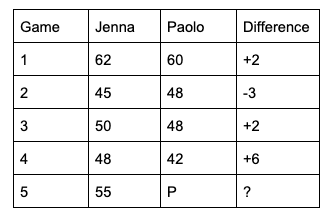
You can see then that before Game 5, Jenna is a total of 7 points ahead, meaning that her Game 5 score of 55 must be 3 higher than Paolo's so that she's a total of 10 points ahead. So Paolo's P must be 52.
What is the sum of the solutions to the given equation?
x2−12x+20=0
Answer: 12
We can solve by factoring:
(x−10)(x−2)=0, so solutions are x=10 and x=2.
Sum = 10+2=12.
Importantly, don't forget to set each parenthetical equal to zero to get your roots. -12 is a tempting trap answer for students working so quickly that they sum the factors in parentheses and not the solutions.
SAT Strategy
Use the formula for the sum of roots: −b/a.
Here, a=1 and b=−12.
Sum =−(−12)/1=12. This requires no factoring.
Which expression is equivalent to x−13−x2−12x+4 for all values of x where the expression is defined?
Answer: x+11
To subtract rational expressions, we must first find a common denominator.
1. Factor the denominators:
The first denominator is x−1.
The second denominator is a difference of squares: x2−1=(x−1)(x+1).
The least common denominator (LCD) is (x−1)(x+1).
2. Rewrite the fractions with the LCD:
Multiply the numerator and denominator of the first fraction by (x+1):
(x−1)(x+1)3(x+1)=(x−1)(x+1)3x+3
The second fraction already has the LCD:
(x−1)(x+1)2x+4
3. Subtract the numerators:
Be careful to distribute the negative sign to both terms in the second numerator:
(x−1)(x+1)(3x+3)−(2x+4)(x−1)(x+1)3x+3−2x−4(x−1)(x+1)x−1
4. Simplify:
Cancel the common factor (x−1) from the numerator and denominator:
x+11SAT Strategy: Pick Your Own Numbers
Because this problem asks you to "rearrange" variables and not directly solve for them, you can pick your own numbers for each variable (in this case, just x) and then test the answer choices to see which expression gives you the same output.
Here, choose a simple number for x (avoiding 1 and -1, which make the denominator zero).
Let x=0:
* Original Expression: 0−13−02−12(0)+4=−13−−14=−3−(−4)=1.
* Test Answer Choices:
* A) 0−11=−1 (Incorrect)
* B) 0+11=1 (Correct)
* C) 0−10+7=−7 (Incorrect)
* D) 0−10+7=−7 (Incorrect)
Bonnie is conducting a survey in her class to understand how many fruits her peers eat on a daily basis. How many of Bonnie's peers eat less than 2 fruits daily?
Answer: 11
This problem comes down to two things: reading the historgram correctly, and reading the question correctly. According to the histogram, 3 of her peers eat 0 fruits daily and 8 of her peers eat 1 fruit daily. This gives us 11 classmates. And the question asks for the number of classmates who eat less than two (not "exactly two" or "two or less" which each have trap answer choices associated with them), so be certain to read carefully.
For the linear function f, the graph of y=f(x) in the xy-plane is defined by the equation 2x+5y=20. What is the y-intercept of the graph of f?
Answer: (0,4)
The y-intercept occurs when x=0.
1\. Substitute 0 for x in the equation: 2(0)+5y=20.
2\. Simplify: 5y=20.
3\. Divide by 5: y=4.
The coordinate is (0,4).
A car is traveling at a speed of 60 miles per hour. If 1 mile \= 1,760 yards, what is the speed of the car in yards per minute?
Answer: 1,760
1\. Convert miles to yards: 60 miles/hr×1,760 yards/mile=105,600 yards/hr.
2\. Convert hours to minutes: 105,600 yards/hr÷60 min/hr=1,760 yards/min.
SAT Strategy: Think Logically
For those paying attention to the numbers chosen in this problem this can be a quick mental math problem. 60 miles per hour is the same as one mile per minute. And since you're asked for yards per minute, and given that 1 mile \= 1,760 yards, you can do that conversion without even needing a calculator or pencil.
A researcher surveyed a random sample of 1,000 voters and found that 52% plan to vote for Candidate X. The margin of error for this estimate is 3%. If the researcher wants to decrease the margin of error, which of the following changes to the study design would be most effective?
Answer: Increasing the sample size to 2,000.
The question asks which design change would most effectively shrink a 3% margin of error. Margin of error scales with 1/sqrt(n), so it shrinks only when the sample grows: going from 1,000 voters to 2,000 divides the margin by about sqrt(2), bringing it to roughly 2.1%. Cutting the sample to 500 does the opposite, multiplying the margin by about sqrt(2) to roughly 4.2%, so it makes the estimate less precise. Restricting the sample to one specific region does not reduce error about all state voters; it introduces selection bias, producing an estimate that is precise about the wrong population. Asking a different survey question changes what is being measured rather than the precision of the 52% figure, because precision depends on sample size, not wording.
3x−y=6ax−3y=12
In the system of equations above, a is a constant. If the system has no solution, what is the value of a?
Answer: 9
For a system of linear equations to have no solution, the lines must be parallel. This means they must have the same slope but different y-intercepts.
1. Rewrite the first equation in slope-intercept form (y=mx+b):
−y=−3x+6→y=3x−6. The slope is 3.
2. Rewrite the second equation:
−3y=−ax+12→y=3ax−4. The slope is 3a.
3. Set the slopes equal: 3=3a.
4. Solve for a: a=9.
Strategy Tip
For standard form Ax+By=C and Dx+Ey=F, the lines are parallel if the ratio of x-coefficients equals the ratio of y-coefficients: a3=−3−1.
Cross multiply: −9=−a, so a=9.
The equation of a circle in the xy-plane is shown below.
x2+y2−6x+4y=12
What is the radius of the circle?
Answer: 5
We must complete the square to put the equation in standard form: (x−h)2+(y−k)2=r2.
1\. Group terms: (x2−6x)+(y2+4y)=12.
2\. Complete the square for x: Add (−6/2)2=9.
3\. Complete the square for y: Add (4/2)2=4.
4\. Balance the equation: (x2−6x+9)+(y2+4y+4)=12+9+4.
5\. Simplify: (x−3)2+(y+2)2=25.
6\. r2=25, so r=5.
SAT Strategy: Use The Calculator
Note that when you're given an equation and you may not understand it or anticipate that working with it is a lot of work (completing the square often is), another viable strategy is to just plug the equation into Desmos or your graphing calculator. Here if you do that, you'll see a graph of the circle and can click on two points on its diameter to get that length, then divide in two to get the radius.
3(2x−4)=5(x+1)−7
What is the solution to the given equation?
Answer: 10
To solve for x, we first distribute the constants on both sides of the equation.
1. Distribute: 6x−12=5x+5−7
2. Combine like terms on the right side: 6x−12=5x−2
3. Subtract 5x from both sides: x−12=−2
4. Add 12 to both sides: x=10SAT Strategy
You can plug the answer choices back into the equation.
Try x=10:
Left Hand Side: 3(20−4)=3(16)=48
Right Hand Side: 5(10+1)−7=5(11)−7=55−7=48
Since 48=48, B is correct. Often with "clean" numbers like 1, 2, 10, etc. you can quickly do the backsolving arithmetic in your head or on your calculator if the algebra looks tricky or time-consuming.
In triangle ABC, the measure of angle A is 40∘ and the measure of angle B is 60∘. If side AC is extended to point D, what is the measure of the exterior angle at C?
Answer: 100∘
1\. Find the measure of interior angle C: 180∘−(40∘+60∘)=80∘.
2\. The exterior angle is supplementary to the interior angle: 180∘−80∘=100∘.
Alternatively, by the Exterior Angle Theorem, the exterior angle equals the sum of the two opposite interior angles: 40∘+60∘=100∘.
A local gym charges a one-time initiation fee of 50 plus a monthly membership fee of 30. Which equation represents the total cost, C, in dollars, for a member who joins for m months?
Answer: C=50+30m
- The variable cost is the monthly fee: 30 per month →30m. - The fixed cost is the initiation fee: 50 (paid once). - Total Cost = Fixed + Variable →C=50+30m.
Triangle A is similar to Triangle B. The length of a side of Triangle B is 3 times the length of the corresponding side of Triangle A. The area of Triangle A is 12. What is the area of Triangle B?
Answer: 108
If the scale factor of side lengths is k, the scale factor of the \*\*area\*\* is k2.
Here, the side scale factor is 3.
Therefore, the area scale factor is 32=9.
Area of Triangle B=9×(Area of Triangle A)=9×12=108.
\*\*Strategic Advice:\*\*
A common trap is to multiply the area by 3 and choose 36. Remember: Area is two-dimensional so it scales by the square!
The following equation represents the growth of bacteria in a petri dish:
$ C(t) = 50(2)t $
Which of the following statements best describes this function?
Answer: This relationship is exponential and the population of bacteria doubles every hour.
The correct answer is "This relationship is exponential and doubles every hour." Since the time variable t is an exponent, we can narrow down our options and definitively state the function is exponential. The t is an exponent with a base of 2, so as t grows, the number of times 2 is multiplied by itself also grows.
In a right triangle, sin(x∘)=54. What is the value of cos(90∘−x∘)?
Answer: 54
A fundamental identity of trigonometry for right triangles is that the sine of an angle is equal to the cosine of its complement.
sin(x)=cos(90−x).
Therefore, if sin(x)=54, then cos(90−x)=54.
What is the sum of angle measures a and b?
Answer: 270
The key to this problem is recognizing the two relationships here that must sum to 180 degrees: the three angles in a triangle must sum to 180 , and supplementary angles (those that are formed by splitting a straight line) must also sum to 180. Using those relationships, you should see that:
In the big triangle (JXZ), two angles are already given as 40 and 90, meaning that angle KZY must equal 50, based on the sum of angles in that triangle needing to be 180.
Since that angle KZY is 50, that means that b \= 130, as it has to sum with its supplementary angle to 180.
And using the small triangle to the right, KYZ, if you know that the two bottom angles (KYZ and KZY) are 90 and 50, then the third angle (YKZ at the top of that triangle) must account for the remaining 40.
And then since a is supplementary to that-degree angle, it has to be 140.
So a \= 140 and b \= 130, making the sum a + b \= 270.
The equation of a parabola in the xy-plane is y=2(x−3)2+5. Which of the following statements is true about the parabola?
Answer: The minimum value of y is 5.
The equation is in vertex form y=a(x−h)2+k, where (h,k) is the vertex.
Here, the vertex is (3,5).
Since the leading coefficient (a=2) is positive, the parabola opens upward, meaning the vertex represents the \*\*minimum\*\* value.
The minimum y-value is 5.
SAT Strategy: Use The Calculator
Graph it in Desmos. You will visually see the bottom of the curve is at y=5. Importantly - many students see a question like this and feel lost because they've forgotten or never really knew the equation of a parabola. But so many questions can be solved with the calculator, so "when in doubt, graph it out" to at least give yourself a chance.
x+14=x+2
What is the solution to the given equation?
Answer: 2
1\. Square both sides: x+14=(x+2)2.
2\. Expand: x+14=x2+4x+4.
3\. Set to zero: x2+3x−10=0.
4\. Factor: (x+5)(x−2)=0.
5\. Potential solutions: x=−5,x=2.
6\. Check for extraneous solutions:
- If x=−5: 9=−3 (False, principal root must be positive).
- If x=2: 16=4 (True).
Only x=2 is valid.
SAT Strategy: Backsolve
Plug the answer choices into the equation.
A) −5+14=−5+2→3=−3 (False).
B) 2+14=2+2→4=4 (True).
The table below summarizes the results of a survey asking 150 students whether they prefer to study in the library or the cafeteria.
If a student is selected at random from those who prefer to study in the library, what is the probability that the selected student is in Grade 12?
Answer: 9553
This is a conditional probability question. The phrasing "from those who..." establishes a condition that restricts our total sample space.
1. Identify the Condition (The Denominator): The question asks to select a student "from those who prefer to study in the library." Looking at the table, the "Total" column for "Library" is 95. This is our denominator. We ignore the Cafeteria students entirely.
2. Identify the Target (The Numerator): From that specific group of 95 library students, we want to find the number of students in Grade 12. Looking at the intersection of "Library" and "Grade 12", we find 53 students.
3. Form the Fraction:
P(Grade 12∣Library)=Restricted TotalTarget Group=9553SAT Strategy: Denominator Check
On the SAT, probability questions almost always hinge on reading the denominator correctly.
* If the question says "from the total group," the denominator is 150.
* If the question says "given the student is in Grade 12," the denominator is 70.
* Shortcut: Immediately circle the row or column mentioned after the words "given that," "if," or "from those." That circled number is your denominator. In this case, you would circle the "Library" column.
