The Geometric
Distribution
Model the number of trials until the first success in a sequence of independent Bernoulli trials with constant probability \( p \).
What Is the Geometric Distribution?
Imagine flipping a coin repeatedly until you get heads. You might get it on the 1st flip, the 3rd, or the 20th. The geometric distribution describes the probability that the first success occurs on the \( k \)-th trial.
Four Conditions for a Geometric Setting
Visualizing the PMF
The probability mass function shows that the most likely outcome is success on the first trial, with probabilities decreasing geometrically for each subsequent trial.
The Probability Formula
For a geometric random variable \( X \) with success probability \( p \), the probability of the first success on trial \( k \) is:
Ten cereal boxes, five collectible prizes, and one changing stopping rule
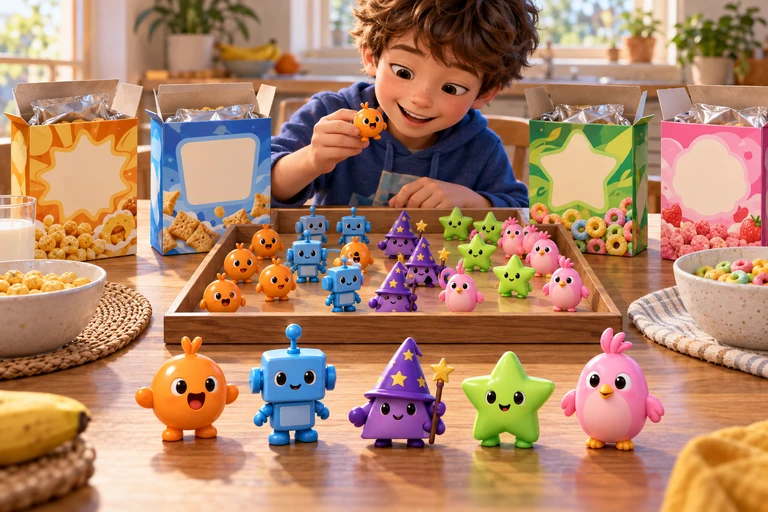 Collecting all prize types and waiting for the first designated prize use different stopping rules. Define the response variable before generating trials.
Stop at the first success
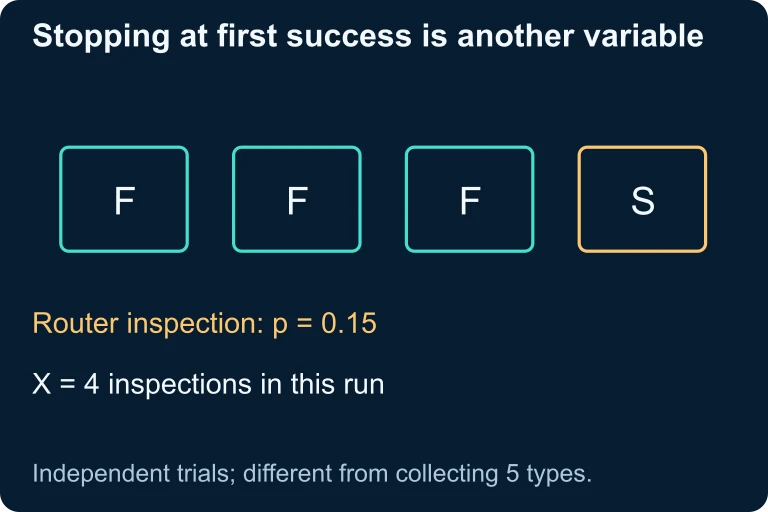 In a separate router example, each independent trial succeeds with probability 0.15. The sequence failure, failure, failure, success gives X = 4, with probability 0.85³ × 0.15. This stopping rule differs from collecting all five cereal-prize types.
Mean and Standard Deviation
If \( X \sim \text{Geo}(p) \), the expected number of trials and the spread are:
Cumulative Probability
Often we want the probability of success within the first \( k \) trials, or of needing more than \( k \) trials.
Success by trial \( k \)
Still no success after \( k \) trials
Geometric vs Binomial
| Geometric | Binomial | |
|---|---|---|
| Question | How many trials until first success? | How many successes in \( n \) trials? |
| Random variable | Number of trials | Number of successes |
| Number of trials | Not fixed | Fixed at \( n \) |
| Parameters | \( p \) | \( n, p \) |
| Mean | \( \frac{1}{p} \) | \( np \) |
| Shape | Always right-skewed | Can be symmetric |
How to Apply It: Step by Step
Example 1: Free Throws
A basketball player makes 70% of her free throws. What is the probability that her first made free throw in a game is her 3rd attempt?
Example 2: Quality Control
A factory produces widgets, 5% of which are defective. An inspector tests widgets one at a time. What is the probability that the first defective widget is found within the first 10 tested?
Example 3: More Than \( k \) Trials
A telemarketer has a 12% chance of making a sale on each call. What is the probability that it takes more than 8 calls to make the first sale?
Shape: Always Right-Skewed
The Memoryless Property
The geometric distribution has a remarkable property: past failures do not change future probabilities.
If you've already failed 5 times, the probability of needing at least 3 more trials is the same as if you were starting from scratch and needed at least 3 trials.
Common Mistakes
Summary at a Glance
| Property | Formula / Value |
|---|---|
| PMF | \( P(X = k) = (1-p)^{k-1} \cdot p \) |
| CDF | \( P(X \leq k) = 1 - (1-p)^k \) |
| Survival | \( P(X > k) = (1-p)^k \) |
| Mean | \( \mu = \frac{1}{p} \) |
| Std Dev | \( \sigma = \frac{\sqrt{1-p}}{p} \) |
| Shape | Always right-skewed |
| Special property | Memoryless |
Question 1 of 5
A fair die is rolled until a 6 appears. What is the probability that the first 6 appears on the 4th roll?
Question 2 of 5
If \( X \sim \text{Geo}(0.4) \), what is the expected value of \( X \)?
Question 3 of 5
A spinner has a 20% chance of landing on red. What is the probability that it takes more than 5 spins to land on red for the first time?
Question 4 of 5
Which of the following is NOT a condition for a geometric setting?
Question 5 of 5
A student has already attempted a puzzle 10 times without solving it. Each attempt has a 15% chance of success, independently. What is the probability that the student solves it on the next attempt?