Selecting an
Experimental Design
Learn how to choose the right experimental design: completely randomized, randomized block, or matched pairs to maximize validity and minimize confounding.
What Is an Experiment?
An experiment deliberately imposes a treatment on individuals to observe their responses. Unlike observational studies, experiments allow us to establish cause-and-effect relationships because the researcher controls who receives which treatment.
Three Principles of Experimental Design
Why Design Matters
Choosing the right experimental design controls variability and strengthens our ability to detect a real treatment effect. If our design is weak, the noise from lurking variables drowns out the signal from the treatment.
Completely Randomized Design
In a completely randomized design (CRD), all experimental units are assigned to treatments entirely by chance. Every unit has an equal probability of receiving any treatment.
Randomized Block Design
A randomized block design (RBD) groups experimental units into blocks based on a known source of variability, then randomly assigns treatments within each block. This reduces variability between groups.
A university population with four visibly different sampling routes
 The way people or groups enter a study determines its design. Sampling within groups, selecting whole groups and assigning treatments answer different questions.
Randomize schools within blocks
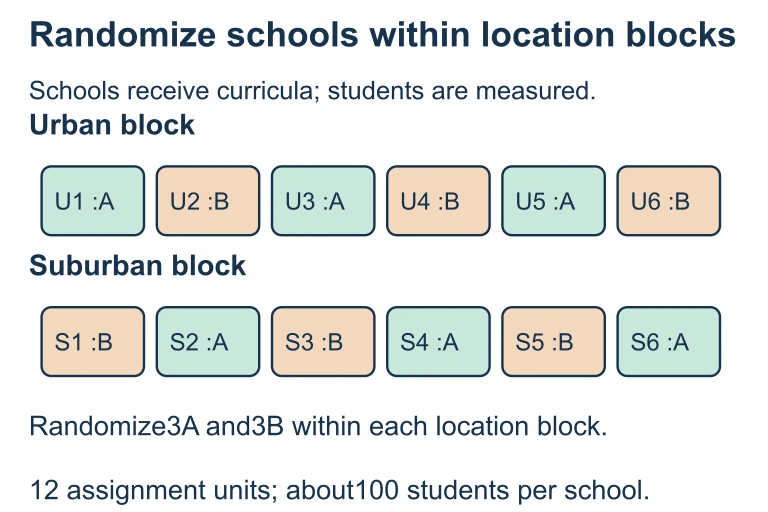 Suppose 12 schools are blocked as urban or suburban, with three schools assigned to each curriculum in each block. Schools are the assignment units; measuring many students within a school does not create additional independent treatment assignments.
Matched Pairs Design
A matched pairs design is a special case of a randomized block design where each block has exactly two experimental units (or one unit measured twice). This is the most powerful way to compare exactly two treatments.
Comparing the Three Designs
| Feature | CRD | RBD | Matched Pairs |
|---|---|---|---|
| Blocking | None | Yes: groups by a variable | Yes: pairs of 2 |
| Number of Treatments | Any | Any | Exactly 2 |
| Best When | Units are homogeneous | Known lurking variable exists | Comparing 2 treatments closely |
| Controls Variability | Least | Moderate | Most |
| Complexity | Simplest | Moderate | Moderate |
How to Choose the Right Design
Decision Flowchart
Example 1: Fertilizer Test
A farmer wants to test whether a new fertilizer increases crop yield. She has 30 identical plots in the same field and 3 fertilizers to compare (Fertilizer A, B, and a control). What design should she use?
Example 2: Study Drug Trial
A researcher tests two headache medications on 40 volunteers. She suspects that age strongly affects recovery time: younger patients recover faster regardless of medication. What design should she use?
Example 3: Taste Test
A coffee company wants to compare two new blends. Each of 25 tasters will taste both blends (in random order) and rate each. What design is this?
Blinding and Placebos
In addition to choosing a design, researchers should consider blinding to reduce bias from expectations and the placebo effect.
Common Mistakes
Question 1 of 5
A researcher wants to test three different diets on weight loss. She has 60 volunteers with no known differences that might affect results. Which design is most appropriate?
Question 2 of 5
A school wants to compare two teaching methods. Students vary greatly in prior math ability. The school creates groups of students with similar math scores, then randomly assigns methods within each group. This is an example of:
Question 3 of 5
In a matched pairs experiment, 20 runners each run a mile with Shoe A and Shoe B on different days, in random order. The response variable is mile time. Why is matched pairs appropriate here?
Question 4 of 5
A pharmaceutical company tests a new drug against a placebo. Neither the patients nor the doctors measuring outcomes know who received the drug. This is an example of:
Question 5 of 5
A researcher notices that sunlight exposure varies across her greenhouse. She wants to test 4 fertilizers on plant growth. She divides the greenhouse into sections with similar light levels and randomly assigns fertilizers within each section. What principle does this illustrate?