01 / 20

Introduction to
Probability

Learn to quantify uncertainty using the language of probability: from sample spaces to the addition and complement rules.

AP Statistics

What Is Probability?

Probability is a numerical measure of how likely an event is to occur. It always falls between 0 (impossible) and 1 (certain), inclusive.

We use probability to make informed decisions in the face of uncertainty: weather forecasting, medical testing, sports analytics, and statistical inference all rely on it.

Key Vocabulary

Experiment
A process that produces a well-defined outcome (e.g., rolling a die).
Sample Space
The set \( S \) of all possible outcomes (e.g., \( \{1,2,3,4,5,6\} \)).
Event
A subset of the sample space (e.g., "rolling an even number" = \( \{2,4,6\} \)).

The Probability Scale

0 0.25 0.50 0.75 1 Impossible Equally Likely Certain

The Classical Probability Formula

When all outcomes in a sample space are equally likely, the probability of an event \( A \) is:

This is sometimes called the "counting" definition of probability. It works perfectly for fair coins, fair dice, well-shuffled cards, and random selections.

Visualizing the Sample Space

\( S = \{1, 2, 3, 4, 5, 6\} \)
\( A = \text{Even} \)
\( 2 \)
\( 4 \)
\( 6 \)
\( 1 \)
\( 3 \)
\( 5 \)

The Complement Rule

The complement of event \( A \), written \( A^c \), is the set of all outcomes not in \( A \). The probabilities of an event and its complement always sum to 1:

S
\( A \)
\( P(A) \)
\( A^c \)
\( 1 - P(A) \)

The Addition Rule

When two events can overlap, we must subtract their intersection to avoid double-counting:

S
\( A \)
\( B \)
\( A \cap B \)

Mutually Exclusive vs. Overlapping

Mutually Exclusive (Disjoint)
Events cannot happen at the same time: \( P(A \cap B) = 0 \). The addition rule simplifies to \( P(A \cup B) = P(A) + P(B) \).
Overlapping (Not Disjoint)
Events can happen together: \( P(A \cap B) > 0 \). You must subtract the overlap: \( P(A \cup B) = P(A) + P(B) - P(A \cap B) \).

How to Find a Probability

1
Identify the experiment. What random process is occurring?
2
List the sample space \( S \). Write out every possible outcome.
3
Define the event \( A \). Which outcomes count as "success"?
4
Count and divide. Compute \( P(A) = \frac{|A|}{|S|} \), or use a rule (complement, addition).
5
Sanity check. Is \( 0 \leq P(A) \leq 1 \)? Do all probabilities sum to 1?

Example 1: Drawing a Card

A card is drawn at random from a standard 52-card deck. What is the probability of drawing a heart?

52-card deck ♥ 13 cards ♦ 13 cards ♣ 13 cards ♠ 13 cards

Example 2: Complement Rule

A fair six-sided die is rolled. What is the probability of not rolling a 6?

1
Define the event: \( A = \{6\} \), so \( P(A) = \frac{1}{6} \).
2
Apply the complement rule: \( P(A^c) = 1 - P(A) = 1 - \frac{1}{6} \).
3
Result: \( P(\text{not a 6}) = \frac{5}{6} \approx \) 0.833.

Example 3: Addition Rule

From a standard 52-card deck, what is the probability of drawing a heart or a king?

1
Hearts: \( P(\text{Heart}) = \frac{13}{52} \).
2
Kings: \( P(\text{King}) = \frac{4}{52} \).
3
Overlap: The King of Hearts is in both: \( P(\text{Heart} \cap \text{King}) = \frac{1}{52} \).
4
Apply: \( P(\text{Heart} \cup \text{King}) = \frac{13}{52} + \frac{4}{52} - \frac{1}{52} = \frac{16}{52} = \frac{4}{13} \approx \) 0.308.

Common Mistakes

✕ Forgetting the Overlap
Adding \( P(A) + P(B) \) without subtracting \( P(A \cap B) \) when events are not mutually exclusive. This double-counts shared outcomes.
✕ Probability \( > 1 \)
If your answer exceeds 1, something is wrong. Go back and check for double-counting or an incorrect sample space.
✕ Unequal Outcomes
Using the classical formula \( \frac{|A|}{|S|} \) when outcomes are not equally likely (e.g., a loaded die or biased coin).

Probability Rules at a Glance

Rule Formula When to Use
Classical \( P(A) = \frac{|A|}{|S|} \) All outcomes equally likely
Complement \( P(A^c) = 1 - P(A) \) "Not A" or "at least one"
Addition (General) \( P(A \cup B) = P(A) + P(B) - P(A \cap B) \) "A or B" with possible overlap
Addition (Disjoint) \( P(A \cup B) = P(A) + P(B) \) "A or B" when mutually exclusive

Worked Example — Applying the Addition Rule

A survey of 500 college students found that 220 play a varsity sport, 180 are in a performing-arts group, and 60 do both. If a student is selected at random, what is the probability that the student plays a varsity sport or is in a performing-arts group? Applying the General Addition Rule Step 1 — Define Events and Identify Given Information Let A = "plays a varsity sport" and B = "is in a performing-arts group." From the survey data: P(A) = 220/500 = 0.44, P(B) = 180/500 = 0.36, and P(A ∩ B) = 60/500 = 0.12. The events are not mutually exclusive because 60 students participate in both. Step 2 — Select the Appropriate Rule Because A and B overlap, we cannot simply add P(A) and P(B)—doing so would double-count the 60 students in the intersection. We use the General Addition Rule: P(A ∪ B) = P(A) + P(B) − P(A ∩ B). Step 3 — Substitute and Compute P(A ∪ B) = 0.44 + 0.36 − 0.12 = 0.68. P(A ∪ B) = 0.68 Step 4 — Interpret in Context There is a 0.68 probability (or 68% chance) that a randomly selected student from this college plays a varsity sport, is in a performing-arts group, or participates in both. Context matters on the AP exam—always state what the probability represents in the language of the problem. Step 5 — Verify with the Complement Students doing neither: 500 − (220 + 180 − 60) = 500 − 340 = 160. So P(neither) = 160/500 = 0.32, and P(A ∪ B) = 1 − 0.32 = 0.68. ✓ The result checks out.
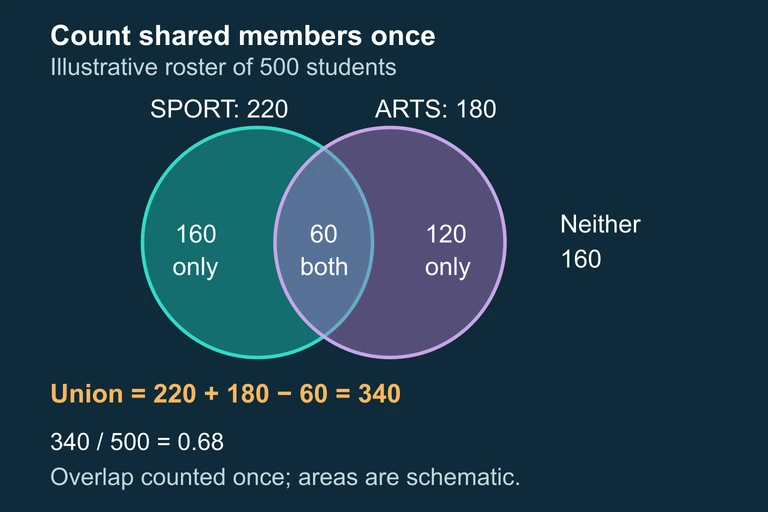
Schematic Venn diagram for 500 students: sport-only 160, both 60, arts-only 120 and neither 160. Union is 340, or 0.68.
The 60 students belonging to both groups are subtracted once to avoid double counting, giving 340 of 500 in the union.
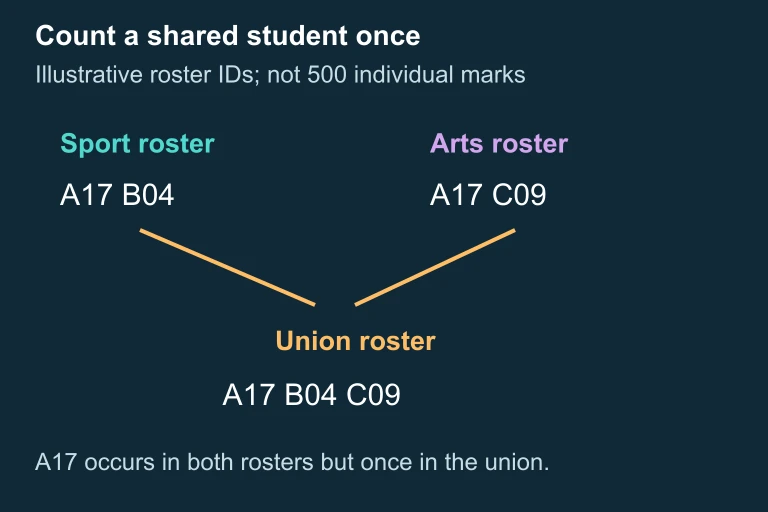
Illustrative roster showing shared ID A17 in both lists but only once in their union, alongside B04 and C09.

Question 1 of 5

A fair coin is flipped three times. What is the probability of getting exactly two heads?

Question 2 of 5

If \( P(A) = 0.7 \), what is \( P(A^c) \)?

Question 3 of 5

Events \( A \) and \( B \) are mutually exclusive with \( P(A) = 0.3 \) and \( P(B) = 0.4 \). What is \( P(A \cup B) \)?

Question 4 of 5

A bag contains 5 red, 3 blue, and 2 green marbles. What is the probability of drawing a marble that is not green?

Question 5 of 5

From a standard 52-card deck, what is the probability of drawing a queen or a diamond?