Introduction to
Planning a Study
Learn how to design observational studies, surveys, and experiments that produce valid, reliable statistical conclusions.
Why Does Study Design Matter?
In statistics, how you collect data is just as important as how you analyze it. A poorly designed study can lead to biased results, invalid conclusions, and wasted resources: no amount of fancy analysis can fix bad data.
The Three Types of Statistical Studies
Essential Vocabulary
Choosing the Right Study Type
Observational vs. Experiment
| Observational Study | Experiment | |
|---|---|---|
| Treatment imposed? | No | Yes |
| Random assignment? | No | Yes |
| Can show causation? | No: only association | Yes: if well-designed |
| Confounders | Always possible | Controlled by randomization |
| Example | Comparing test scores of students who chose to study vs. not | Randomly assigning students to a study program vs. control |
The Three Principles of Experimental Design
Random Selection vs. Random Assignment
Scope of Inference
How to Plan a Study: Step by Step
Common Sampling Methods
Sources of Bias in Studies
Example 1: Identifying Study Type
Example 2: Designing an Experiment
Example 3: Blocking to Reduce Variability
Blocking groups subjects by a characteristic known to affect the response, then randomizes within each block. It's like a stratified sample for experiments.
Light defines the greenhouse blocks
 The top shelf receives more light than the lower shelf. Place both fertilizer treatments on each shelf, control watering, soil and pot size, and measure height increase over four weeks.
Randomize within each shelf
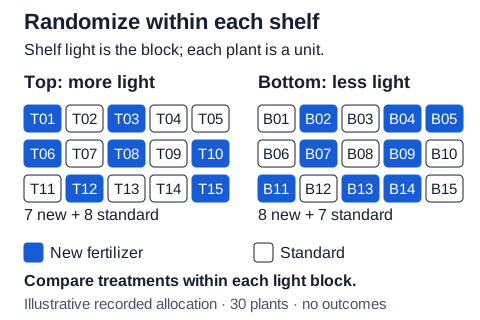 For 30 seedlings, form two 15-plant shelf blocks and randomize both fertilizers within each shelf. The shown allocation assigns 7 new and 8 standard on top, 8 new and 7 standard below. Compare treatment growth within shelves so the light difference stays in the analysis.Open full diagram
Common Mistakes
Question 1 of 5
A researcher records the blood pressure of 200 adults and notes how many hours per week they exercise. What type of study is this?
Question 2 of 5
Which of the following is the primary purpose of random assignment in an experiment?
Question 3 of 5
A survey is mailed to 2,000 randomly selected households, but only 300 respond. The opinions of non-respondents likely differ from respondents. This is an example of:
Question 4 of 5
In a study, participants are grouped by age (under 30, 30-50, over 50), and then within each group, randomly assigned to receive a drug or a placebo. This design is called a:
Question 5 of 5
A study uses random selection to choose participants from a city and random assignment to assign them to treatment groups. What conclusions can be drawn?