01 / 21

Independent Events
and Unions of Events

Master the Multiplication Rule for independent events and the Addition Rule for unions: the two pillars of probability calculations on the AP exam.

AP Statistics

What Is an Event?

An event is any subset of outcomes from a sample space. When we roll a die, the event "roll an even number" is the set \(\{2, 4, 6\}\). Every probability question starts by defining the events we care about.

Sample Space
The set \(S\) of all possible outcomes of an experiment.
Event
A subset \(A \subseteq S\). It "occurs" when the outcome lands in \(A\).
Complement
\(A^c\): everything in \(S\) that is not in \(A\). Always \(P(A^c) = 1 - P(A)\).

What Does Independent Mean?

Two events \(A\) and \(B\) are independent if knowing that one occurred does not change the probability of the other. Formally:

Classic example: flipping a coin twice. The result of the first flip has no effect on the second. Contrast this with drawing cards without replacement, where each draw changes the deck.

Visualizing Unions and Intersections

\(A\)
only A
\(A \cap B\)
\(B\)
only B
\(A \cup B\) = everything shaded
\(S\)

The Multiplication Rule

This extends to any number of independent events. For three independent events \(A\), \(B\), and \(C\):

The rule only works when independence holds. If the events are dependent, you must use the general rule: \(P(A \cap B) = P(A) \cdot P(B \mid A)\).

The Addition Rule for Unions

\(P(A)\)
+
\(P(B)\)
−
\(P(A \cap B)\)
Why subtract? The overlap gets counted twice.

Mutually Exclusive Events

Events are mutually exclusive (disjoint) if they cannot both occur: \(A \cap B = \emptyset\), so \(P(A \cap B) = 0\). The Addition Rule simplifies to:

\(S\)
\(A\)
\(B\)
no overlap

Independent vs Mutually Exclusive

Students often confuse these. They are not the same: in fact, if two events both have positive probability, they cannot be both independent and mutually exclusive.

Independent Mutually Exclusive
Definition \(P(A \cap B) = P(A) \cdot P(B)\) \(P(A \cap B) = 0\)
Can both occur? Yes No
Knowing A affects B? No effect B cannot happen
Venn diagram Circles overlap Circles separated

How to Test for Independence

1
Find \(P(A)\), \(P(B)\), and \(P(A \cap B)\). Read these from a table, tree, or problem statement.
2
Compute \(P(A) \cdot P(B)\). Multiply the two individual probabilities.
3
Compare. If \(P(A \cap B) = P(A) \cdot P(B)\), the events are independent. If not, they are dependent.

Step-by-Step: Solving Probability Problems

1
Define events. Label each event with a letter and write its probability.
2
Identify the relationship. Are the events independent? Mutually exclusive? Neither?
3
Choose the right rule. Use the Multiplication Rule for "and" (\(\cap\)). Use the Addition Rule for "or" (\(\cup\)).
4
Compute and check. Verify your answer is between 0 and 1, and that it makes intuitive sense.

Example 1: Independent Coin Flips

A fair coin is flipped three times. What is the probability of getting heads on all three flips?

Example 2: Union with Overlap

In a class of students, \(P(\text{plays soccer}) = 0.40\), \(P(\text{plays basketball}) = 0.30\), and \(P(\text{plays both}) = 0.12\). Find \(P(\text{soccer or basketball})\).

Example 3: Combining Rules

A smoke detector has two independent sensors. Sensor A detects a fire with probability 0.95 and Sensor B with probability 0.90. What is the probability at least one sensor detects the fire?

The Complement Shortcut

For "at least one" problems with independent events, the complement approach is often faster:

When to Use
"At least one," "one or more," or when computing the union directly involves many terms.
Why It Works
"At least one" and "none" are complements. Computing "none" is a single multiplication for independent events.

Common Mistakes

✕ Assuming Independence
Drawing without replacement, related medical tests, or correlated events are not independent. Always verify.
✕ Forgetting to Subtract
For \(P(A \cup B)\), you must subtract \(P(A \cap B)\). Adding without subtracting double-counts the overlap.
✕ Confusing the Two Concepts
Independent (\(P(A \cap B) = P(A) \cdot P(B)\)) and mutually exclusive (\(P(A \cap B) = 0\)) are different and almost opposite.

Summary of Key Formulas

Rule Formula When to Use
Multiplication (independent) \(P(A \cap B) = P(A) \cdot P(B)\) "and" with independence
Multiplication (general) \(P(A \cap B) = P(A) \cdot P(B \mid A)\) "and" without independence
Addition (general) \(P(A \cup B) = P(A) + P(B) - P(A \cap B)\) "or" for any events
Addition (disjoint) \(P(A \cup B) = P(A) + P(B)\) "or" when mutually exclusive
Complement \(P(A^c) = 1 - P(A)\) "at least one" problems

Worked Example

A quality-control engineer inspects circuit boards at a factory. Each board is tested for two independent defect types: a soldering defect (event S) and a component defect (event C). Historical data show that P(S) = 0.08 and P(C) = 0.05. Find (a) the probability that a randomly selected board has both defect types, (b) the probability that it has at least one defect, and (c) the probability that it has exactly one defect. Independent Defects on a Circuit Board Step 1 — Identify the relationship The problem states that the two defect types occur independently. This means we can use the simplified multiplication rule: P(S ∩ C) = P(S) × P(C). No conditional probability adjustment is needed. Step 2 — Find P(both defects) Applying the multiplication rule for independent events: P(S ∩ C) = P(S) × P(C) = 0.08 × 0.05 = 0.004. So 0.4% of boards are expected to have both defect types simultaneously. P(S ∩ C) = 0.004 Step 3 — Find P(at least one defect) using the addition rule "At least one defect" is the union S ∪ C. Apply the general addition rule: P(S ∪ C) = P(S) + P(C) − P(S ∩ C) = 0.08 + 0.05 − 0.004 = 0.126. Alternatively, use the complement: P(at least one) = 1 − P(neither) = 1 − (1 − 0.08)(1 − 0.05) = 1 − (0.92)(0.95) = 1 − 0.874 = 0.126. Both approaches yield the same answer, confirming our calculation. P(S ∪ C) = 0.126 Step 4 — Find P(exactly one defect) "Exactly one defect" means the board has a soldering defect or a component defect, but not both. This is the union minus the intersection: P(exactly one) = P(S ∪ C) − P(S ∩ C) = 0.126 − 0.004 = 0.122. Equivalently, P(S only) + P(C only) = P(S) × P(C') + P(S') × P(C) = (0.08)(0.95) + (0.92)(0.05) = 0.076 + 0.046 = 0.122. P(exactly one) = 0.122 Step 5 — Verify and interpret As a check, the probabilities of all mutually exclusive outcomes should sum to 1: P(neither) + P(exactly one) + P(both) = 0.874 + 0.122 + 0.004 = 1.000 ✓. In context, about 12.6% of boards have at least one defect, with the vast majority of defective boards (12.2 out of 12.6 percentage points) exhibiting only one defect type.
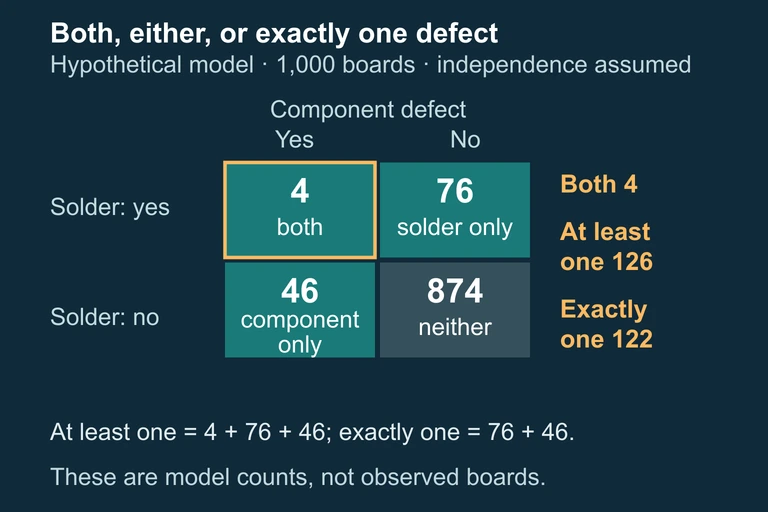
Per 1,000 items, a model table gives 4 with both faults, 76 solder-only, 46 component-only and 874 neither. The union contains 126 and exactly one fault contains 122.
The two independent defect probabilities distinguish both defects, at least one defect and exactly one defect; the 1000-board panel is hypothetical.

Question 1 of 5

Events \(A\) and \(B\) are independent with \(P(A) = 0.3\) and \(P(B) = 0.5\). What is \(P(A \cap B)\)?

Question 2 of 5

\(P(A) = 0.6\), \(P(B) = 0.4\), and \(P(A \cap B) = 0.15\). What is \(P(A \cup B)\)?

Question 3 of 5

Events \(C\) and \(D\) are mutually exclusive. If \(P(C) = 0.25\) and \(P(D) = 0.35\), what is \(P(C \cup D)\)?

Question 4 of 5

A system has three independent components, each working with probability 0.90. The system fails only if all three components fail. What is the probability the system works?

Question 5 of 5

If \(P(A) = 0.4\), \(P(B) = 0.5\), and \(P(A \cap B) = 0.2\), are \(A\) and \(B\) independent?