Conditional
Probability
How does knowing one event occurred change the probability of another? Master \( P(A \mid B) \) and unlock the core of statistical reasoning.
What Is Conditional Probability?
Conditional probability measures the likelihood of an event given that another event has already occurred. Instead of looking at the entire sample space, we restrict our focus to only the outcomes where the condition is true.
This concept is foundational for Bayes' Theorem, independence testing, and real-world decision-making: from medical diagnoses to weather forecasting.
Visualizing with a Venn Diagram
Why Does It Matter?
Conditional probability is everywhere. Misunderstanding it leads to the prosecutor's fallacy, bad medical decisions, and flawed AI models.
The Core Formula
The Multiplication Rule
Rearranging the conditional probability formula gives us a powerful tool for finding joint probabilities:
This is essential when you know a conditional probability and want to find the probability of both events happening together. It forms the backbone of tree diagrams and Bayes' Theorem.
Conditional vs. Joint vs. Marginal
| Conditional | Joint | Marginal | |
|---|---|---|---|
| Notation | \( P(A \mid B) \) | \( P(A \cap B) \) | \( P(A) \) |
| Question | How likely is A given B? | How likely are both? | How likely is A overall? |
| Sample space | Restricted to B | Entire space | Entire space |
| Range | \( 0 \) to \( 1 \) | \( 0 \) to \( \min(P(A), P(B)) \) | \( 0 \) to \( 1 \) |
Independence and Conditional Probability
Two events are independent if knowing one gives no information about the other. In conditional probability terms:
How to Apply the Formula
Example 1: Two-Way Table
A survey of 200 students asks about sport preference and grade level:
| Soccer | Basketball | Total | |
|---|---|---|---|
| Freshman | 40 | 30 | 70 |
| Sophomore | 50 | 80 | 130 |
| Total | 90 | 110 | 200 |
Example 2: Tree Diagram
A bag has 3 red and 2 blue marbles. You draw two without replacement. What is \( P(\text{2nd red} \mid \text{1st red}) \)?
Example 3: Medical Test
A disease affects 1% of a population. A test is 95% accurate (true positive rate) with a 3% false positive rate. If a person tests positive, what is the probability they have the disease?
The Connection to Bayes' Theorem
Example 3 actually used Bayes' Theorem, which is just the conditional probability formula applied systematically:
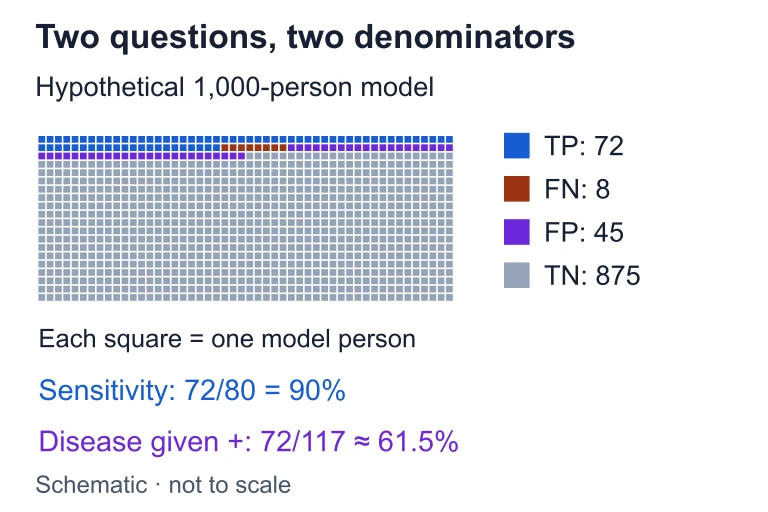
A screening station where positive results split into two origins

A positive screening result can come from someone with or without the condition. Conditioning on a positive result changes the denominator to all positive results.Choose the conditional denominator
Suppose 1,000 people include 72 true positives, 8 false negatives, 45 false positives and 875 true negatives. Sensitivity is 72/80 = 90%. Among the 117 positive results, 72 have the condition, so P(condition | positive) = 72/117 ≈ 61.5%.Common Mistakes
Summary of Key Formulas
| Concept | Formula | When to Use |
|---|---|---|
| Conditional Probability | \( P(A \mid B) = \frac{P(A \cap B)}{P(B)} \) | Given B happened, find P(A) |
| Multiplication Rule | \( P(A \cap B) = P(B) \cdot P(A \mid B) \) | Find joint from conditional |
| Independence Test | \( P(A \mid B) = P(A) \) | Check if events are independent |
| Bayes' Theorem | \( P(A \mid B) = \frac{P(B \mid A) \cdot P(A)}{P(B)} \) | Reverse a conditional |
Worked Example
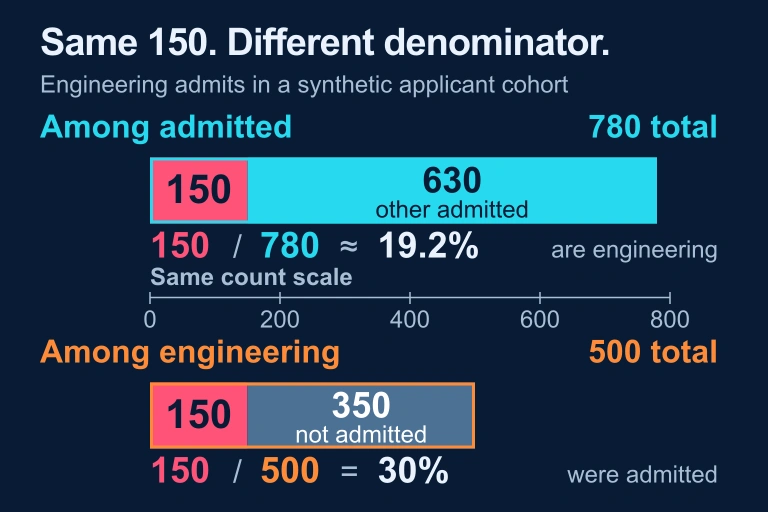
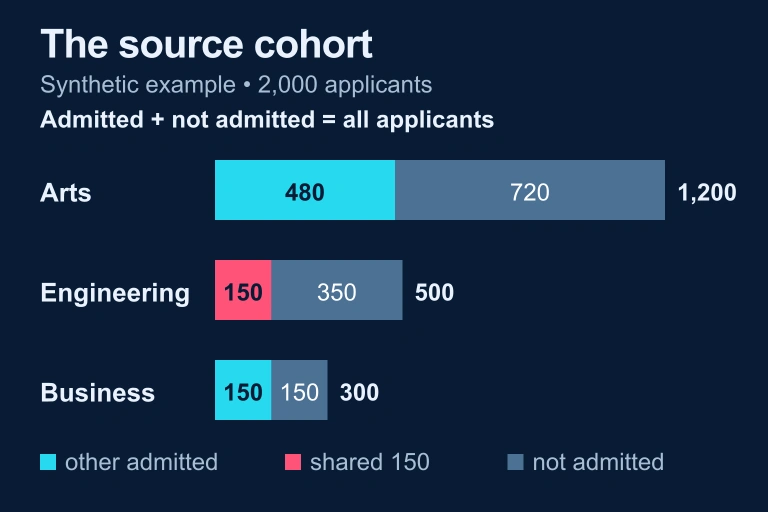
A university admissions office reports the following data for 2,000 applicants: 60% applied to the College of Arts & Sciences (A), 25% applied to the School of Engineering (E), and 15% applied to the School of Business (B). Among Arts & Sciences applicants, 40% were admitted; among Engineering applicants, 30% were admitted; and among Business applicants, 50% were admitted. A randomly selected applicant is found to have been admitted. What is the probability that this student applied to Engineering? Bayes' Theorem — Admissions Scenario Step 1 — Identify Given Information Let A, E, and B denote the events of applying to Arts & Sciences, Engineering, and Business respectively. Let W denote the event of being admitted ("winning" admission). We are given: P(A) = 0.60, P(E) = 0.25, P(B) = 0.15, P(W | A) = 0.40, P(W | E) = 0.30, P(W | B) = 0.50. Step 2 — Compute Joint Probabilities (Multiply Along) Apply the multiplication rule to each branch: P(A ∩ W) = 0.60 × 0.40 = 0.24, P(E ∩ W) = 0.25 × 0.30 = 0.075, P(B ∩ W) = 0.15 × 0.50 = 0.075. Joint probabilities: 0.24, 0.075, 0.075 Step 3 — Find P(W) Using the Law of Total Probability (Add Across) P(W) = P(A ∩ W) + P(E ∩ W) + P(B ∩ W) = 0.24 + 0.075 + 0.075 = 0.39. So 39% of all applicants were admitted. P(W) = 0.39 Step 4 — Apply Bayes' Theorem P(E | W) = P(E ∩ W) / P(W) = 0.075 / 0.39 ≈ 0.1923. Among admitted students, approximately 19.2% applied to Engineering. P(E | W) ≈ 0.192 Step 5 — Interpret in Context Although 25% of all applicants chose Engineering, only about 19.2% of admitted students came from Engineering. This makes sense because Engineering had the lowest admit rate (30%), so it is under-represented among admitted students relative to its share of the applicant pool. AP Exam Tip Free-response questions require you to show your work and communicate your reasoning in context. Always name the events, state the rule you are using (e.g., "By Bayes' theorem…" or "Using the general multiplication rule…"), show the arithmetic, and interpret your final answer in the language of the problem—don't just leave a number.
Question 1 of 5
In a class of 100 students, 60 study math, 45 study science, and 25 study both. What is \( P(\text{Math} \mid \text{Science}) \)?
Question 2 of 5
If \( P(A) = 0.4 \), \( P(B) = 0.5 \), and \( P(A \cap B) = 0.2 \), are A and B independent?
Question 3 of 5
A bag contains 4 red and 6 blue marbles. Two are drawn without replacement. What is \( P(\text{2nd blue} \mid \text{1st red}) \)?
Question 4 of 5
Which statement is always true about conditional probability?
Question 5 of 5
A factory has two machines. Machine X produces 70% of items and has a 2% defect rate. Machine Y produces 30% with a 5% defect rate. An item is found defective. What is \( P(\text{Machine Y} \mid \text{Defective}) \)?