Understanding
Vectors
Master the mathematics of magnitude and direction: from component form to operations and real-world applications.
What Is a Vector?
A vector is a mathematical object that has both magnitude (length) and direction. Unlike a scalar, which is just a number, a vector tells you how much and which way.
Component Form of a Vector
Every 2D vector can be broken into horizontal and vertical parts called components. If a vector goes from the origin to point \((a, b)\), we write it in component form:
Magnitude and Direction
The Unit Vector
A unit vector has a magnitude of exactly 1. It shows direction only. To find the unit vector in the direction of \(\vec{v}\):
Vector Addition
To add two vectors, add their corresponding components. Geometrically, place the tail of the second vector at the head of the first:
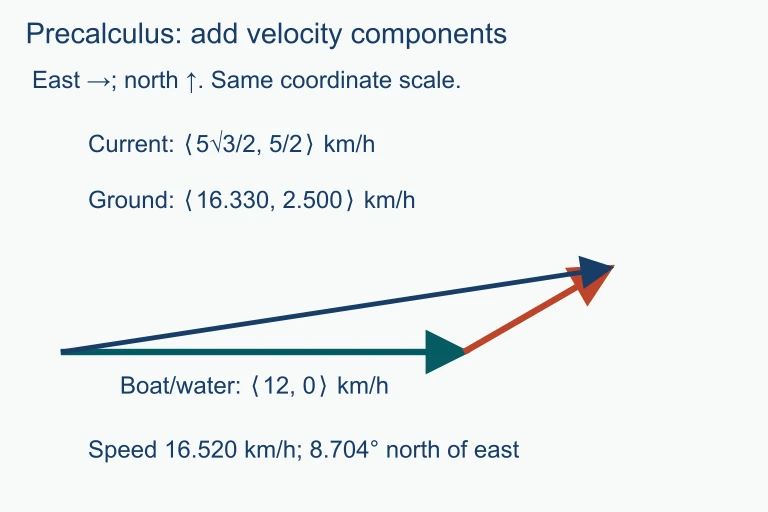
One boat, two velocity frames

Add the boat’s velocity relative to the water to the current’s velocity relative to the ground. Components give a ground speed of about 16.52 km/h, directed 8.70° north of east.One boat, two velocity frames
Add the boat’s velocity relative to the water to the current’s velocity relative to the ground. Components give a ground speed of about 16.52 km/h, directed 8.70° north of east.Scalar Multiplication
Scalar multiplication scales a vector's magnitude without changing its direction (unless the scalar is negative, which reverses direction).
Vector Subtraction
Subtracting vectors combines addition with scalar multiplication by \(-1\):
The Dot Product
The dot product of two vectors produces a scalar. It measures how much one vector goes in the direction of another.
Vectors vs. Scalars
| Vector | Scalar | |
|---|---|---|
| Has magnitude? | ✓ Yes | ✓ Yes |
| Has direction? | ✓ Yes | ✕ No |
| Notation | \(\vec{v}\), \(\langle a, b \rangle\) | \(k\), a single number |
| Examples | Velocity, force, displacement | Speed, mass, temperature |
| Graphed as | Arrow | Point on number line |
Converting Between Forms
How to Solve Vector Problems
Example 1: Adding Vectors
Find \(\vec{u} + \vec{v}\) where \(\vec{u} = \langle 4, -1 \rangle\) and \(\vec{v} = \langle -2, 5 \rangle\).
Example 2: Magnitude and Direction
A vector has magnitude \(10\) and direction \(120^\circ\). Find its component form.
Example 3: Dot Product and Angle
Find the angle between \(\vec{u} = \langle 3, 4 \rangle\) and \(\vec{v} = \langle -4, 3 \rangle\).
Common Mistakes
Worked practice: Practice Problems — airplane and wind
Work through this original lesson problem, then reveal the solution and illustrations.
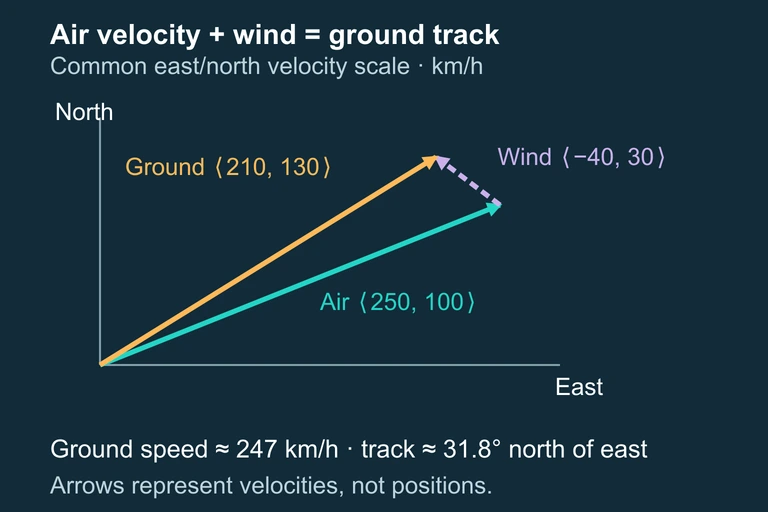
An airplane flies with a velocity of ⟨250, 100⟩ km/h relative to the air, and the wind has a velocity of ⟨−40, 30⟩ km/h. (a) Find the resultant ground velocity vector. (b) Calculate the ground speed (magnitude of the resultant). (c) Determine the direction angle of the airplane's ground path. (d) A second airplane must arrive at the same ground velocity. If this plane encounters the same wind, find the airspeed and the direction angle (heading) at which it should aim to achieve this resultant.
Show answer and explanation
(a) Resultant = ⟨250 + (−40), 100 + 30⟩ = ⟨210, 130⟩ km/h. [1 pt] (b) Ground speed = √(210² + 130²) = √(44100 + 16900) = √61000 ≈ 246.98 km/h. [1 pt] (c) θ = tan⁻¹(130/210) ≈ tan⁻¹(0.6190) ≈ 31.8°. Since both components are positive, the vector lies in Quadrant I and no adjustment is needed. [1 pt] (d) The second airplane's air velocity vector is ⟨s cos α, s sin α⟩ where s is its airspeed. For the ground velocity to equal ⟨210, 130⟩ with wind ⟨−40, 30⟩, we need: s cos α − 40 = 210 → s cos α = 250 s sin α + 30 = 130 → s sin α = 100 So the required airspeed is s = √(250² + 100²) = √(62500 + 10000) = √72500 ≈ 269.3 km/h. [1 pt] The heading angle is α = tan⁻¹(100/250) = tan⁻¹(0.4) ≈ 21.8°. Since both components are positive, the angle is in Quadrant I and no adjustment is needed. [1 pt]
Question 1 of 5
If \(\vec{u} = \langle 2, -3 \rangle\) and \(\vec{v} = \langle -1, 5 \rangle\), what is \(\vec{u} + \vec{v}\)?
Question 2 of 5
What is the magnitude of the vector \(\vec{v} = \langle 6, 8 \rangle\)?
Question 3 of 5
What is the dot product of \(\vec{u} = \langle 3, -2 \rangle\) and \(\vec{v} = \langle 4, 6 \rangle\)?
Question 4 of 5
A vector has magnitude 5 and direction \(60^\circ\). What is its component form?
Question 5 of 5
If \(\vec{v} = \langle -3, 4 \rangle\), what is the unit vector in the direction of \(\vec{v}\)?