Trigonometric
Equations & Inequalities
Master the techniques for solving equations involving \(\sin\), \(\cos\), and \(\tan\), and learn to express solution sets using intervals and the unit circle.
What Is a Trigonometric Equation?
A trigonometric equation is any equation that contains a trigonometric function of an unknown variable. Your goal is to find all values of the variable that make the equation true.
The Unit Circle Connection
General Solutions and Periodicity
Since \(\sin\) and \(\cos\) repeat every \(2\pi\), and \(\tan\) repeats every \(\pi\), each pair of base solutions generates infinitely many solutions by adding integer multiples of the period.
Core Rule: Solving \(\sin\theta = k\)
Solving \(\cos\theta = k\) on the Unit Circle
Equations vs Inequalities
| Equations | Inequalities | |
|---|---|---|
| Form | \(\sin\theta = k\) | \(\sin\theta \geq k\) |
| Solutions | Discrete angles | Intervals of angles |
| Unit circle | Points of intersection | Arcs above or below a line |
| Notation | \(\theta = \frac{\pi}{6} + 2n\pi\) | \(\theta \in \bigl[\frac{\pi}{6},\, \frac{5\pi}{6}\bigr]\) |
| Periodicity | Add \(+2n\pi\) to each angle | Add \(+2n\pi\) to each endpoint |
Solving \(\sin\theta \geq \frac{1}{2}\)
How to Solve Step by Step
Example 1: \(2\sin\theta - \sqrt{3} = 0\)
Example 2: \(\tan^2 x - 1 = 0\)
Example 3: \(\cos\theta < -\frac{\sqrt{2}}{2}\)
Quadratic Trig Equations
Many trig equations are quadratic in disguise. Substituting \(u = \sin\theta\) or \(u = \cos\theta\) converts them into a standard quadratic that you can factor or apply the quadratic formula to.
Using Identities to Simplify
When an equation involves multiple trig functions, use identities to rewrite it in terms of a single function before solving.
Common Mistakes to Avoid
Summary of Solution Strategies
| Equation Type | Strategy | Period |
|---|---|---|
| \(\sin\theta = k\) | Reference angle + QI, QII (or QIII, QIV) | \(2\pi\) |
| \(\cos\theta = k\) | Reference angle + QI, QIV (or QII, QIII) | \(2\pi\) |
| \(\tan\theta = k\) | Reference angle + one solution per period | \(\pi\) |
| Quadratic in trig | Substitute \(u = \text{trig}(\theta)\), factor/quadratic formula | Depends |
| Inequalities | Solve boundary equation, then identify arc/interval | Same as function |
Worked practice: Practice Problems — oscillating mechanical arm
Work through this original lesson problem, then reveal the solution and illustrations.
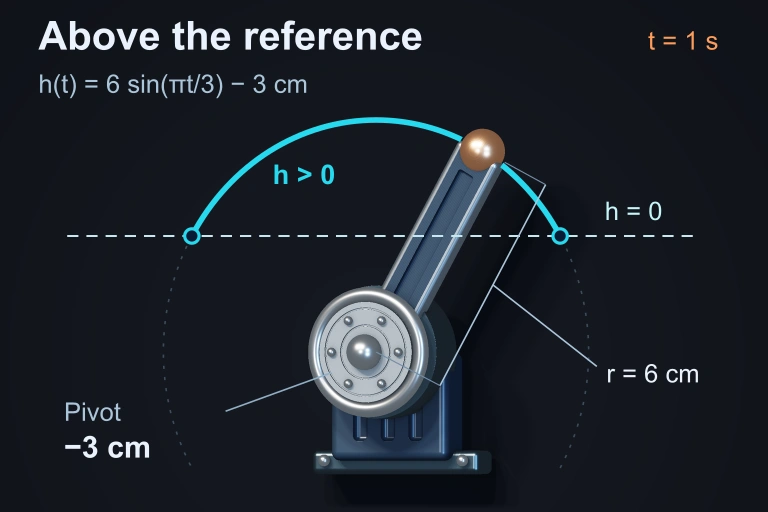
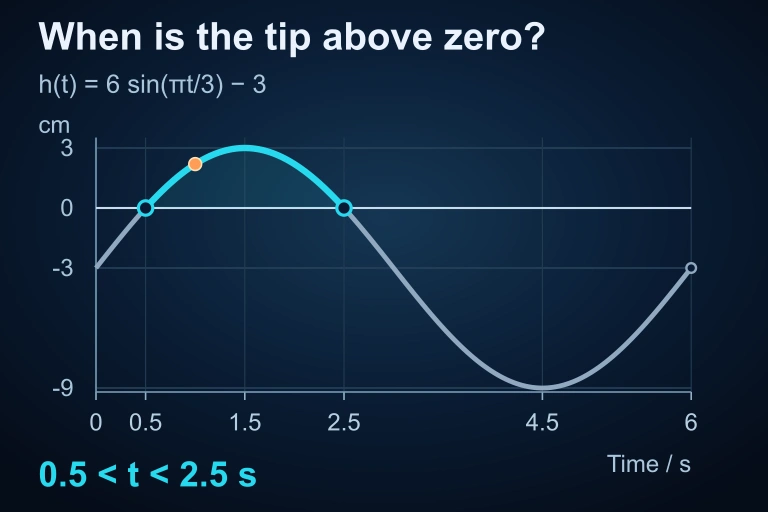
A mechanical arm oscillates so that its vertical displacement in centimeters is modeled by h(t) = 6 sin(πt/3) − 3, where t is measured in seconds. During the first 6 seconds (0 ≤ t < 6), determine the exact interval(s) of time for which the arm is above the horizontal axis—that is, find all t such that h(t) > 0. Show your work, including the boundary equation and the reasoning used to determine the correct interval(s).
Show answer and explanation
Point 1 (Setup): Set h(t) = 0 to find the boundaries: 6 sin(πt/3) − 3 = 0, so sin(πt/3) = 1/2. Point 2 (Solve the boundary equation): The general solution for sin(θ) = 1/2 is θ = π/6 + 2nπ or θ = 5π/6 + 2nπ. Substituting θ = πt/3: πt/3 = π/6 + 2nπ gives t = 1/2 + 6n, and πt/3 = 5π/6 + 2nπ gives t = 5/2 + 6n. On [0, 6): the relevant boundary values are t = 1/2 and t = 5/2 (from n = 0). The next values (n = 1) give t = 13/2 > 6, so they are outside the domain. Point 3 (Determine the inequality direction): Since sin(πt/3) > 1/2 between the ascending and descending crossings within one period, and the period of sin(πt/3) is 2π/(π/3) = 6, the sine exceeds 1/2 on the interval (1/2, 5/2) within [0, 6). Point 4 (State the solution with correct notation): h(t) > 0 when 6 sin(πt/3) > 3, i.e., sin(πt/3) > 1/2. Therefore the arm is above the horizontal axis for t ∈ (1/2, 5/2), which represents a 2-second window. In context, the arm rises above the axis at t = 0.5 seconds and drops back below at t = 2.5 seconds.
Question 1 of 5
What are all solutions to \(\sin\theta = -\frac{\sqrt{3}}{2}\) on the interval \([0, 2\pi)\)?
Question 2 of 5
Solve \(2\cos^2 x - 1 = 0\) for \(x \in [0, 2\pi)\).
Question 3 of 5
What is the general solution to \(\tan\theta = -1\)?
Question 4 of 5
On \([0, 2\pi)\), the solution set for \(\cos\theta \geq \frac{1}{2}\) is:
Question 5 of 5
How many solutions does \(\sin\theta\cos\theta = 0\) have on \([0, 2\pi)\)?