01 / 21

The Tangent
Function

Explore the properties of \(\tan(\theta)\): its definition as a ratio, its periodic behavior, vertical asymptotes, and how it connects sine and cosine.

AP Precalculus

What Is the Tangent Function?

The tangent function is one of the six fundamental trigonometric functions. It is defined as the ratio of sine to cosine:

In a right triangle, \(\tan(\theta)\) equals the length of the opposite side divided by the adjacent side. On the unit circle, it represents the slope of the terminal ray at angle \(\theta\).

Tangent on the Unit Circle

\(\theta\) \(\sin\theta\) \(\cos\theta\) \(\tan\theta\) \(x=1\) \((\cos\theta,\,\sin\theta)\)

Why Tangent Matters

Slope
\(\tan(\theta)\) gives the slope of any line making angle \(\theta\) with the positive \(x\)-axis.
Physics
Inclined plane problems use \(\tan(\theta)\) to relate forces parallel and perpendicular to the surface.
Calculus
The derivative of \(\tan(x)\) is \(\sec^2(x)\), a cornerstone identity in integration and differentiation.

Key Properties of \(\tan(\theta)\)

1
Domain: All real numbers except \(\theta = \frac{\pi}{2} + n\pi\), where \(n\) is any integer (where \(\cos\theta = 0\)).
2
Range: \((-\infty, \infty)\): tangent can take any real value.
3
Period: \(\pi\) (not \(2\pi\) like sine and cosine).
4
Symmetry: Odd function: \(\tan(-\theta) = -\tan(\theta)\).
5
Vertical asymptotes: At every \(\theta = \frac{\pi}{2} + n\pi\), the graph shoots to \(\pm\infty\).

Graph of \(y = \tan(x)\)

Understanding Vertical Asymptotes

Since \(\tan(\theta) = \frac{\sin(\theta)}{\cos(\theta)}\), the function is undefined whenever \(\cos(\theta) = 0\). This occurs at:

Left of Asymptote
As \(\theta \to \frac{\pi}{2}^-\), \(\cos\theta \to 0^+\) while \(\sin\theta \to 1\), so \(\tan\theta \to +\infty\).
Right of Asymptote
As \(\theta \to \frac{\pi}{2}^+\), \(\cos\theta \to 0^-\) while \(\sin\theta \to 1\), so \(\tan\theta \to -\infty\).

Tangent vs. Sine & Cosine

Property \(\sin(x)\) / \(\cos(x)\) \(\tan(x)\)
Period \(2\pi\) \(\pi\)
Range \([-1, 1]\) \((-\infty, \infty)\)
Asymptotes None Yes, at \(\frac{\pi}{2}+n\pi\)
Amplitude 1 (or scaled) Not defined
Symmetry \(\sin\): odd, \(\cos\): even Odd
Zeros \(\sin\): \(n\pi\), \(\cos\): \(\frac{\pi}{2}+n\pi\) \(n\pi\)

Graphing Transformed Tangent

1
Find the period: Compute \(\displaystyle\frac{\pi}{|b|}\). This is the distance between consecutive asymptotes.
2
Locate asymptotes: Solve \(b(x - c) = \pm\frac{\pi}{2}\) to find the first pair, then shift by the period.
3
Plot the midpoint: The point \((c, d)\) is the center of each branch (the inflection point).
4
Apply vertical stretch: The factor \(a\) stretches the curve; if \(a < 0\), the graph reflects across the midline.
5
Sketch the S-curve: Draw the increasing (or decreasing) branch between each pair of asymptotes, passing through the midpoint.

Example 1: Evaluating \(\tan(\theta)\)

Find the exact value of \(\tan\!\left(\frac{\pi}{3}\right)\).

1
Recall sine and cosine: \(\sin\!\left(\frac{\pi}{3}\right) = \frac{\sqrt{3}}{2}\), \(\cos\!\left(\frac{\pi}{3}\right) = \frac{1}{2}\).
2
Apply the definition: \(\tan\!\left(\frac{\pi}{3}\right) = \frac{\sin(\pi/3)}{\cos(\pi/3)} = \frac{\sqrt{3}/2}{1/2}\).
3
Simplify: \(\frac{\sqrt{3}/2}{1/2} = \sqrt{3}\).

Example 2: Negative Angles

Find the exact value of \(\tan\!\left(-\frac{\pi}{4}\right)\).

1
Use the odd-function property: \(\tan(-\theta) = -\tan(\theta)\).
2
Evaluate: \(\tan\!\left(\frac{\pi}{4}\right) = 1\), so \(\tan\!\left(-\frac{\pi}{4}\right) = -1\).

Example 3: Graphing \(y = 2\tan\!\left(\frac{x}{2}\right)\)

1
Identify parameters: \(a = 2\), \(b = \frac{1}{2}\), \(c = 0\), \(d = 0\).
2
Period: \(\frac{\pi}{|b|} = \frac{\pi}{1/2} = 2\pi\).
3
Asymptotes: \(\frac{x}{2} = \pm\frac{\pi}{2} \implies x = \pm\pi\). The pattern repeats every \(2\pi\).
4
Midpoint: \((0, 0)\) is the inflection point.
5
Vertical stretch: The factor of 2 doubles the steepness: at \(x = \frac{\pi}{4}\), \(y = 2\tan\!\left(\frac{\pi}{8}\right) \approx 0.83\) instead of \(\approx 0.41\).

Period and Phase Shift

Period
For \(y = \tan(bx)\), the period is \(\frac{\pi}{|b|}\). Doubling \(b\) halves the period: the branches compress.
Phase Shift
In \(y = \tan(b(x - c))\), the graph shifts right by \(c\). Every asymptote and zero moves by the same amount.

The Inverse: \(\arctan(x)\)

Because \(\tan\) is not one-to-one over all reals, we restrict its domain to \(\left(-\frac{\pi}{2}, \frac{\pi}{2}\right)\) to define the inverse:

Domain
\((-\infty, \infty)\): you can take the arctangent of any real number.
Range
\(\left(-\frac{\pi}{2}, \frac{\pi}{2}\right)\): outputs are always in this open interval.
Key Values
\(\arctan(0) = 0\), \(\arctan(1) = \frac{\pi}{4}\), \(\arctan(\sqrt{3}) = \frac{\pi}{3}\).

Common Mistakes to Avoid

✕ Wrong Period
Using \(2\pi\) as the period of \(\tan(x)\). Remember: the period is \(\pi\), not \(2\pi\).
✕ Forgetting Asymptotes
Trying to evaluate \(\tan\!\left(\frac{\pi}{2}\right)\) as if it were defined. It is undefined.
✕ Confusing Range
Claiming \(\tan(x)\) has range \([-1,1]\). That is sine and cosine. Tangent's range is all real numbers.

Summary of Tangent Properties

Property Value / Description
Definition \(\dfrac{\sin\theta}{\cos\theta}\)
Domain \(\theta \neq \frac{\pi}{2} + n\pi\)
Range \((-\infty, \infty)\)
Period \(\pi\)
Symmetry Odd: \(\tan(-\theta) = -\tan(\theta)\)
Asymptotes \(x = \frac{\pi}{2} + n\pi\)
Zeros \(x = n\pi\)
General Form \(y = a\tan(b(x-c))+d\)

Worked practice: Practice Problems — rotating spotlight

Work through this original lesson problem, then reveal the solution and illustrations.

A spotlight is mounted on the ground 20 meters from a straight wall. The light rotates at a constant rate, and the angle θ (in radians) between the perpendicular to the wall and the beam is given by θ(t) = πt/6, where t is time in seconds. Let d(t) be the distance along the wall from the foot of the perpendicular to the point where the beam hits the wall. (a) Write d(t) as a function of t involving the tangent function. (b) State the domain of d(t) in the context of this problem, restricted to one full sweep before the beam reaches the wall's edge at 90° from perpendicular. (c) Find d(t) when t = 1 second. Give an exact answer. (d) Explain, using the properties of the tangent function, what happens to d(t) as t approaches 3 seconds.

Show answer and explanation

Rubric (4 points): Point 1 — Part (a): The beam, the perpendicular, and the wall segment form a right triangle where the adjacent side is 20 m and the opposite side is d(t). Therefore d(t) = 20 tan(θ(t)) = 20 tan(πt/6). Award 1 point for the correct function. Point 2 — Part (b): The beam can only hit the wall when |θ| < π/2, i.e., |πt/6| < π/2, giving |t| < 3. For a single forward sweep (t ≥ 0), the domain is 0 ≤ t < 3 seconds. Award 1 point for stating the domain correctly with an open endpoint at t = 3. Point 3 — Part (c): d(1) = 20 tan(π/6) = 20 × (√3/3) = 20√3/3 meters (approximately 11.55 m). Award 1 point for the exact value 20√3/3. Point 4 — Part (d): As t → 3⁻, the angle θ → π/2, and tan(π/2) is undefined with a vertical asymptote. The function d(t) = 20 tan(πt/6) → +∞, meaning the beam's spot on the wall moves infinitely far from the perpendicular foot — physically, the beam becomes parallel to the wall and no longer intersects it. Award 1 point for connecting the vertical asymptote of tangent to the physical behavior.
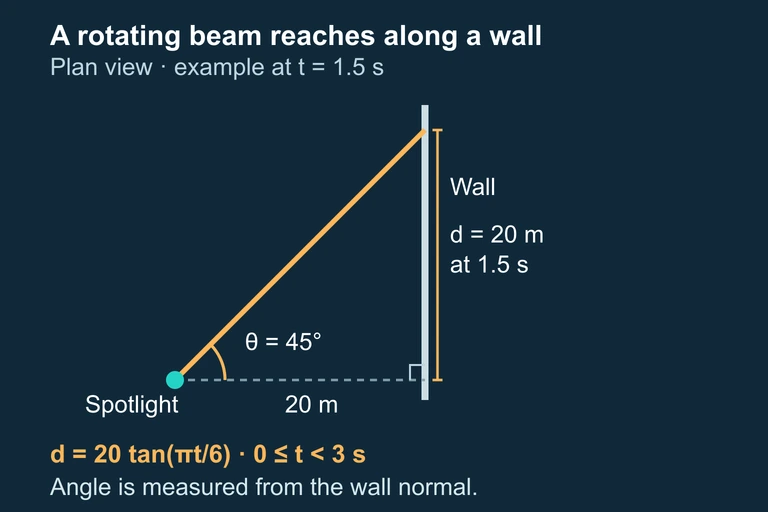
Spotlight plan with wall distance 20, angle measured from the wall normal, and tangent model. At t=1.5 the angle is 45° and wall displacement is 20; domain is 0≤t<3.
The wall spot follows d=20 tan(πt/6) before the light ray becomes parallel to the wall; the angle is from the wall-normal direction.

Question 1 of 5

What is the period of \(y = \tan(x)\)?

Question 2 of 5

Where are the vertical asymptotes of \(y = \tan(x)\)?

Question 3 of 5

What is the exact value of \(\tan\!\left(\dfrac{5\pi}{4}\right)\)?

Question 4 of 5

What is the period of \(y = \tan(3x)\)?

Question 5 of 5

The range of \(\arctan(x)\) is: