01 / 21

Sinusoidal
Functions

Master the amplitude, period, phase shift, and vertical shift of sine and cosine functions to model periodic behavior.

AP Precalculus

What Is a Sinusoidal Function?

A sinusoidal function is any function that can be written in the form of a transformed sine or cosine. These functions produce smooth, repeating wave patterns that oscillate above and below a central axis.

Periodic
The pattern repeats after a fixed interval called the period.
Bounded
Outputs always stay between a maximum and minimum value.
Smooth
The curve is continuous and differentiable everywhere.

The Parent Functions

\(\sin(x)\)
Starts at the origin \((0,0)\), rises to 1, falls to \(-1\), and returns.
\(\cos(x)\)
Starts at the maximum \((0,1)\), falls to \(-1\), and returns.

Key Vocabulary

Amplitude
The distance from the midline to a peak or trough: \(|a|\).
Period
The horizontal length of one full cycle: \(\frac{2\pi}{|b|}\).
Phase Shift
The horizontal translation of the wave: \(c\).
Vertical Shift
The midline of the wave, shifted up or down by \(d\).

The General Form

a
Amplitude \(= |a|\). If \(a < 0\), the wave is reflected vertically.
b
Period \(= \frac{2\pi}{|b|}\). Larger \(|b|\) means a faster oscillation.
c
Phase Shift \(= c\). Positive \(c\) shifts the graph right.
d
Vertical Shift \(= d\). The midline is \(y = d\).

Amplitude and Period Visualized

\(\sin\) vs. \(\cos\): Key Distinction

\(\sin(x)\) \(\cos(x)\)
Value at \(x = 0\) 0 1
First Peak \(x = \frac{\pi}{2}\) \(x = 0\)
Symmetry Odd: \(\sin(-x)=-\sin(x)\) Even: \(\cos(-x)=\cos(x)\)
Relationship \(\cos(x) = \sin\!\left(x + \frac{\pi}{2}\right)\)

Phase Shift and Vertical Shift

Phase Shift
Slides the entire wave left or right without changing its shape. \(c > 0\) shifts right.
Vertical Shift
Moves the midline up or down. \(d > 0\) shifts up, changing the range to \([d-|a|,\; d+|a|]\).

How to Graph a Sinusoid

1
Identify the parameters: Read \(a\), \(b\), \(c\), and \(d\) from the equation \(a\sin(b(x-c))+d\).
2
Draw the midline: Sketch the horizontal line \(y = d\).
3
Mark the amplitude: Place dashed lines at \(y = d + |a|\) (max) and \(y = d - |a|\) (min).
4
Compute the period: \(T = \frac{2\pi}{|b|}\). Divide one period into four equal quarter-intervals.
5
Apply the phase shift: Start the first key point at \(x = c\) instead of \(x = 0\).
6
Plot and connect: Place the 5 key points (start, peak, midline, trough, end) and draw a smooth curve.

The harbor makes half a tide cycle visible

Two matched harbor views show the same fixed pier, pilings, shoreline buildings and blue boat at higher water and lower water; exposed rocks and piling lengths increase in the lower-water view.The harbor scene introduces periodic change; the accompanying graph models annual temperature. The temperature model has minimum 28 °F at month 1 and maximum 82 °F at month 7. Its midline is 55 °F, amplitude 27 °F, and period 12 months.

A separate annual temperature cycle
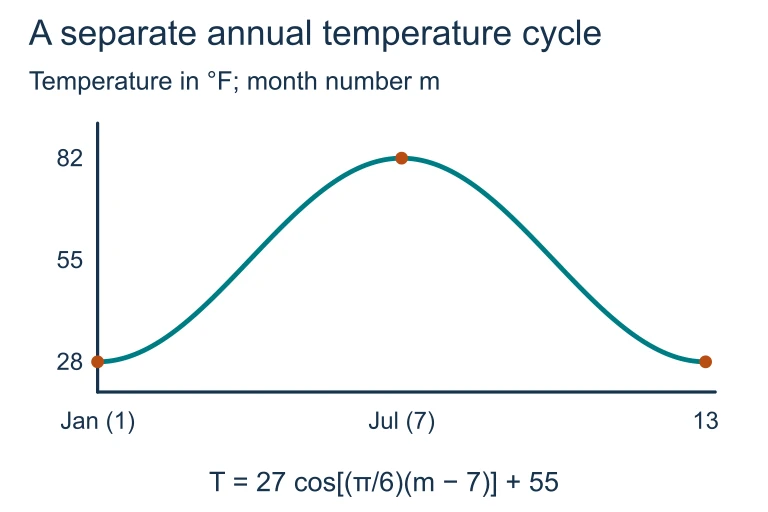
The harbor scene introduces periodic change; the accompanying graph models annual temperature. The temperature model has minimum 28 °F at month 1 and maximum 82 °F at month 7. Its midline is 55 °F, amplitude 27 °F, and period 12 months.The harbor scene introduces periodic change; the accompanying graph models annual temperature. The temperature model has minimum 28 °F at month 1 and maximum 82 °F at month 7. Its midline is 55 °F, amplitude 27 °F, and period 12 months.

Example 1: Identifying Parameters

1
Amplitude: \(|a| = |3| = \) 3
2
Period: \(\frac{2\pi}{|b|} = \frac{2\pi}{2} = \) \(\pi\)
3
Phase Shift: \(c = \) 0 (no horizontal shift)
4
Vertical Shift: \(d = \) 1, midline at \(y = 1\)
5
Range: \([1 - 3,\; 1 + 3] = [-2,\; 4]\)

Example 1: Graph

Example 2: Phase Shift

1
Amplitude: \(|a| = |-2| = \) 2. Negative \(a\) means reflection over the midline.
2
Period: \(\frac{2\pi}{1} = \) \(2\pi\)
3
Phase Shift: \(c = \frac{\pi}{3}\) : shift right by \(\frac{\pi}{3}\).
4
Vertical Shift: \(d = 0\), midline at \(y = 0\).

Example 2: Reflected Cosine Graph

Example 3: Writing the Equation

A sinusoidal function has a maximum of 5, a minimum of \(-1\), a period of \(4\pi\), and passes through its maximum at \(x = \frac{\pi}{2}\).

1
Amplitude: \(a = \frac{5 - (-1)}{2} = \) 3
2
Midline: \(d = \frac{5 + (-1)}{2} = \) 2
3
Find \(b\): \(\frac{2\pi}{|b|} = 4\pi \implies |b| = \) \(\frac{1}{2}\)
4
Phase shift: Max at \(x = \frac{\pi}{2}\), so using cosine: \(c = \frac{\pi}{2}\).

Common Mistakes

✕ Wrong Period Formula
Using \(\frac{\pi}{|b|}\) instead of \(\frac{2\pi}{|b|}\). The full cycle is always \(\frac{2\pi}{|b|}\).
✕ Ignoring the Negative \(a\)
A negative amplitude means the wave is reflected, not that the amplitude is negative. Amplitude is always positive: \(|a|\).
✕ Phase Shift Sign Error
In \(\sin(b(x - c))\), the shift is \(+c\) (right). If you see \(\sin(2x + \pi)\), factor first: \(\sin(2(x + \frac{\pi}{2}))\), so shift is left by \(\frac{\pi}{2}\).

Summary of Parameters

Parameter Symbol Effect on Graph Formula
Amplitude \(a\) Vertical stretch/compression \(|a|\)
Period \(b\) Horizontal stretch/compression \(\frac{2\pi}{|b|}\)
Phase Shift \(c\) Horizontal translation \(c\) units right
Vertical Shift \(d\) Vertical translation Midline \(y = d\)

Question 1 of 5

What is the amplitude of \(f(x) = -4\sin(3x) + 7\)?

Question 2 of 5

What is the period of \(g(x) = \cos(4x - \pi)\)?

Question 3 of 5

What is the phase shift of \(h(x) = 2\sin(3x + \pi)\)?

Question 4 of 5

A sinusoidal function has a maximum of 10 and a minimum of 2. What is the midline?

Question 5 of 5

Which equation represents a cosine function with amplitude 5, period \(\pi\), and midline \(y = -3\)?