Sine, Cosine, and
Tangent
Master the three fundamental trigonometric ratios that connect angles to side lengths in right triangles and unlock the power of the unit circle.
What Are Trigonometric Ratios?
In any right triangle, the three sides have special names relative to a chosen acute angle: the opposite side faces the angle, the adjacent side touches it, and the hypotenuse is the longest side opposite the right angle.
The Three Ratios Defined
Why Do They Matter?
Trigonometric ratios are not just abstract formulas: they appear throughout science, engineering, and mathematics. Any situation involving angles and distances relies on these three functions.
The Unit Circle Connection
Core Identities
These two identities follow directly from the definitions. The Pythagorean identity is just the Pythagorean theorem applied to the unit circle: \(x^2 + y^2 = 1\). The quotient identity shows tangent is not independent: it is the ratio of sine to cosine.
Sine vs. Cosine
| Sine | Cosine | |
|---|---|---|
| Ratio | Opposite / Hypotenuse | Adjacent / Hypotenuse |
| Unit circle coord | \(y\)-coordinate | \(x\)-coordinate |
| Value at \(0\) | 0 | 1 |
| Value at \(\frac{\pi}{2}\) | 1 | 0 |
| Symmetry | Odd: \(\sin(-\theta) = -\sin\theta\) | Even: \(\cos(-\theta) = \cos\theta\) |
| Period | \(2\pi\) | \(2\pi\) |
How to Apply the Ratios
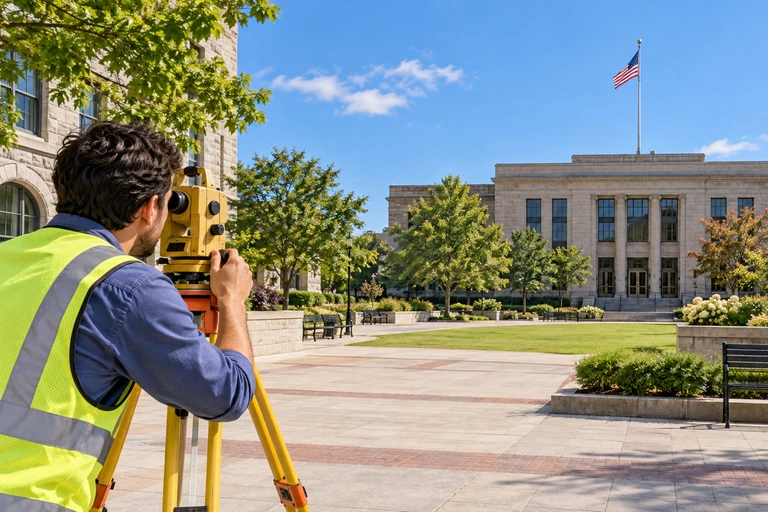
A surveyor separates two nearly overlapping heights
 Both elevation angles use the same 50 m horizontal baseline. Subtracting 50 tan 62° from 50 tan 67° gives the pole’s height, about 23.76 m.
Two elevation angles share one horizontal baseline and observer reference.
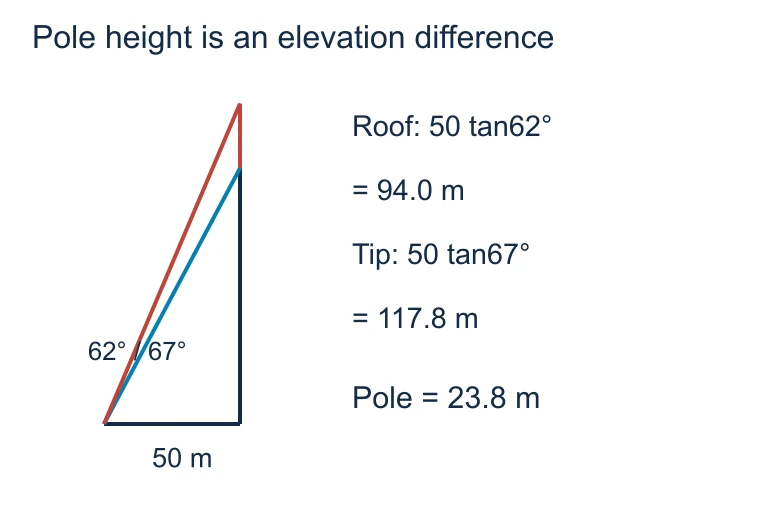 Both elevation angles use the same 50 m horizontal baseline. Subtracting 50 tan 62° from 50 tan 67° gives the pole’s height, about 23.76 m.
Example 1: Finding a Side
A right triangle has a hypotenuse of 10 and an angle of \(30^\circ\). Find the length of the side opposite the angle.
Example 2: Finding an Angle
A right triangle has legs of length 7 (opposite) and 12 (adjacent). Find angle \(\theta\).
Example 3: Unit Circle Values
Find \(\sin\!\left(\frac{5\pi}{6}\right)\), \(\cos\!\left(\frac{5\pi}{6}\right)\), and \(\tan\!\left(\frac{5\pi}{6}\right)\).
Special Angle Values
| \(\theta\) | \(\sin\theta\) | \(\cos\theta\) | \(\tan\theta\) |
|---|---|---|---|
| \(0\) | 0 | 1 | 0 |
| \(\frac{\pi}{6}\) | \(\frac{1}{2}\) | \(\frac{\sqrt{3}}{2}\) | \(\frac{\sqrt{3}}{3}\) |
| \(\frac{\pi}{4}\) | \(\frac{\sqrt{2}}{2}\) | \(\frac{\sqrt{2}}{2}\) | 1 |
| \(\frac{\pi}{3}\) | \(\frac{\sqrt{3}}{2}\) | \(\frac{1}{2}\) | \(\sqrt{3}\) |
| \(\frac{\pi}{2}\) | 1 | 0 | undefined |
Graphs of \(\sin x\) and \(\cos x\)
Graph of \(\tan x\)
Common Mistakes to Avoid
Summary of Key Facts
| Sine | Cosine | Tangent | |
|---|---|---|---|
| Ratio (right triangle) | Opp / Hyp | Adj / Hyp | Opp / Adj |
| Unit circle | \(y\) | \(x\) | \(y / x\) |
| Range | \[-1, 1\] | \[-1, 1\] | \((-\infty, \infty)\) |
| Period | \(2\pi\) | \(2\pi\) | \(\pi\) |
| Symmetry | Odd | Even | Odd |
| Undefined at | Never | Never | \(\frac{\pi}{2} + n\pi\) |
Question 1 of 5
In a right triangle, the side opposite to angle \(\theta\) has length 5 and the hypotenuse has length 13. What is \(\sin\theta\)?
Question 2 of 5
What is the exact value of \(\cos\!\left(\frac{\pi}{3}\right)\)?
Question 3 of 5
If \(\tan\theta = \dfrac{3}{4}\) and \(\theta\) is in Quadrant I, what is \(\sin\theta\)?
Question 4 of 5
At which angle is \(\tan\theta\) undefined?
Question 5 of 5
What is the period of the tangent function \(y = \tan x\)?