Sine and Cosine
Function Values
Master the unit circle definitions of \(\sin\theta\) and \(\cos\theta\), evaluate them at key angles, and understand how they generate the wave-like graphs you see everywhere in mathematics.
The Unit Circle Foundation
The unit circle is a circle of radius 1 centered at the origin. Every point on it can be written as \((\cos\theta,\,\sin\theta)\), where \(\theta\) is the angle measured counter-clockwise from the positive \(x\)-axis.
Why Do These Values Matter?
Sine and cosine are not just abstract definitions: they model periodic phenomena throughout science and engineering. Understanding their exact values at key angles is essential for solving equations, graphing transformations, and working with identities.
Memorizing Key Angles
Five reference angles in the first quadrant produce all the exact values you need. Every other angle on the unit circle is a reflection of one of these.
Exact Values Table
| \(\theta\) | \(\sin\theta\) | \(\cos\theta\) |
|---|---|---|
| \(0\) | \(0\) | \(1\) |
| \(\dfrac{\pi}{6}\) | \(\dfrac{1}{2}\) | \(\dfrac{\sqrt{3}}{2}\) |
| \(\dfrac{\pi}{4}\) | \(\dfrac{\sqrt{2}}{2}\) | \(\dfrac{\sqrt{2}}{2}\) |
| \(\dfrac{\pi}{3}\) | \(\dfrac{\sqrt{3}}{2}\) | \(\dfrac{1}{2}\) |
| \(\dfrac{\pi}{2}\) | \(1\) | \(0\) |
The Pythagorean Identity
Because every point \((\cos\theta,\sin\theta)\) lies on the unit circle \(x^2+y^2=1\), we get the most fundamental trigonometric identity:
This lets you find one function from the other. If \(\sin\theta = \frac{3}{5}\) and \(\theta\) is in QI, then \(\cos\theta = \frac{4}{5}\).
Sine vs Cosine: Key Distinctions
| Property | \(\sin\theta\) | \(\cos\theta\) |
|---|---|---|
| Unit circle coordinate | y-coordinate | x-coordinate |
| Value at \(\theta=0\) | \(0\) | \(1\) |
| Value at \(\theta=\frac{\pi}{2}\) | \(1\) | \(0\) |
| Symmetry | Odd: \(\sin(-\theta)=-\sin\theta\) | Even: \(\cos(-\theta)=\cos\theta\) |
| Graph shift | Starts at origin | Starts at peak |
| Period | \(2\pi\) | \(2\pi\) |
Signs by Quadrant
Use the mnemonic "All Students Take Calculus" to remember which functions are positive in each quadrant.
Using Reference Angles
A reference angle \(\alpha\) is the acute angle between the terminal side and the \(x\)-axis. The trig value at any angle equals the trig value at its reference angle, with a sign determined by the quadrant.
How to Evaluate Step by Step
Follow this checklist every time you need an exact sine or cosine value:
Example 1: Find \(\sin\!\left(\frac{5\pi}{6}\right)\)
Example 2: Find \(\cos\!\left(\frac{5\pi}{4}\right)\)
Example 3: Evaluate \(\sin(-300^\circ)\)
From boarding angle to rider height
 For a wheel of radius 30 m centered 35 m above ground, let α be the counterclockwise angle from the lowest point. H = 35 − 30 cos α, so α = 2π/3 gives H = 50 m.
From boarding angle to rider height
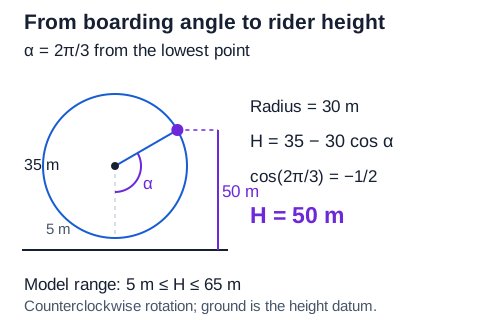 For a wheel of radius 30 m centered 35 m above ground, let α be the counterclockwise angle from the lowest point. H = 35 − 30 cos α, so α = 2π/3 gives H = 50 m.Open full diagram
Graphs of \(\sin\theta\) and \(\cos\theta\)
Common Mistakes to Avoid
Complete Reference Summary
| \(\theta\) | \(\sin\theta\) | \(\cos\theta\) | Quadrant |
|---|---|---|---|
| \(0\) | \(0\) | \(1\) | + x-axis |
| \(\frac{\pi}{6}\) | \(\frac{1}{2}\) | \(\frac{\sqrt{3}}{2}\) | QI |
| \(\frac{\pi}{4}\) | \(\frac{\sqrt{2}}{2}\) | \(\frac{\sqrt{2}}{2}\) | QI |
| \(\frac{\pi}{3}\) | \(\frac{\sqrt{3}}{2}\) | \(\frac{1}{2}\) | QI |
| \(\frac{\pi}{2}\) | \(1\) | \(0\) | + y-axis |
| \(\pi\) | \(0\) | \(-1\) | − x-axis |
| \(\frac{3\pi}{2}\) | \(-1\) | \(0\) | − y-axis |
| \(2\pi\) | \(0\) | \(1\) | + x-axis |
Question 1 of 5
What is the exact value of \(\sin\!\left(\frac{2\pi}{3}\right)\)?
Question 2 of 5
What is the exact value of \(\cos\!\left(\frac{7\pi}{6}\right)\)?
Question 3 of 5
If \(\cos\theta = -\frac{1}{2}\) and \(\theta\) is in Quadrant III, what is \(\sin\theta\)?
Question 4 of 5
Which of the following correctly states the relationship between \(\sin\theta\) and \(\cos\theta\)?
Question 5 of 5
Evaluate \(\cos\!\left(-\frac{3\pi}{4}\right)\).