Sine & Cosine
Function Graphs
Master the shapes of \(\sin x\) and \(\cos x\), understand amplitude, period, phase shift, and vertical shift to graph any sinusoidal function.
What Is a Sinusoidal Function?
A sinusoidal function is any function that can be written in the form \( y = a\sin(bx + c) + d \) or \( y = a\cos(bx + c) + d \). These functions produce smooth, repeating wave shapes that model phenomena like sound waves, tides, and circular motion.
The Unit Circle Connection
As a point travels around the unit circle, its \(y\)-coordinate traces out \(\sin\theta\) and its \(x\)-coordinate traces out \(\cos\theta\). "Unrolling" these coordinates against the angle \(\theta\) produces the familiar wave graphs.
Graph of \( y = \sin x \)
Graph of \( y = \cos x \)
The General Sinusoidal Form
Amplitude & Period
Phase Shift & Vertical Shift
For \( y = a\sin(b(x - c)) + d \), factor the argument so the shift is clearly visible. The value \(c\) tells you how far and which direction the entire wave slides horizontally.
Sine vs Cosine: Key Distinction
| \(\sin x\) | \(\cos x\) | |
|---|---|---|
| Value at \(x = 0\) | 0 | 1 |
| First peak | \(x = \frac{\pi}{2}\) | \(x = 0\) |
| Symmetry | Odd: \(\sin(-x) = -\sin x\) | Even: \(\cos(-x) = \cos x\) |
| Zeros in \([0,2\pi]\) | \(0,\;\pi,\;2\pi\) | \(\frac{\pi}{2},\;\frac{3\pi}{2}\) |
| Phase relation | \(\cos x = \sin\!\bigl(x + \frac{\pi}{2}\bigr)\) | |
Choose cosine from the boarding position
 Suppose a wheel has radius 30 m and center height 35 m. Starting at the bottom gives H(α) = 35 − 30 cos α: amplitude 30 m, midline 35 m, and range 5–65 m.
Choose cosine from the boarding position
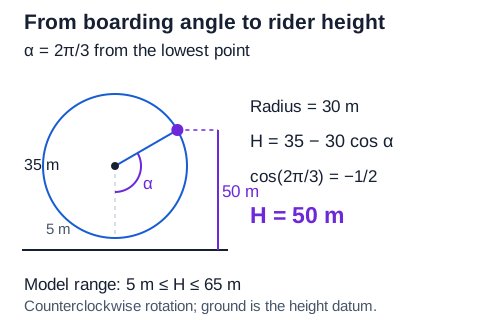 Suppose a wheel has radius 30 m and center height 35 m. Starting at the bottom gives H(α) = 35 − 30 cos α: amplitude 30 m, midline 35 m, and range 5–65 m.Open full diagram
How to Graph a Sinusoidal Function
Example 1: \( y = 2\sin x \)
Example 2: \( y = \cos(2x) \)
Example 3: \( y = -3\cos\!\bigl(x - \frac{\pi}{2}\bigr) + 1 \)
Reading Parameters from a Graph
Common Mistakes
Summary of Transformations
| Parameter | Effect | Formula |
|---|---|---|
| \(a\) | Vertical stretch / reflect | Amplitude \(= |a|\) |
| \(b\) | Horizontal compress / stretch | Period \(= \frac{2\pi}{|b|}\) |
| \(c\) | Horizontal shift | Phase shift \(= c\) |
| \(d\) | Vertical shift | Midline: \(y = d\) |
| Max | Highest point | \(d + |a|\) |
| Min | Lowest point | \(d - |a|\) |
Question 1 of 5
What is the amplitude of \( y = -4\sin(3x) + 2 \)?
Question 2 of 5
What is the period of \( y = \cos(4x) \)?
Question 3 of 5
For \( y = 2\sin\!\bigl(x - \frac{\pi}{3}\bigr) + 5 \), what is the phase shift?
Question 4 of 5
Which equation represents a cosine function with amplitude 3, period \(\pi\), and midline \(y = -1\)?
Question 5 of 5
The graph of \( y = \sin x \) is shifted \(\frac{\pi}{2}\) to the left. Which function results?