Polar Function
Graphs
Explore curves defined by distance and angle: from circles and cardioids to roses and limaçons, all through the lens of \( r = f(\theta) \).
What Is the Polar Coordinate System?
Instead of locating a point by how far right and up it is (Cartesian), the polar system locates it by how far from the origin and at what angle from the positive \( x \)-axis.
Polar Equations: \( r = f(\theta) \)
A polar function expresses the radius \( r \) as a function of the angle \( \theta \). As \( \theta \) sweeps from \( 0 \) to \( 2\pi \) (or beyond), the point traces out a curve in the plane.
Why Use Polar Coordinates?
Many curves that are complicated in Cartesian form become elegant in polar. Circular symmetry, spirals, and petal patterns are naturally described by distance-and-angle relationships.
Converting: Polar and Cartesian
These relationships come directly from right-triangle trigonometry. They let you translate any polar equation into Cartesian form (or vice versa) when that form is more convenient.
Core Polar Curve Types
| Curve | Equation | Shape |
|---|---|---|
| Circle | \( r = a \) or \( r = a\cos\theta \) | Full circle |
| Cardioid | \( r = a \pm a\cos\theta \) | Heart with cusp at origin |
| Limaçon | \( r = a \pm b\cos\theta \), \( a \neq b \) | Loop, dimple, or convex |
| Rose | \( r = a\cos(n\theta) \) | Petals (\( n \) or \( 2n \)) |
| Lemniscate | \( r^2 = a^2\cos(2\theta) \) | Figure-eight |
Rose Curves: \( r = a\cos(n\theta) \)
Cardioids vs. Limaçons
Both have the form \( r = a \pm b\cos\theta \) (or \( \sin\theta \)). The ratio \( \tfrac{a}{b} \) determines the shape:
Key Distinction: \( \cos\theta \) vs. \( \sin\theta \)
| Feature | \( r = f(\cos\theta) \) | \( r = f(\sin\theta) \) |
|---|---|---|
| Symmetry | About the polar axis (\( x \)-axis) | About the line \( \theta = \pi/2 \) (\( y \)-axis) |
| Rose petals tip | Along \( \theta = 0, \pi \) first | Along \( \theta = \pi/2 \) first |
| Cardioid cusp | Cusp at \( \theta = \pi \) (left) | Cusp at \( \theta = 3\pi/2 \) (bottom) |
| Circle center | On the \( x \)-axis | On the \( y \)-axis |
How to Graph a Polar Function
Example 1: \( r = 2 + 2\cos\theta \)
Example 2: \( r = 1 + 3\cos\theta \)
Example 3: \( r = 4\sin(2\theta) \)
Rate of Change of \( r \)
On the AP exam, you may be asked about how \( r \) is increasing or decreasing as \( \theta \) changes. This is simply \( \frac{dr}{d\theta} = f'(\theta) \).
Common Mistakes to Avoid
Polar Curves Summary
| Curve | Equation Form | Petals / Shape | Symmetry |
|---|---|---|---|
| Circle | \( r = a \) | Full circle | All axes |
| Cardioid | \( r = a \pm a\cos\theta \) | Heart, cusp at origin | Polar axis |
| Limaçon (loop) | \( r = a + b\cos\theta, a < b \) | Inner loop | Polar axis |
| Rose (odd \( n \)) | \( r = a\cos(n\theta) \) | \( n \) petals | Depends on trig function |
| Rose (even \( n \)) | \( r = a\cos(n\theta) \) | \( 2n \) petals | Polar axis, \( \theta=\pi/2 \), and pole |
| Lemniscate | \( r^2 = a^2\cos(2\theta) \) | Figure-eight | Polar axis, \( \theta=\pi/2 \), and pole |
Worked practice: Practice Problems — microphone polar sensitivity
Work through this original lesson problem, then reveal the solution and illustrations.
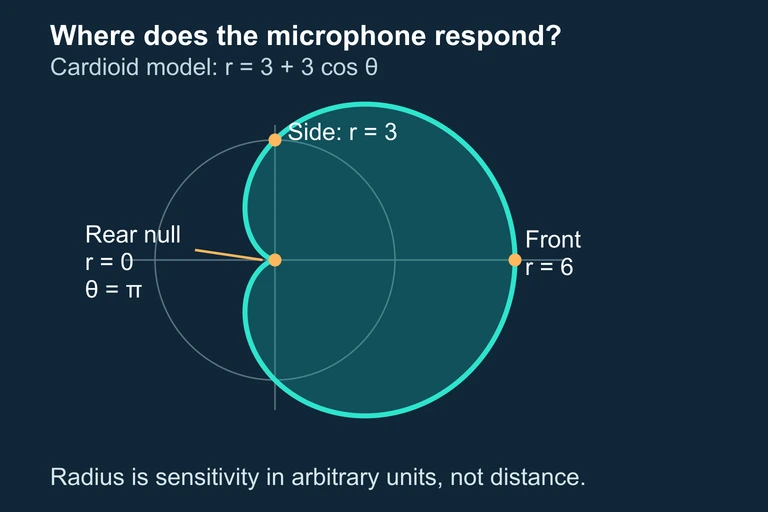
A microphone has a polar sensitivity pattern modeled by r = 3 + 3 cos θ, where r represents the pickup sensitivity (in arbitrary units) at angle θ from the front of the microphone. (a) Identify the type of polar curve and justify your answer. (b) Determine the maximum sensitivity and the angle at which it occurs. (c) Find all angles θ in [0, 2π) where the sensitivity is zero. Explain what this means physically. (d) A sound source is located at angle θ = 2π/3 from the front of the microphone. Calculate the sensitivity at this angle and express it as a fraction of the maximum sensitivity.
Show answer and explanation
Point-by-point rubric: (a) [1 point] The equation r = 3 + 3 cos θ has the form r = a + a cos θ with a = 3. Since a/b = 3/3 = 1, this is a cardioid. The equal coefficients confirm that the curve is a cardioid rather than a general limaçon. (b) [1 point] Maximum sensitivity occurs when cos θ = 1, i.e., θ = 0. At θ = 0, r = 3 + 3(1) = 6. The maximum sensitivity is 6 units, occurring directly in front of the microphone. (c) [1 point] Set r = 0: 3 + 3 cos θ = 0 → cos θ = −1 → θ = π. The sensitivity is zero at θ = π, which corresponds to directly behind the microphone. Physically, the microphone rejects all sound arriving from the rear, which is the defining characteristic of a cardioid pickup pattern. (d) [1 point] At θ = 2π/3: r = 3 + 3 cos(2π/3) = 3 + 3(−1/2) = 3 − 3/2 = 3/2. As a fraction of maximum: (3/2)/6 = 1/4. The microphone picks up only one-quarter of its maximum sensitivity at this off-axis angle.
Question 1 of 5
How many petals does the rose curve \( r = 5\cos(4\theta) \) have?
Question 2 of 5
Which polar equation produces a cardioid?
Question 3 of 5
For the curve \( r = 1 + 2\cos\theta \), what happens at the values of \( \theta \) where \( r = 0 \)?
Question 4 of 5
If \( r = 4 - 2\sin\theta \), on what interval is \( r \) increasing?
Question 5 of 5
The polar curve \( r = 3\cos\theta \) is symmetric about which of the following?