Periodic
Phenomena
Master the mathematics of repeating patterns using sinusoidal functions: amplitude, period, midline, and phase shift.
What Is a Periodic Function?
A function \( f \) is periodic if there exists a positive constant \( p \) such that \( f(x + p) = f(x) \) for all \( x \) in its domain. The smallest such \( p \) is called the period.
Periodic Phenomena in the Real World
Key Vocabulary for Sinusoidal Models
The General Sinusoidal Model
Anatomy of \( \sin x \) Visualized
\( \sin x \) vs \( \cos x \)
| \( \sin x \) | \( \cos x \) | |
|---|---|---|
| Value at \( x = 0 \) | 0 | 1 |
| First maximum | \( x = \frac{\pi}{2} \) | \( x = 0 \) |
| Relationship | \( \cos x = \sin\!\left(x + \frac{\pi}{2}\right) \) | |
| Period | \( 2\pi \) | \( 2\pi \) |
How to Build a Sinusoidal Model
The harbor makes half a tide cycle visible
 Tide height ranges from 2.8 to 11.2 ft, giving midline 7 ft and amplitude 4.2 ft. The 6.25-hour high-to-low interval is half the 12.5-hour period.
High to low is only half a period
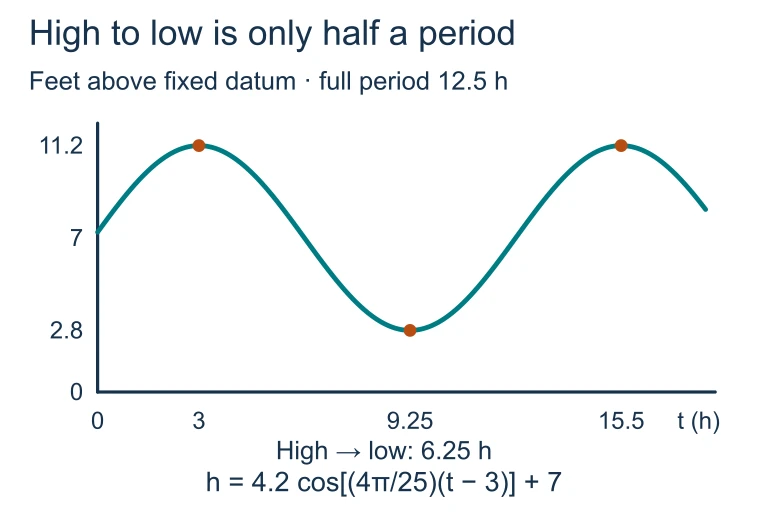 Tide height ranges from 2.8 to 11.2 ft, giving midline 7 ft and amplitude 4.2 ft. The 6.25-hour high-to-low interval is half the 12.5-hour period.
Example 1: Ferris Wheel
A Ferris wheel has a radius of 20 m and its center is 25 m above the ground. It completes one revolution every 40 seconds. A rider starts at the lowest point. Model the rider's height \( h(t) \).
Ferris Wheel: Graph
Example 2: Daylight Hours
A city has 15 hours of daylight on the summer solstice (day 172) and 9 hours on the winter solstice (day 355). Model daylight \( L(d) \) as a function of day \( d \).
Example 3: Reading a Graph
From the graph: max = 7, min = 1, one cycle from \( x = 0 \) to \( x = 6 \). The function starts at its maximum.
Common Mistakes to Avoid
Parameter Summary Table
| Parameter | Symbol | How to Find | Effect |
|---|---|---|---|
| Amplitude | \( |A| \) | \( \frac{\text{max} - \text{min}}{2} \) | Vertical stretch |
| Period | \( T \) | \( \frac{2\pi}{|B|} \) | Horizontal stretch |
| Phase Shift | \( C \) | Locate cycle start | Horizontal translation |
| Midline | \( D \) | \( \frac{\text{max} + \text{min}}{2} \) | Vertical translation |
Rate of Change in Periodic Functions
The average rate of change of a periodic function over one full period is always zero because it returns to its starting value. The instantaneous rate of change varies: it is greatest at the midline crossings and zero at the peaks and troughs.
Question 1 of 5
A sinusoidal function has a maximum of 10 and a minimum of 2. What are the amplitude and midline?
Question 2 of 5
What is the period of the function \( f(x) = 5\sin(3x) + 1 \)?
Question 3 of 5
A Ferris wheel completes one revolution every 60 seconds. Its center is 30 m above the ground and its radius is 25 m. If a rider starts at the bottom, which function models their height?
Question 4 of 5
Which transformation converts \( y = \sin x \) into \( y = \sin(x - \frac{\pi}{4}) + 3 \)?
Question 5 of 5
At what points on a sinusoidal curve does the rate of change equal zero?