Parametrically Defined
Circles and Lines
Master the art of describing circles and lines using parametric equations with \(\cos t\), \(\sin t\), and linear functions of \(t\).
What Are Parametric Equations?
Instead of expressing \(y\) directly as a function of \(x\), we introduce an independent parameter \(t\) and write both coordinates as separate functions:
The parameter \(t\) often represents time, an angle, or simply a convenient variable that controls how we move along the curve.
Why Use Parametric Form?
The Parametric Circle
Circles with Shifted Centers
When the center is at \((h, k)\) instead of the origin, simply translate:
The Parametric Line
Line in General Parametric Form
Circle vs. Line: Key Distinction
| Parametric Circle | Parametric Line | |
|---|---|---|
| Form of \(x(t)\) | \(h + r\cos t\) | \(a + bt\) |
| Form of \(y(t)\) | \(k + r\sin t\) | \(c + dt\) |
| Key functions | \(\cos t, \sin t\) | Linear in \(t\) |
| Path shape | Closed loop | Extends infinitely |
| Period | \(2\pi\) | None (not periodic) |
Eliminating the Parameter: Circle
Eliminating the Parameter: Line
How to Apply: Step by Step
Example 1: Identifying a Circle
Example 1: Visualized
Example 2: Parametric Line
Example 3: Semicircle Restriction
Common Mistakes to Avoid
Summary Reference
| Property | Circle | Line |
|---|---|---|
| Parametric form | \(x = h + r\cos t\), \(y = k + r\sin t\) | \(x = a + bt\), \(y = c + dt\) |
| Cartesian form | \((x-h)^2 + (y-k)^2 = r^2\) | \(y = \frac{d}{b}(x-a) + c\) |
| Key identity | \(\cos^2 t + \sin^2 t = 1\) | Solve for \(t\), substitute |
| Direction | CCW (standard), CW if sign flipped | Along \(\langle b, d \rangle\) |
| Full trace needs | \(0 \leq t < 2\pi\) | \(t \in (-\infty, \infty)\) |
Worked practice: Practice Problems — circular drone surveillance
Work through this original lesson problem, then reveal the solution and illustrations.
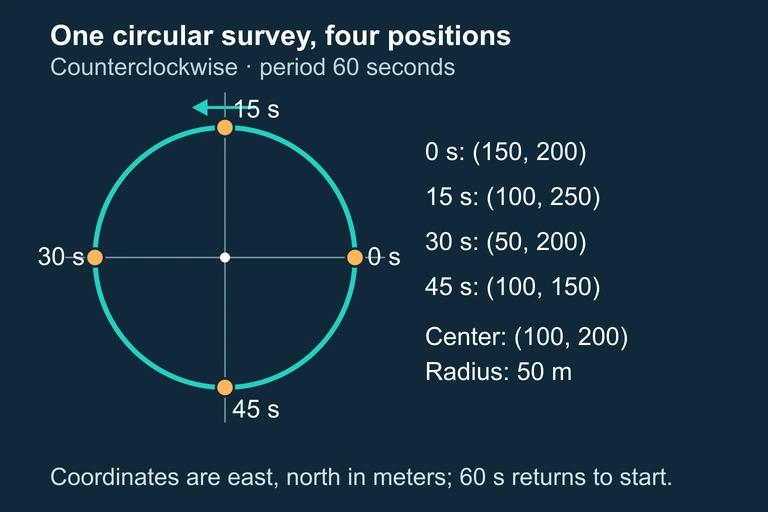
A drone is programmed to fly in a circular surveillance pattern centered at the point (100, 200) (measured in meters from a base station), with a radius of 50 meters, completing one full counterclockwise loop every 60 seconds. (a) Write parametric equations x(t) and y(t) for the drone's position, where t is measured in seconds, and the drone starts at position (150, 200) when t = 0. (b) Find the drone's position at t = 15 seconds. (c) At what time(s) during the first loop does the drone have a y-coordinate of 225? (d) Write the Cartesian equation of the drone's path and state any information lost in the conversion.
Show answer and explanation
(a) [1 point] Since the drone completes one full loop in 60 seconds, the angular parameter is (2π/60)t = πt/30. With center (100, 200), radius 50, and starting point (150, 200): x(t) = 100 + 50 cos(πt/30), y(t) = 200 + 50 sin(πt/30), for t ∈ [0, 60). (b) [1 point] At t = 15: x(15) = 100 + 50 cos(π·15/30) = 100 + 50 cos(π/2) = 100 + 50(0) = 100. y(15) = 200 + 50 sin(π/2) = 200 + 50(1) = 250. The drone is at (100, 250). (c) [1 point] Set y(t) = 225: 200 + 50 sin(πt/30) = 225 → sin(πt/30) = 1/2 → πt/30 = π/6 or 5π/6. Solving: t = 5 seconds or t = 25 seconds. (d) [1 point] Eliminating t using cos²(πt/30) + sin²(πt/30) = 1 gives (x − 100)² + (y − 200)² = 2500. The information lost includes: the starting position (150, 200), the counterclockwise direction of travel, the period of 60 seconds (speed), and the time at which the drone occupies any given point on the circle.
Question 1 of 5
What curve is described by \(x = 2\cos t\), \(y = 2\sin t\), \(0 \leq t < 2\pi\)?
Question 2 of 5
Given \(x = 5 + 2t\) and \(y = -1 + 4t\), what is the slope of the line?
Question 3 of 5
What is the center and radius of the circle given by \(x = -1 + 7\cos t\), \(y = 3 + 7\sin t\)?
Question 4 of 5
If \(x = 6\cos t\) and \(y = 6\sin t\), with \(0 \leq t \leq \dfrac{\pi}{2}\), what portion of the circle is traced?
Question 5 of 5
Which parametric equations describe a line passing through \((2, -3)\) with direction vector \(\langle 4, 1 \rangle\)?