Parametric Functions
Modeling Planar Motion
Learn how pairs of functions describe an object's position in two dimensions as time evolves, and master the connection between parametric equations and the curves they trace.
What Are Parametric Functions?
In standard Cartesian form, we write \( y = f(x) \). But many real-world motions: a ball in flight, a car on a track, a planet in orbit: cannot be described by a single function of \( x \). Instead, we introduce a parameter \( t \) (usually time) and define both coordinates independently.
Why Use a Parameter?
Visualizing Planar Motion
The Formal Definition
Particle Position from Component Functions
The individual graphs of \( x(t) \) and \( y(t) \) combine to produce the parametric curve below. Each value of \( t \) gives one point on the curve.
Equal-time flashes reveal independent projectile components
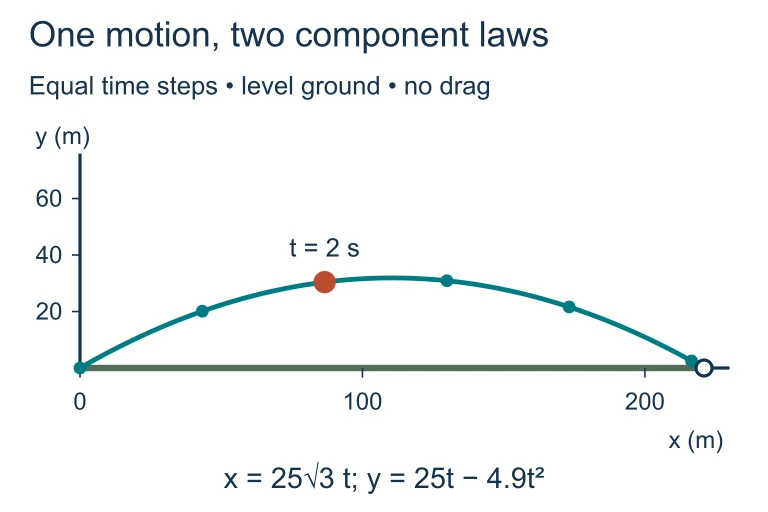 A ball launched at 50 m/s at 30° has constant horizontal velocity and downward acceleration of 9.8 m/s². Equal-time points show equal horizontal steps and changing vertical steps.
Parametric vs. Cartesian
| Parametric | Cartesian | |
|---|---|---|
| Form | \( x = f(t),\; y = g(t) \) | \( y = h(x) \) |
| Independent variable | \( t \) (parameter) | \( x \) |
| Direction info | Yes: encoded in increasing \( t \) | No |
| Circles / loops | Naturally handled | Requires splitting |
| Speed info | Yes: rate of change of \( t \) | No |
Eliminating the Parameter
To find the Cartesian equation of the curve, solve one parametric equation for \( t \) and substitute into the other. This removes \( t \) but may lose direction and timing information.
How to Analyze Parametric Motion
Example 1: Linear Motion
Example 2: Circular Motion
Example 3: Projectile Motion
Direction and Orientation
Two different parameterizations can trace the same curve but in opposite directions. The orientation is determined by the direction of increasing \( t \).
Traces the unit circle counterclockwise.
Same circle, but clockwise.
Two carriage motions produce one pen path
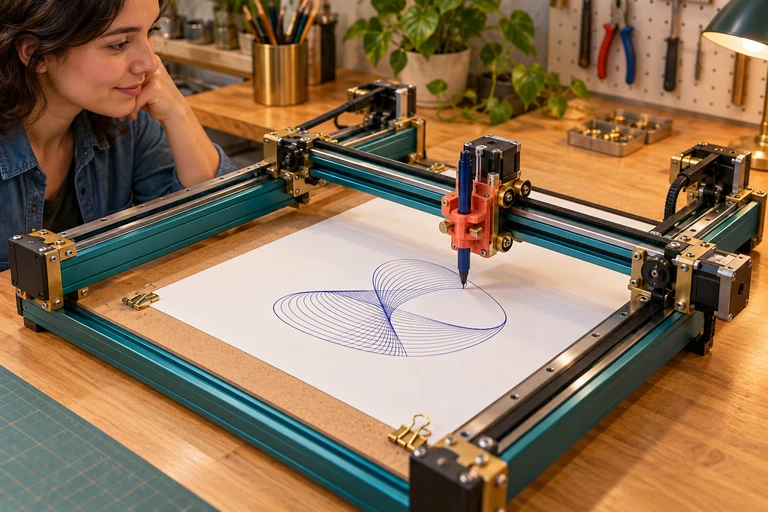 One shared parameter synchronizes horizontal and vertical position. For x = 1 + 3 cos t and y = −4 + 2 sin t, increasing t traces the ellipse counterclockwise.
Two carriage motions produce one pen path
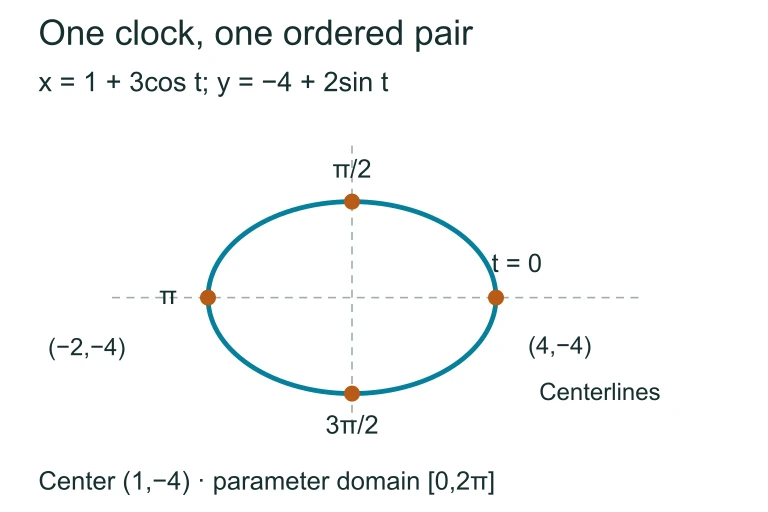 One shared parameter synchronizes horizontal and vertical position. For x = 1 + 3 cos t and y = −4 + 2 sin t, increasing t traces the ellipse counterclockwise.
Domain Restrictions Matter
When eliminating the parameter, the domain of \( t \) restricts which portion of the Cartesian curve is actually traced. Forgetting this produces an incorrect graph.
gives the entire parabola \( x = y^2 \).
gives only the top branch with \( 0 \leq y \leq 3 \).
Common Mistakes
Summary of Key Concepts
| Concept | What It Means | Watch Out For |
|---|---|---|
| Parameter \( t \) | Independent variable driving both \( x \) and \( y \) | Not the same as \( x \) |
| Orientation | Direction the curve is traced as \( t \) increases | Lost when eliminating \( t \) |
| Elimination | Solving for \( t \) and substituting to get \( y = h(x) \) | Must restrict domain |
| Trig identity | Use \( \cos^2 t + \sin^2 t = 1 \) for circles/ellipses | Check radius and center shifts |
| Component graphs | Separate graphs of \( x(t) \) and \( y(t) \) vs. \( t \) | These are NOT the parametric curve |
Question 1 of 5
A particle moves according to \( x(t) = 2t + 1 \) and \( y(t) = t^2 - 4 \). What is the Cartesian equation of the path?
Question 2 of 5
The parametric equations \( x = 5\cos t \), \( y = 5\sin t \) for \( 0 \leq t \leq 2\pi \) describe which curve?
Question 3 of 5
For the parametric curve \( x = t^2 \), \( y = t^3 \) with \( -1 \leq t \leq 2 \), what is the starting point when \( t = -1 \)?
Question 4 of 5
Which of the following is a key advantage of parametric equations over the Cartesian form \( y = f(x) \)?
Question 5 of 5
A particle follows \( x(t) = 4\cos t \), \( y(t) = 3\sin t \). After eliminating the parameter, which equation describes the path?