01 / 21

Parametric Functions
Rates of Change

Explore how parametric equations describe motion in the plane, and learn to compute rates of change using \(\frac{dy}{dx}\) from \(\frac{dy}{dt}\) and \(\frac{dx}{dt}\).

AP Precalculus

What Are Parametric Functions?

Instead of expressing \(y\) directly in terms of \(x\), parametric functions define both coordinates through a third variable called the parameter, usually \(t\):

\(x(t)\)
Horizontal position as a function of the parameter \(t\)
\(y(t)\)
Vertical position as a function of the parameter \(t\)
Parameter \(t\)
Often represents time, connecting both coordinates together

Tracing a Parametric Curve

Consider \(x(t) = \cos(t)\) and \(y(t) = \sin(t)\) for \(t \in [0, 2\pi]\). As \(t\) increases, the point traces a unit circle.

x y 1 -1 1 -1 \(t=0\) \(t=\tfrac{\pi}{2}\) \(t=\pi\)

Why Use Parametric Equations?

Many real-world curves cannot be expressed as a single function \(y = f(x)\). Parametric equations let us describe:

Loops and Spirals
Curves that double back on themselves or cross their own path
Projectile Motion
Horizontal and vertical positions as separate functions of time
Direction and Speed
Not just where a particle is, but how fast and which way it moves

The Chain Rule Connection

To find how \(y\) changes with respect to \(x\) along a parametric curve, we use the chain rule. Since both \(x\) and \(y\) depend on \(t\):

1
Differentiate \(y(t)\) with respect to \(t\) to get \(\frac{dy}{dt}\)
2
Differentiate \(x(t)\) with respect to \(t\) to get \(\frac{dx}{dt}\)
3
Divide: \(\frac{dy}{dx} = \frac{dy/dt}{dx/dt}\)

Geometric Meaning of \(\frac{dy}{dx}\)

x y tangent slope = \(\frac{dy}{dx}\) \(\frac{dx}{dt}\) \(\frac{dy}{dt}\)

Average vs. Instantaneous Rate

Average Rate of Change
$$\frac{\Delta y}{\Delta x} = \frac{y(t_2) - y(t_1)}{x(t_2) - x(t_1)}$$ Slope of the secant line between two points on the curve
Instantaneous Rate of Change
$$\frac{dy}{dx} = \frac{dy/dt}{dx/dt}$$ Slope of the tangent line at a single point: the limit as the two points merge

Two carriage motions produce one pen path
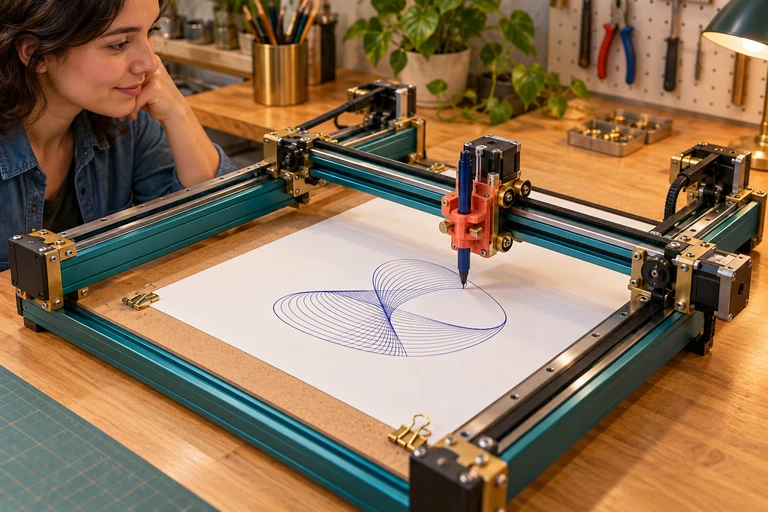
A tabletop XY plotter uses supported rails,a transverse gantry and one pen carriage while an operator watches.On t ∈ [1,4], x = 3t − 1 and y = t² + 2 have average rates 3 and 5. Their ratio gives a y-versus-x secant slope of 5/3.

Parametric rates source preset
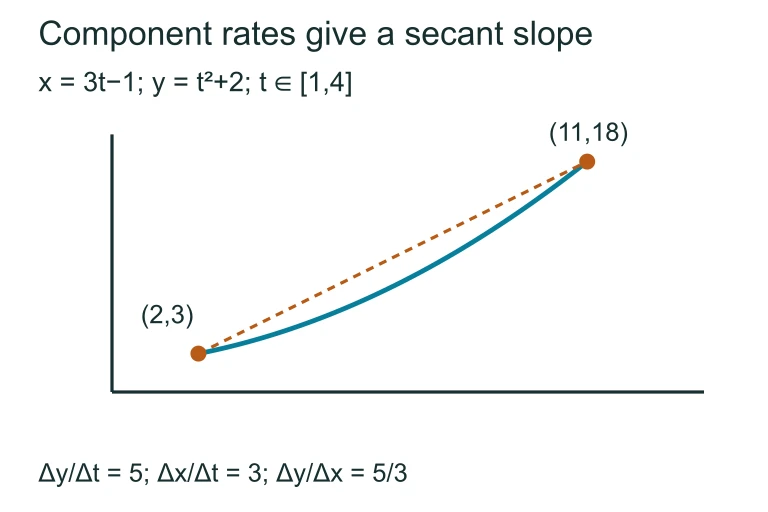
On t ∈ [1,4], x = 3t − 1 and y = t² + 2 have average rates 3 and 5. Their ratio gives a y-versus-x secant slope of 5/3.On t ∈ [1,4], x = 3t − 1 and y = t² + 2 have average rates 3 and 5. Their ratio gives a y-versus-x secant slope of 5/3.

When \(\frac{dy}{dx}\) Is Zero or Undefined

Horizontal Tangent
When \(\frac{dy}{dt} = 0\) but \(\frac{dx}{dt} \neq 0\), the slope is zero: the curve is flat at that point.
Vertical Tangent
When \(\frac{dx}{dt} = 0\) but \(\frac{dy}{dt} \neq 0\), the slope is undefined: the tangent line is vertical.

How to Find \(\frac{dy}{dx}\): Step by Step

1
Identify the parametric equations \(x(t)\) and \(y(t)\) and the domain of \(t\).
2
Differentiate each with respect to \(t\): compute \(\frac{dx}{dt}\) and \(\frac{dy}{dt}\).
3
Form the ratio: \(\frac{dy}{dx} = \frac{dy/dt}{dx/dt}\).
4
Simplify and substitute the specific \(t\)-value if evaluating at a point.
5
Interpret: the result is the slope of the tangent line at that position on the curve.

Example 1: Linear Motion

Given \(x(t) = 2t + 1\) and \(y(t) = 3t - 4\), find \(\frac{dy}{dx}\).

1
\(\frac{dx}{dt} = 2\)
2
\(\frac{dy}{dt} = 3\)
3
\(\frac{dy}{dx} = \frac{3}{2}\)

Example 2: Unit Circle

Given \(x(t) = \cos t\) and \(y(t) = \sin t\), find \(\frac{dy}{dx}\) at \(t = \frac{\pi}{4}\).

1
\(\frac{dx}{dt} = -\sin t\), \(\frac{dy}{dt} = \cos t\)
2
\(\frac{dy}{dx} = \frac{\cos t}{-\sin t} = -\cot t\)
3
At \(t = \frac{\pi}{4}\): \(\frac{dy}{dx} = -\cot\!\left(\frac{\pi}{4}\right) = -1\)

Example 3: Polynomial Path

A particle moves along \(x(t) = t^2\), \(y(t) = t^3 - 3t\). Find \(\frac{dy}{dx}\) at \(t = 2\).

1
\(\frac{dx}{dt} = 2t\), so at \(t = 2\): \(\frac{dx}{dt} = 4\)
2
\(\frac{dy}{dt} = 3t^2 - 3\), so at \(t = 2\): \(\frac{dy}{dt} = 9\)
3
\(\frac{dy}{dx} = \frac{9}{4}\)

Example 4: Average Rate of Change

Using the same curve \(x(t) = t^2\), \(y(t) = t^3 - 3t\), find the average rate of change of \(y\) with respect to \(x\) from \(t = 1\) to \(t = 2\).

1
At \(t = 1\): \(x = 1\), \(y = 1 - 3 = -2\). Point: \((1, -2)\)
2
At \(t = 2\): \(x = 4\), \(y = 8 - 6 = 2\). Point: \((4, 2)\)
3
Average rate: \(\frac{\Delta y}{\Delta x} = \frac{2 - (-2)}{4 - 1} = \frac{4}{3}\)

Finding Horizontal and Vertical Tangents

For \(x(t) = t^2\), \(y(t) = t^3 - 3t\), find where tangent lines are horizontal or vertical.

x y horizontal (\(t=1\)) horizontal (\(t=-1\)) vertical (\(t=0\))

Common Mistakes to Avoid

✕ Inverting the Fraction
Writing \(\frac{dx/dt}{dy/dt}\) instead of \(\frac{dy/dt}{dx/dt}\). Remember: \(dy\) goes on top.
✕ Differentiating \(y\) with respect to \(x\)
Taking \(\frac{d}{dx}[y(t)]\) directly. You must differentiate each function with respect to \(t\) first.
✕ Forgetting the Domain
Not checking if \(\frac{dx}{dt} = 0\) at the target \(t\)-value, which makes \(\frac{dy}{dx}\) undefined.

Summary of Key Formulas

Concept Formula Condition
Instantaneous slope \(\frac{dy}{dx} = \frac{dy/dt}{dx/dt}\) \(\frac{dx}{dt} \neq 0\)
Average rate of change \(\frac{y(t_2) - y(t_1)}{x(t_2) - x(t_1)}\) \(x(t_2) \neq x(t_1)\)
Horizontal tangent \(\frac{dy}{dt} = 0\) \(\frac{dx}{dt} \neq 0\)
Vertical tangent \(\frac{dx}{dt} = 0\) \(\frac{dy}{dt} \neq 0\)

Question 1 of 5

Given \(x(t) = 3t\) and \(y(t) = t^2 + 1\), what is \(\frac{dy}{dx}\)?

Question 2 of 5

For the parametric curve \(x(t) = \sin t\), \(y(t) = \cos t\), what is \(\frac{dy}{dx}\) at \(t = \frac{\pi}{6}\)?

Question 3 of 5

A particle moves along \(x(t) = t^2 - 4\), \(y(t) = 2t^3 + t\). At which value of \(t\) does the curve have a vertical tangent?

Question 4 of 5

For \(x(t) = e^t\), \(y(t) = e^{2t}\), what is the average rate of change of \(y\) with respect to \(x\) from \(t = 0\) to \(t = 1\)?

Question 5 of 5

If \(x(t) = t^2 + 1\) and \(y(t) = 4t - t^2\), at what value of \(t\) is the tangent to the curve horizontal?