Parametric
Functions
Explore how two equations working together can trace curves that ordinary functions cannot: from circles to projectiles and beyond.
What Are Parametric Functions?
In a standard function, you write \( y = f(x) \). But sometimes a single equation cannot describe the motion or shape you need. Parametric functions introduce a third variable, typically \( t \), called the parameter.
The parameter \( t \) often represents time, but it can be any independent quantity that drives both \( x \) and \( y \) simultaneously.
Why Use Parametric Equations?
Visualizing the Parameter \( t \)
As \( t \) increases along the number line, the point \( (x, y) \) traces a path in the plane. Here, \( x = \cos t,\; y = \sin t \) traces a unit circle counterclockwise.
Formal Definition
Eliminating the Parameter
To convert a parametric curve to a rectangular equation \( y = h(x) \), solve one equation for \( t \) and substitute into the other. This is called eliminating the parameter.
Parametric vs Rectangular
| Parametric | Rectangular | |
|---|---|---|
| Form | \( x = f(t),\; y = g(t) \) | \( y = h(x) \) |
| Direction | Built-in orientation | No direction info |
| Vertical line test | Can fail (loops, circles) | Must pass |
| Motion modeling | Natural: \( t \) = time | Requires extra work |
| Complexity | Two equations needed | Single equation |
How to Sketch a Parametric Curve
Example 1: Linear Parametric Curve
Example 2: Circular Parametric Curve
Example 3: Parabolic Path
Orientation and Direction
Two different parametrizations can trace the same curve but in opposite directions. The orientation is the direction the point travels as \( t \) increases.
Domain Restrictions Matter
Eliminating the parameter can lose information. The original interval for \( t \) restricts which part of the rectangular curve is actually traced.
\( 0 \leq t \leq 2\pi \)
Traces the complete circle.
\( 0 \leq t \leq \pi \)
Only the top semicircle: \( y \geq 0 \).
\( 0 \leq t \leq \pi/2 \)
Only the first-quadrant arc.
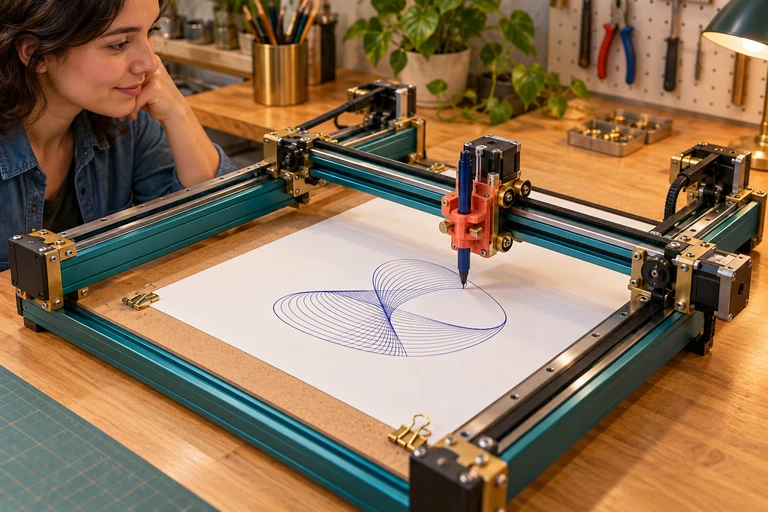
Two carriage motions produce one pen path
 Eliminating t from x = 3t − 2 and y = t² − 4t + 1 gives y = (x² − 8x − 11)/9. The original interval t ∈ [0,5] restricts x to [−2,13].
Restricted parametric path
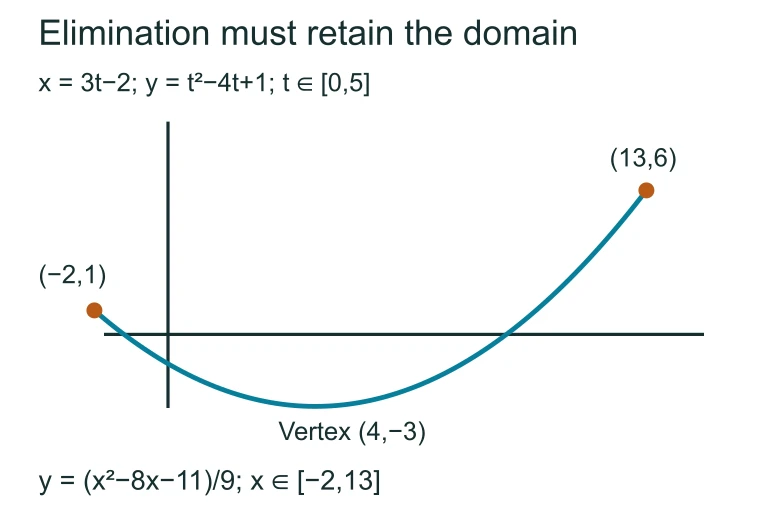 Eliminating t from x = 3t − 2 and y = t² − 4t + 1 gives y = (x² − 8x − 11)/9. The original interval t ∈ [0,5] restricts x to [−2,13].
Application: Projectile Motion
A ball launched at angle \( \theta \) with initial speed \( v_0 \) follows:
Common Mistakes
Parametric Curves: Summary
| Curve Type | Parametric Form | Rectangular Form |
|---|---|---|
| Line | \( x = at + b,\; y = ct + d \) | \( y = \frac{c}{a}(x - b) + d \) |
| Circle (radius \( r \)) | \( x = r\cos t,\; y = r\sin t \) | \( x^2 + y^2 = r^2 \) |
| Ellipse | \( x = a\cos t,\; y = b\sin t \) | \( \frac{x^2}{a^2} + \frac{y^2}{b^2} = 1 \) |
| Parabola (horiz.) | \( x = t^2,\; y = 2t \) | \( x = \frac{y^2}{4} \) |
Question 1 of 5
What is the rectangular equation for the parametric curve \( x = 5\cos t \), \( y = 5\sin t \)?
Question 2 of 5
For the parametric equations \( x = t + 1 \), \( y = t^2 \), what is \( y \) in terms of \( x \)?
Question 3 of 5
The parametric curve \( x = 2\cos t \), \( y = 3\sin t \) traces which shape?
Question 4 of 5
If \( x = \cos t \), \( y = -\sin t \), \( 0 \leq t \leq 2\pi \), the unit circle is traced in which direction?
Question 5 of 5
For \( x = 3\cos t \), \( y = 3\sin t \), with \( 0 \leq t \leq \pi \), what portion of the circle \( x^2 + y^2 = 9 \) is traced?