Matrices Modeling
Real-World Contexts
Learn how to organize data, represent relationships, and solve problems using matrix operations in applied settings.
What Is a Matrix?
A matrix is a rectangular array of numbers arranged in rows and columns. We describe its size as \( m \times n \), where \( m \) is the number of rows and \( n \) is the number of columns.
Why Use Matrices to Model?
Real-world data often has multiple categories measured across multiple subjects. Matrices let us organize, transform, and compute with this data efficiently.
Key Vocabulary
Core Matrix Operations
The Dimension Rule for Multiplication
Addition vs Multiplication
| Addition \( A + B \) | Multiplication \( AB \) | |
|---|---|---|
| Dimension Rule | Same dimensions | Inner dims match |
| Operation | Entry-by-entry | Row-by-column dot product |
| Commutative? | Yes: \( A+B = B+A \) | No: \( AB \neq BA \) generally |
| Result Size | Same as inputs | \( m \times p \) |
How to Model with Matrices
Example 1: Scalar Multiplication
A bakery tracks daily sales of muffins and cookies at two locations. Matrix \( S \) shows Monday's sales. If Tuesday's sales are twice Monday's, find Tuesday's matrix.
Example 2: Matrix Addition
A store tracks morning and afternoon sales separately. Add the matrices to find total daily sales.
Example 3: Matrix Multiplication
A cafe sells 3 items. Matrix \( Q \) gives quantities sold at 2 locations. Matrix \( P \) gives the price per item. Find total revenue per location with \( QP \).
Inside the Dot Product
Each entry of the product \( AB \) is computed by pairing a row of \( A \) with a column of \( B \), multiplying corresponding entries, and summing.
A bakery counter turns a dot product into a bill
 Align the product categories in each inventory row with the same categories in the price column. Their dot product gives the value of that location’s inventory.
Align reordered prices by category
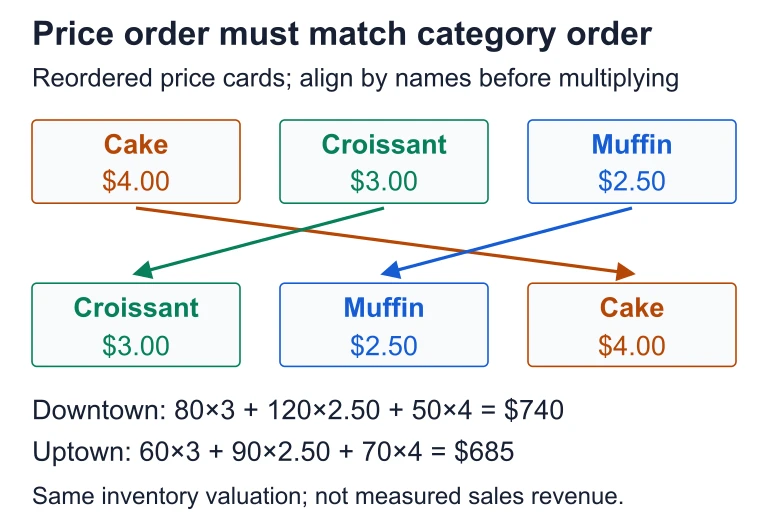 Align the product categories in each inventory row with the same categories in the price column. Their dot product gives the value of that location’s inventory.
Turn aligned quantities into inventory value
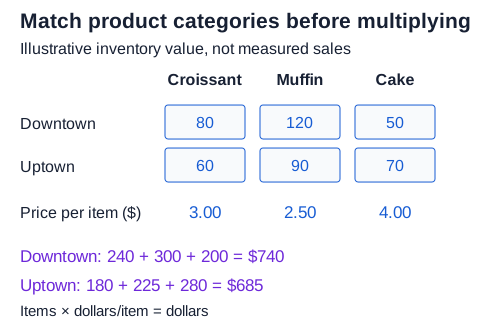 For croissants, muffins and cakes priced at $3, $2.50 and $4, the inventory rows (80, 120, 50) and (60, 90, 70) give values $740 and $685. Each row’s quantities pair with the same product order in the price column.Open full diagram
Interpreting Every Entry
In a modeling context, every row, column, and entry has real-world meaning. The AP exam often asks you to interpret a specific entry.
Example 4: Nutrition Tracking
Matrix \( F \) gives servings of 3 foods eaten by 2 people. Matrix \( N \) gives calories and protein per serving. Compute \( FN \) for totals.
Common Mistakes
Summary of Matrix Operations
| Operation | Rule | Context Use |
|---|---|---|
| Scalar \( kA \) | Multiply each entry by \( k \) | Scaling (doubling sales, adjusting rates) |
| \( A + B \) | Same dimensions required | Combining totals (morning + afternoon) |
| \( A - B \) | Same dimensions required | Finding differences (change over time) |
| \( AB \) | Inner dims match: \( n \) | Aggregating (\( \text{quantities} \times \text{prices} = \text{revenue} \)) |
Question 1 of 5
Matrix \( A \) is \( 3 \times 4 \) and matrix \( B \) is \( 4 \times 2 \). What are the dimensions of \( AB \)?
Question 2 of 5
A store tracks sales of hats and scarves at 2 locations in matrix \( S \). If all prices increase by 10%, which operation gives the new price matrix?
Question 3 of 5
Matrix \( Q \) (\( 2 \times 3 \)) gives quantities of 3 items at 2 stores. Matrix \( P \) (\( 3 \times 1 \)) gives prices. What does entry \( (QP)_{2,1} \) represent?
Question 4 of 5
If \( A = \begin{bmatrix} 2 & 5 \\ 1 & 3 \end{bmatrix} \) and \( B = \begin{bmatrix} 4 & 0 \\ 2 & 6 \end{bmatrix} \), what is \( A + B \)?
Question 5 of 5
Which of the following products is undefined?