Worked practice: Practice Problems — sound intensity level
Work through this original lesson problem, then reveal the solution and illustrations.
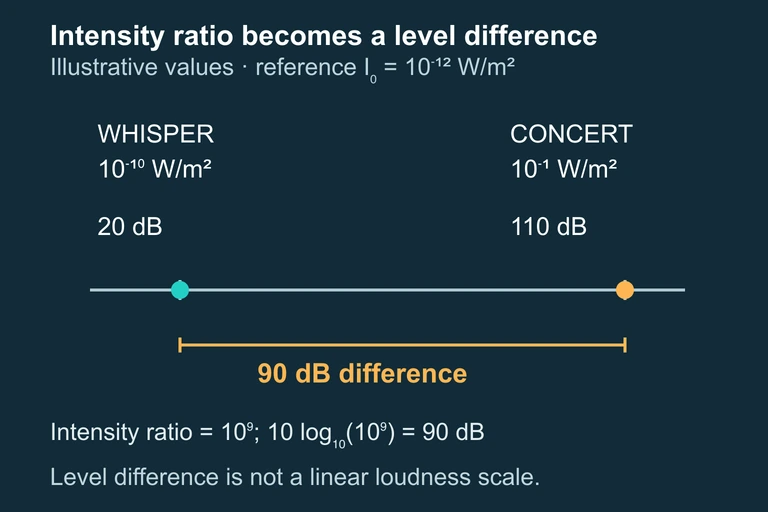
The sound intensity level β (in decibels) is given by β = 10 log(I / I₀), where I is the intensity of the sound and I₀ = 10⁻¹² W/m² is the reference intensity. (a) A rock concert has an intensity I₁ = 10⁻¹ W/m². Calculate the decibel level β₁. (b) A whisper has an intensity I₂ = 10⁻¹⁰ W/m². Calculate the decibel level β₂. (c) Using logarithmic properties, express the difference β₁ − β₂ as a single logarithmic expression and evaluate it. (d) Explain what the result from part (c) tells you about how logarithmic scales compress the range of physical measurements.
Show answer and explanation
Rubric (4 points): Point 1 — Part (a): β₁ = 10 log(10⁻¹ / 10⁻¹²) = 10 log(10¹¹) = 10 × 11 = 110 dB. Point 2 — Part (b): β₂ = 10 log(10⁻¹⁰ / 10⁻¹²) = 10 log(10²) = 10 × 2 = 20 dB. Point 3 — Part (c): β₁ − β₂ = 10 log(I₁/I₀) − 10 log(I₂/I₀) = 10[log(I₁/I₀) − log(I₂/I₀)] = 10 log[(I₁/I₀) / (I₂/I₀)] = 10 log(I₁/I₂) by the quotient rule. Evaluating: 10 log(10⁻¹ / 10⁻¹⁰) = 10 log(10⁹) = 10 × 9 = 90 dB. Point 4 — Part (d): The rock concert is 10⁹ (one billion) times more intense than the whisper in raw physical units, yet the decibel difference is only 90 dB. The logarithmic scale compresses this factor-of-a-billion range into a manageable two-digit number. This illustrates why logarithmic expressions are essential for modeling quantities that span many orders of magnitude: they convert multiplicative ratios into additive differences, making comparison and communication practical.