01 / 22

Linear & Quadratic
Rates of Change

Understand how average rate of change behaves differently for linear and quadratic functions, and why it matters for AP Precalculus.

AP Precalculus

What is Rate of Change?

The rate of change describes how one quantity changes relative to another. In a function \( f(x) \), it tells us how much the output \( f(x) \) changes for each unit change in the input \( x \).

Visualizing the Secant Line

x y A B (a, f(a)) (b, f(b)) Secant Line slope = AROC f(x)

Why Rates of Change Matter

Real-World Modeling
Speed, cost per unit, and growth rates are all rates of change: they describe how fast something is happening.
Foundation for Calculus
Average rate of change is the precursor to the derivative: the instantaneous rate of change at a single point.
AP Exam Focus
Comparing rates of change across function types is a core AP Precalculus skill tested in both MCQ and FRQ formats.

Linear Rate of Change

For a linear function \( f(x) = mx + b \), the average rate of change over any interval is always the same: it equals the slope \( m \).

x y run = 1 rise = 2

Quadratic Rate of Change

For a quadratic function \( f(x) = ax^2 + bx + c \), the average rate of change depends on the interval. It is not constant: it changes as you move along the curve.

x y 1 2 3 4 5 AROC = 1 AROC = 5 AROC = 9
\( f(x) = x^2 \)

The Core Rule: AROC Formula

Linear: \( f(x) = mx + b \)
AROC \( = m \) always. The rate of change is constant regardless of the interval.
Quadratic: \( f(x) = ax^2 + bx + c \)
AROC on \([x_1, x_2]\) is \( a(x_1 + x_2) + b \). The rate of change varies by interval.

AROC of \( ax^2 + bx + c \) on \([x_1, x_2]\)

1
Compute outputs: \( f(x_1) = ax_1^2 + bx_1 + c \) and \( f(x_2) = ax_2^2 + bx_2 + c \).
2
Subtract: \( f(x_2) - f(x_1) = a(x_2^2 - x_1^2) + b(x_2 - x_1) \).
3
Factor: \( = (x_2 - x_1)\bigl[a(x_2 + x_1) + b\bigr] \).
4
Divide: \( \displaystyle\frac{f(x_2) - f(x_1)}{x_2 - x_1} = a(x_1 + x_2) + b \).

Constant vs. Changing Rates

Linear \( f(x) = mx + b \) Quadratic \( f(x) = ax^2 + bx + c \)
AROC on any interval \( m \) (constant) \( a(x_1 + x_2) + b \) (varies)
Graph shape Straight line Parabola (curved)
Second differences Always 0 Constant \( = 2a \)
Rate of the rate No change Changes at a constant rate

Understanding Second Differences

If we compute the AROC of a quadratic on equally spaced intervals, the differences between consecutive AROCs (called second differences) are constant.

x 0 1 2 3 4 5 f(x) 0 1 4 9 16 25 1st diff 1 3 5 7 9 2nd diff 2 2 2 2
\( \text{Second differences} = 2a = 2(1) = 2 \) ✓
For \( f(x) = x^2 \), the constant second difference confirms it is quadratic.

How to Compute AROC

1
Identify the interval \([a, b]\) and the function \( f(x) \).
2
Evaluate \( f(a) \) and \( f(b) \) by substituting into the function.
3
Subtract outputs: compute \( f(b) - f(a) \) (the change in \( y \)).
4
Subtract inputs: compute \( b - a \) (the change in \( x \)).
5
Divide: \( \displaystyle\frac{f(b) - f(a)}{b - a} \). This is your AROC.

Example 1: Linear Function

Find the average rate of change of \( f(x) = 3x - 5 \) on the interval \([2, 7]\).

1
Evaluate: \( f(2) = 3(2) - 5 = \) 1
2
Evaluate: \( f(7) = 3(7) - 5 = \) 16
3
AROC: \( \displaystyle\frac{16 - 1}{7 - 2} = \frac{15}{5} = \) 3

Example 2: Quadratic Function

Find the AROC of \( g(x) = 2x^2 - 3x + 1 \) on the interval \([1, 4]\).

1
Evaluate: \( g(1) = 2(1)^2 - 3(1) + 1 = 2 - 3 + 1 = \) 0
2
Evaluate: \( g(4) = 2(16) - 3(4) + 1 = 32 - 12 + 1 = \) 21
3
AROC: \( \displaystyle\frac{21 - 0}{4 - 1} = \frac{21}{3} = \) 7

Example 3: Comparing Intervals

For \( h(x) = x^2 + 2x \), compare the AROC on \([0, 2]\) versus \([3, 5]\).

Interval \([0, 2]\)
\( h(0) = 0 \), \( h(2) = 8 \)
AROC \( = \frac{8 - 0}{2 - 0} = \) 4
Interval \([3, 5]\)
\( h(3) = 15 \), \( h(5) = 35 \)
AROC \( = \frac{35 - 15}{5 - 3} = \) 10

AROC and Concavity

\( a > 0 \): Concave Up
AROC increases as intervals move right. The function accelerates: it rises faster and faster (or falls slower and slower).
\( a < 0 \): Concave Down
AROC decreases as intervals move right. The function decelerates: it rises slower and slower (or falls faster and faster).
\( a > 0 \)
AROC increases →
\( a < 0 \)
AROC decreases →

Common Mistakes to Avoid

✕ Swapping Numerator and Denominator
Writing \( \frac{b - a}{f(b) - f(a)} \) instead of \( \frac{f(b) - f(a)}{b - a} \). Remember: output change over input change.
✕ Mismatched Order
Computing \( \frac{f(b) - f(a)}{a - b} \). The order must match: if the numerator is \( f(b) - f(a) \), the denominator must be \( b - a \).
✕ Assuming Quadratics Have Constant AROC
Only linear functions have constant AROC. A quadratic's AROC changes with each interval: always check which interval is specified.

Summary: Linear vs. Quadratic

Property Linear Quadratic
General form \( mx + b \) \( ax^2 + bx + c \)
AROC formula \( m \) \( a(x_1 + x_2) + b \)
AROC behavior Constant Changes linearly
First differences Constant Linear (change)
Second differences Zero Constant \( = 2a \)
Graph Straight line Parabola

Worked practice: Practice Problems — ball launched vertically from rooftop

Work through this original lesson problem, then reveal the solution and illustrations.

A ball is launched vertically from a rooftop. Its height in meters above the ground at time t seconds is modeled by H(t) = −4.9t² + 19.6t + 25. (a) Find the average rate of change of H on the interval [0, 2]. Include units and interpret the result in context. (b) Find the average rate of change of H on the interval [2, 4]. Explain why this value differs from part (a). (c) Determine the time at which the ball reaches its maximum height. Use rates of change to justify your answer. (d) Compute the second differences for H using integer values t = 0, 1, 2, 3, 4 and verify that they are consistent with the leading coefficient a = −4.9.

Show answer and explanation

Rubric (4 points): Part (a) — 1 point: H(0) = 25, H(2) = −4.9(4) + 19.6(2) + 25 = −19.6 + 39.2 + 25 = 44.6. AROC = (44.6 − 25)/(2 − 0) = 19.6/2 = 9.8 m/s. Interpretation: Over the first 2 seconds, the ball rises at an average rate of 9.8 meters per second. Award 1 point for correct computation with units and interpretation. Part (b) — 1 point: H(4) = −4.9(16) + 19.6(4) + 25 = −78.4 + 78.4 + 25 = 25. AROC = (25 − 44.6)/(4 − 2) = −19.6/2 = −9.8 m/s. The AROC differs from part (a) because H is quadratic, not linear: its rate of change depends on the interval. The ball is now descending, so the AROC is negative. Award 1 point for correct computation and explanation that the quadratic's AROC varies with the interval. Part (c) — 1 point: The vertex occurs at t = −b/(2a) = −19.6/(2 × (−4.9)) = −19.6/(−9.8) = 2 seconds. Justification: at t = 2, the AROC over symmetric intervals [2 − h, 2 + h] is zero (by symmetry of the parabola), indicating that the ball momentarily stops rising before beginning to fall—the instantaneous rate of change is zero at the maximum. Award 1 point for correct vertex computation and rate-of-change justification. Part (d) — 1 point: H(0) = 25, H(1) = −4.9 + 19.6 + 25 = 39.7, H(2) = 44.6, H(3) = −4.9(9) + 19.6(3) + 25 = −44.1 + 58.8 + 25 = 39.7, H(4) = 25. First differences: 14.7, 4.9, −4.9, −14.7. Second differences: 4.9 − 14.7 = −9.8, −4.9 − 4.9 = −9.8, −14.7 − (−4.9) = −9.8. Verification: 2ah² = 2(−4.9)(1)² = −9.8. ✓ Award 1 point for correct computation and verification.
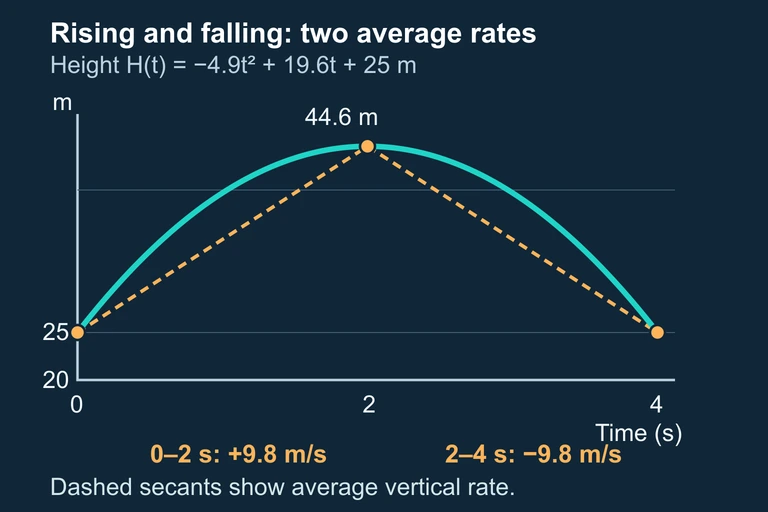
Height rises from 25 to 44.6 and returns to 25 at times 0,2,4 seconds. Secant slopes over the two intervals are 9.8 and −9.8 m/s.
The ball rises from 25 m to 44.6 m and returns to roof height; the two equal-duration average vertical rates have opposite signs. The pictured ball positions form a laterally arranged illustrative sequence, not a measured spatial trajectory; the authoritative plot describes vertical height over time.

Question 1 of 5

What is the average rate of change of \( f(x) = 4x - 7 \) on the interval \[2, 10]\]?

Question 2 of 5

What is the average rate of change of \( g(x) = x^2 + 3x \) on the interval \[1, 5]\]?

Question 3 of 5

For a quadratic function with \( a > 0 \), what happens to the AROC as you move to intervals with larger \( x \)-values (to the right of the vertex)?

Question 4 of 5

A table shows that a function has constant second differences equal to \( 6 \). Which type of function could this be?

Question 5 of 5

The AROC of \( f(x) = -2x^2 + 5x \) on \([1, 3]\) is \( -3 \). What is the AROC on \([2, 4]\)?