Inverse
Trigonometric Functions
Learn how to reverse trigonometric operations, find angles from ratios, and master the restricted domains that make inverses possible.
What Is an Inverse Function?
An inverse function reverses the input-output relationship of the original function. If \( f(a) = b \), then \( f^{-1}(b) = a \). The inverse "undoes" what the original function did.
However, trig functions are not one-to-one over their full domains: they repeat values. To create true inverses, we must restrict the domain so each output corresponds to exactly one input.
Why Restrict the Domain?
The Three Principal Inverses
Range: \( \left[-\frac{\pi}{2},\, \frac{\pi}{2}\right] \)
Range: \( [0,\, \pi] \)
Range: \( \left(-\frac{\pi}{2},\, \frac{\pi}{2}\right) \)
Graph of \( y = \arcsin(x) \)
Graph of \( y = \arccos(x) \)
Graph of \( y = \arctan(x) \)
Formal Definitions
Composition Properties
\( \cos(\arccos(x)) = x \) for \( x \in [-1, 1] \)
\( \tan(\arctan(x)) = x \) for all \( x \)
\( \arccos(\cos(\theta)) = \theta \) only if \( \theta \in [0, \pi] \)
\( \arcsin \) vs \( \arccos \): Key Differences
| \( \arcsin(x) \) | \( \arccos(x) \) | |
|---|---|---|
| Domain | \( [-1, 1] \) | \( [-1, 1] \) |
| Range | \( \left[-\frac{\pi}{2},\, \frac{\pi}{2}\right] \) | \( [0,\, \pi] \) |
| Behavior | Increasing | Decreasing |
| \( f(0) \) | \( 0 \) | \( \frac{\pi}{2} \) |
| Identity | \( \arcsin(x) + \arccos(x) = \frac{\pi}{2} \) | |
How to Evaluate Inverse Trig
Example 1: Evaluate \( \arcsin\!\left(\frac{\sqrt{3}}{2}\right) \)
Example 2: Evaluate \( \arccos\!\left(-\frac{1}{2}\right) \)
Example 3: Composition \( \cos\!\left(\arctan(1)\right) \)
Common Mistakes
Summary Table
| Function | Domain | Range | Key Value |
|---|---|---|---|
| \( \arcsin(x) \) | \( [-1, 1] \) | \( \left[-\frac{\pi}{2}, \frac{\pi}{2}\right] \) | \( \arcsin(0) = 0 \) |
| \( \arccos(x) \) | \( [-1, 1] \) | \( [0, \pi] \) | \( \arccos(0) = \frac{\pi}{2} \) |
| \( \arctan(x) \) | \( (-\infty, \infty) \) | \( \left(-\frac{\pi}{2}, \frac{\pi}{2}\right) \) | \( \arctan(0) = 0 \) |
| \( \text{arccsc}(x) \) | \( |x| \geq 1 \) | \( \left[-\frac{\pi}{2}, \frac{\pi}{2}\right] \setminus \{0\} \) | \( \text{arccsc}(1) = \frac{\pi}{2} \) |
| \( \text{arcsec}(x) \) | \( |x| \geq 1 \) | \( [0, \pi] \setminus \left\{\frac{\pi}{2}\right\} \) | \( \text{arcsec}(1) = 0 \) |
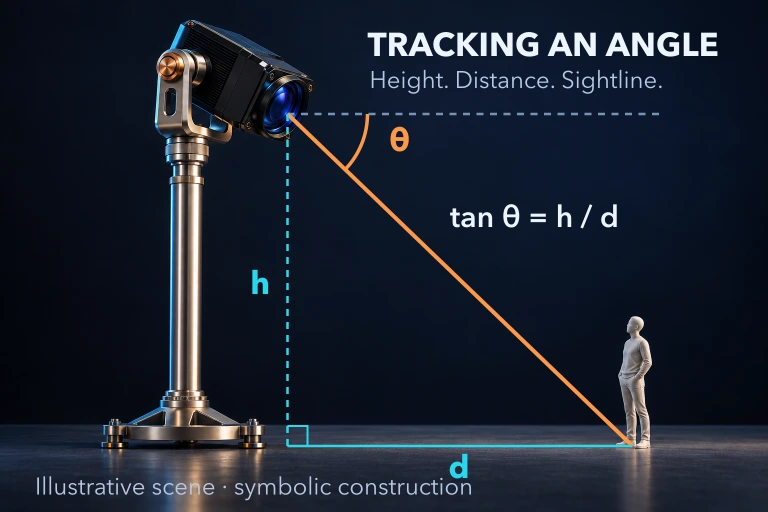
Worked practice: Practice Problems — surveillance camera
Work through this original lesson problem, then reveal the solution and illustrations.
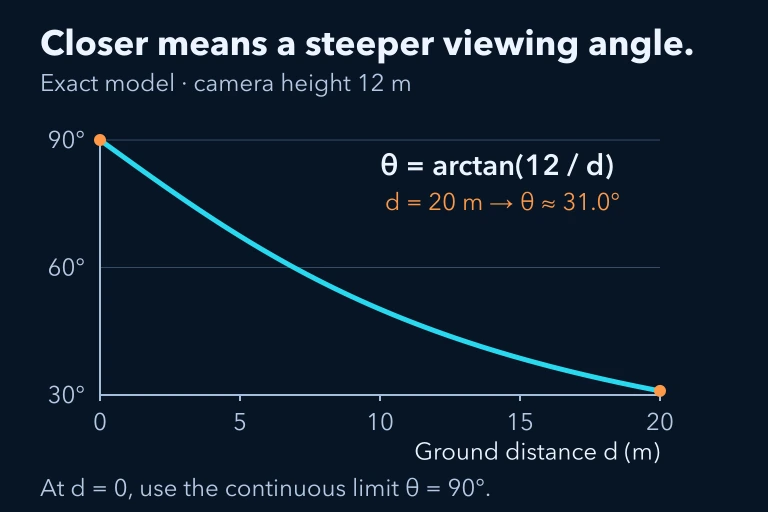
A surveillance camera is mounted on a pole 12 meters above level ground. The camera needs to track an object that moves along the ground from a point directly below the camera to a point 20 meters away horizontally. (a) Write an expression for the angle of depression θ as a function of the horizontal distance d from the base of the pole. State the domain and range of your function in context. (b) Find the exact angle of depression when the object is 12 meters from the base. (c) If the same model is hypothetically extended beyond the 20 m segment, describe the behavior of θ as d → ∞ and explain its physical meaning. (d) Find the horizontal distance at which θ = π/6 in the extended model, and determine whether this occurs on the stated 20 m segment.
Show answer and explanation
Rubric (4 points): Point 1 — Part (a): For 0 < d ≤ 20, θ(d) = arctan(12/d). At d = 0 the line of sight is vertical, so define θ(0) = π/2 by the continuous limit. The physical domain is [0,20] meters and the range is [arctan(3/5),π/2]. Award the point for the expression with its endpoint value and correct domain and range. Point 2 — Part (b): When d = 12, θ = arctan(12/12) = arctan(1) = π/4. The angle of depression is exactly 45°. Point 3 — Part (c): In the hypothetical extension, as d → ∞, 12/d → 0 and θ = arctan(12/d) → 0. The line of sight approaches horizontal as the object recedes. This is the horizontal asymptote of θ as a function of d; it describes continuation beyond the assigned segment. Point 4 — Part (d): In the extended model, tan(π/6) = 12/d gives d = 12√3 ≈ 20.785 m. Since this exceeds 20 m, θ = π/6 is not reached on the specified segment 0 ≤ d ≤ 20. Award the point for the calculation and this feasibility check.
Question 1 of 5
What is the value of \( \arcsin\!\left(\frac{1}{2}\right) \)?
Question 2 of 5
What is the value of \( \arccos\!\left(-\frac{\sqrt{2}}{2}\right) \)?
Question 3 of 5
What is the value of \( \arctan(-\sqrt{3}) \)?
Question 4 of 5
What is the value of \( \sin\!\left(\arccos\!\left(\frac{3}{5}\right)\right) \)?
Question 5 of 5
Which of the following equals \( \arcsin(\sin(\frac{5\pi}{6})) \)?