01 / 20

Inverse
Functions

Learn how to reverse the action of a function, verify inverse pairs with composition, and determine when an inverse exists.

AP Precalculus

What Is an Inverse Function?

A function \( f \) takes an input \( x \) and produces an output \( y \). An inverse function \( f^{-1} \) reverses this process: it takes \( y \) back to \( x \).

Forward
\( f(x) = y \)
Reverse
\( f^{-1}(y) = x \)

Reflection Across \( y = x \)

Graphically, \( f^{-1} \) is the reflection of \( f \) over the line \( y = x \). Every point \( (a, b) \) on \( f \) becomes \( (b, a) \) on \( f^{-1} \).

x y
\( y = x \)
\( f(x) \)
\( f^{-1}(x) \)
(2, 4) (4, 2)

Domain and Range Swap

When you find the inverse, the domain of \( f \) becomes the range of \( f^{-1} \), and vice versa. This is because inputs and outputs trade roles.

Domain of \( f \)
becomes the range of \( f^{-1} \)
Range of \( f \)
becomes the domain of \( f^{-1} \)

The Composition Verification

Two functions \( f \) and \( g \) are inverses if and only if both compositions return the input:

\( f(g(x)) = x \)
for every \( x \) in the domain of \( g \)
\( g(f(x)) = x \)
for every \( x \) in the domain of \( f \)

One-to-One and the Horizontal Line Test

A function has an inverse only if it is one-to-one: each output corresponds to exactly one input. To check graphically, use the Horizontal Line Test.

Passes HLT (one-to-one) Fails HLT (not one-to-one)

\( f^{-1}(x) \) vs. \( \frac{1}{f(x)} \)

These two expressions look similar but mean completely different things. This is the most common source of confusion with inverse notation.

\( f^{-1}(x) \) \( \frac{1}{f(x)} \)
Meaning Inverse function Reciprocal of the output
Operation Undoes \( f \) Divides 1 by \( f(x) \)
Example \( f(x) = 2x \Rightarrow f^{-1}(x) = \frac{x}{2} \) \( f(x) = 2x \Rightarrow \frac{1}{f(x)} = \frac{1}{2x} \)
Key test \( f(f^{-1}(x)) = x \) \( f(x) \cdot \frac{1}{f(x)} = 1 \)

Finding an Inverse Algebraically

1
Replace \( f(x) \) with \( y \). This makes the algebra cleaner.
2
Swap \( x \) and \( y \). This reflects the function across \( y = x \).
3
Solve for \( y \). Isolate the new \( y \) using algebraic operations.
4
Write \( f^{-1}(x) = y \). Rename the result using inverse notation.
5
Verify: check that \( f(f^{-1}(x)) = x \) and \( f^{-1}(f(x)) = x \).

Example 1: Linear Function

Find the inverse of \( f(x) = 3x + 5 \).

1
Write \( y = 3x + 5 \)
2
Swap: \( x = 3y + 5 \)
3
Solve: \( x - 5 = 3y \), so \( y = \frac{x - 5}{3} \)
4
Result: \( f^{-1}(x) = \frac{x - 5}{3} \)

Example 2: Rational Function

Find the inverse of \( f(x) = \frac{2x + 1}{x - 3} \), where \( x \neq 3 \).

1
Write \( y = \frac{2x+1}{x-3} \), then swap: \( x = \frac{2y+1}{y-3} \)
2
Multiply both sides by \( (y - 3) \): \( x(y-3) = 2y + 1 \)
3
Expand: \( xy - 3x = 2y + 1 \). Collect \( y \)-terms: \( xy - 2y = 3x + 1 \)
4
Factor: \( y(x - 2) = 3x + 1 \), so \( y = \frac{3x+1}{x-2} \)

Example 3: Restricted Domain

Find the inverse of \( f(x) = x^2 - 4 \) for \( x \geq 0 \).

1
Write \( y = x^2 - 4 \), swap: \( x = y^2 - 4 \)
2
Solve: \( x + 4 = y^2 \), so \( y = \pm\sqrt{x+4} \)
3
Since the original domain is \( x \geq 0 \), the range of \( f^{-1} \) must be \( \geq 0 \). Choose the positive root.

Graphing \( f \) and \( f^{-1} \)

2 4 6 8 2 4 6
\( y = x \)
\( f(x) \)
\( f^{-1}(x) \)
(0, 1) (1, 0)

Restricting Domains to Create Inverses

When a function is not one-to-one, we can restrict its domain so that the restricted version is one-to-one and has an inverse.

\( f(x) = x^2 \)
Not one-to-one on \( (-\infty, \infty) \). Restrict to \( x \geq 0 \), then \( f^{-1}(x) = \sqrt{x} \).
\( f(x) = \sin x \)
Not one-to-one on \( (-\infty, \infty) \). Restrict to \( \left[-\frac{\pi}{2}, \frac{\pi}{2}\right] \), then \( f^{-1}(x) = \arcsin x \).
\( f(x) = |x| \)
Not one-to-one. Restrict to \( x \geq 0 \), then \( f^{-1}(x) = x \) (identity on \( [0, \infty) \)).

Common Mistakes to Avoid

✕ Confusing Inverse with Reciprocal
Writing \( f^{-1}(x) = \frac{1}{f(x)} \). The notation \( f^{-1} \) means the inverse function, not the reciprocal.
✕ Forgetting to Check Both Compositions
Only verifying \( f(f^{-1}(x)) = x \) but not \( f^{-1}(f(x)) = x \). Both are needed.
✕ Ignoring Domain Restrictions
Finding the inverse of \( x^2 \) as \( \pm\sqrt{x} \) and not choosing the correct branch based on the restricted domain.

Summary of Key Concepts

Concept What to Remember
Definition \( f^{-1} \) undoes \( f \): if \( f(a) = b \), then \( f^{-1}(b) = a \)
Verification \( f(f^{-1}(x)) = x \) and \( f^{-1}(f(x)) = x \)
Graph Reflect over \( y = x \): swap \( (a,b) \leftrightarrow (b,a) \)
Domain/Range Domain of \( f \) = Range of \( f^{-1} \), and vice versa
Existence \( f \) must be one-to-one (pass the Horizontal Line Test)
Algebraic Method Replace \( f(x) \) with \( y \), swap \( x \) and \( y \), solve for \( y \)

Worked practice: Practice Problems — cooling substance

Work through this original lesson problem, then reveal the solution and illustrations.

A scientist models the temperature T (in °C) of a cooling substance as T(t) = 25 + 80 · (0.5)t/10, where t is time in minutes and t ≥ 0. Find the inverse function T−1(T) that gives the time at which the substance reaches a given temperature. Then determine how many minutes it takes for the substance to cool to 45°C.

Show answer and explanation

Point 1 (Setup — Swap variables and identify goal): Starting from T = 25 + 80 · (0.5)^(t/10), the goal is to solve for t in terms of T. To find the inverse, swap the roles of the input and output: the original function takes time t and outputs temperature T, so the inverse takes temperature T and outputs time t. Point 2 (Isolate the exponential expression): Subtract 25 from both sides: T − 25 = 80 · (0.5)^(t/10). Divide both sides by 80: (T − 25)/80 = (0.5)^(t/10). This correctly isolates the exponential term on one side of the equation. Point 3 (Apply logarithm and solve for t): Take the logarithm base 0.5 of both sides: log₀.₅((T − 25)/80) = t/10. Multiply both sides by 10: t = 10 · log₀.₅((T − 25)/80). Using the change-of-base formula, this can be rewritten as t = 10 · ln((T − 25)/80) / ln(0.5). Therefore the inverse function is T⁻¹(T) = 10 · ln((T − 25)/80) / ln(0.5), with domain 25 < T ≤ 105 (the range of the original function for t ≥ 0). In particular, T = 105 gives t = 0. The temperature approaches 25°C but never reaches it at finite time. Point 4 (Evaluate the inverse at T = 45°C): Substitute T = 45 into the inverse function: t = 10 · ln((45 − 25)/80) / ln(0.5) = 10 · ln(20/80) / ln(0.5) = 10 · ln(0.25) / ln(0.5). Since ln(0.25) = ln(1/4) = −2 ln(2) and ln(0.5) = −ln(2), we get t = 10 · (−2 ln(2)) / (−ln(2)) = 10 · 2 = 20 minutes. The substance reaches 45°C after exactly 20 minutes. Verification: Substituting t = 20 back into the original function: T(20) = 25 + 80 · (0.5)^(20/10) = 25 + 80 · (0.5)² = 25 + 80 · 0.25 = 25 + 20 = 45°C. ✓
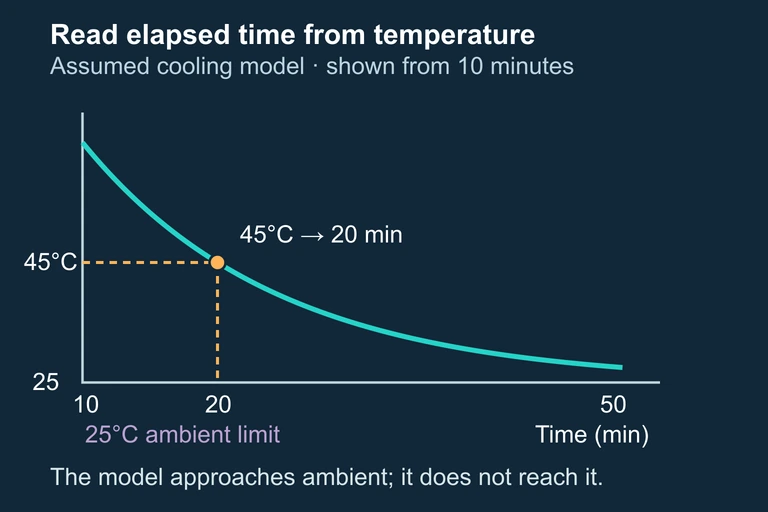
Cooling model displayed from 10 to 50 minutes, approaching 25°C. Temperature 45°C corresponds to 20 minutes.
The stipulated cooling model reaches 45°C at 20 minutes. The displayed model starts at 10 minutes (65°C); 105°C is only its extrapolated mathematical intercept.

Question 1 of 5

If \( f(x) = 4x - 7 \), what is \( f^{-1}(x) \)?

Question 2 of 5

Which condition guarantees that a function \( f \) has an inverse that is also a function?

Question 3 of 5

If \( f(3) = 10 \), what is \( f^{-1}(10) \)?

Question 4 of 5

What is the inverse of \( g(x) = \frac{x+5}{2} \)?

Question 5 of 5

The graph of \( f^{-1} \) is obtained from the graph of \( f \) by reflecting over which line?