01 / 21

Inverse & Determinant
of a Matrix

Master the determinant to unlock matrix inverses, solve systems of equations, and understand when transformations are reversible.

AP Precalculus

What Is a Matrix?

A matrix is a rectangular array of numbers arranged in rows and columns. We use matrices to represent systems of equations, geometric transformations, and data sets.

[
\(a\)
\(b\)
\(c\)
\(d\)
]
\( = \text{a } 2 \times 2 \text{ matrix}\)
Rows → Horizontal entries Columns ↓ Vertical entries

The Determinant Defined

For a \(2 \times 2\) matrix \( A = \begin{bmatrix} a & b \\ c & d \end{bmatrix} \), the determinant is a single number that tells us whether the matrix is invertible and how it scales area.

[
\(a\)
\(b\)
\(c\)
\(d\)
]
\(\det = \textcolor{#4ade80}{ad} - \textcolor{#f87171}{bc}\)
Main diagonal ↘ Anti-diagonal ↙ Subtract the anti-diagonal product from the main diagonal product.

What Does \( \det(A) \) Tell Us?

\( \det(A) \neq 0 \)
The matrix is invertible (non-singular). The transformation is reversible and preserves dimensionality.
\( \det(A) = 0 \)
The matrix is singular: no inverse exists. The transformation collapses 2D space onto a line or point.

The Inverse Matrix

The inverse of a matrix \( A \), written \( A^{-1} \), is the matrix that "undoes" \( A \). Multiplying \( A \) by its inverse gives the identity matrix:

Think of it like multiplication: just as \( 5 \times \frac{1}{5} = 1 \), a matrix times its inverse yields the identity. The identity matrix is the "1" of matrix multiplication: it leaves any matrix unchanged.

The \(2 \times 2\) Inverse Formula

1
Swap the main diagonal entries: \( a \leftrightarrow d \)
2
Negate the anti-diagonal entries: \( b \to -b \) and \( c \to -c \)
3
Divide every entry by the determinant \( ad - bc \)

Determinant vs. Inverse

Determinant Inverse
Output A single number A matrix
Notation \( \det(A) \) or \( |A| \) \( A^{-1} \)
Purpose Check invertibility, area scaling Undo the transformation, solve systems
Exists when Always computable Only if \( \det(A) \neq 0 \)
Relationship The determinant is the gatekeeper: it must be nonzero for the inverse to exist.

How to Find \( A^{-1} \): Step by Step

1
Identify entries: Write down \( a, b, c, d \) from \( A = \begin{bmatrix} a & b \\ c & d \end{bmatrix} \)
2
Compute the determinant: Calculate \( \det(A) = ad - bc \)
3
Check: If \( \det(A) = 0 \), stop: no inverse exists
4
Build the adjugate: Swap \( a \leftrightarrow d \), negate \( b \) and \( c \)
5
Scale: Multiply the adjugate by \( \frac{1}{\det(A)} \)
6
Verify: Check that \( A \cdot A^{-1} = I \)

Example 1: Find \( \det(A) \)

Let \( A = \begin{bmatrix} 3 & 7 \\ 1 & 5 \end{bmatrix} \). Find the determinant.

[
\(3\)
\(7\)
\(1\)
\(5\)
]
\(\det = \textcolor{#4ade80}{(3)(5)} - \textcolor{#f87171}{(7)(1)}\)
\(\det = \textcolor{#4ade80}{15} - \textcolor{#f87171}{7} = \textcolor{#fbbf24}{8}\)
Since \( \det(A) \neq 0 \), the matrix is invertible.

Example 2: Find \( A^{-1} \)

Using \( A = \begin{bmatrix} 3 & 7 \\ 1 & 5 \end{bmatrix} \) with \( \det(A) = 8 \), find \( A^{-1} \).

1
Swap main diagonal: \( 3 \leftrightarrow 5 \) → \( \begin{bmatrix} 5 & 7 \\ 1 & 3 \end{bmatrix} \)
2
Negate anti-diagonal: \( 7 \to -7 \), \( 1 \to -1 \) → \( \begin{bmatrix} 5 & -7 \\ -1 & 3 \end{bmatrix} \)
3
Scale by \( \frac{1}{8} \): \( A^{-1} = \frac{1}{8}\begin{bmatrix} 5 & -7 \\ -1 & 3 \end{bmatrix} = \begin{bmatrix} \frac{5}{8} & \frac{-7}{8} \\ \frac{-1}{8} & \frac{3}{8} \end{bmatrix} \)

Example 3: A Singular Matrix

Let \( B = \begin{bmatrix} 4 & 2 \\ 6 & 3 \end{bmatrix} \). Find \( \det(B) \) and determine if \( B^{-1} \) exists.

[
\(4\)
\(2\)
\(6\)
\(3\)
]
\(\det = \textcolor{#4ade80}{(4)(3)} - \textcolor{#f87171}{(2)(6)}\)
\(\det = \textcolor{#4ade80}{12} - \textcolor{#f87171}{12} = \textcolor{#f87171}{0}\)

Solving Systems with \( A^{-1} \)

If you can write a system of equations as \( AX = B \), then multiply both sides on the left by \( A^{-1} \) to isolate \( X \):

Example: Solve $$ \begin{cases} 3x + 7y = 1 \\ x + 5y = 3 \end{cases} $$

Key Properties of Determinants

Product Rule
\( \det(AB) = \det(A) \cdot \det(B) \)
Inverse Rule
\( \det(A^{-1}) = \frac{1}{\det(A)} \)
Transpose Rule
\( \det(A^T) = \det(A) \)

Key Properties of Inverses

1
Double inverse: \( (A^{-1})^{-1} = A \)
2
Product inverse: \( (AB)^{-1} = B^{-1}A^{-1} \) (note the reversed order)
3
Transpose inverse: \( (A^T)^{-1} = (A^{-1})^T \)
4
Scalar inverse: \( (kA)^{-1} = \frac{1}{k}A^{-1} \) for \( k \neq 0 \)

Common Mistakes to Avoid

✕ Wrong Diagonal
Computing \( bc - ad \) instead of \( ad - bc \). Remember: main diagonal minus anti-diagonal.
✕ Forgetting to Negate
Swapping \( a \) and \( d \) but forgetting to negate \( b \) and \( c \) when building the adjugate.
✕ Dividing by Zero
Attempting to find \( A^{-1} \) when \( \det(A) = 0 \). Always check the determinant first.

Summary Cheat Sheet

Concept Formula / Rule Key Fact
Determinant \( ad - bc \) A number, always computable
Inverse \( \frac{1}{\det}\begin{bmatrix} d & -b \\ -c & a \end{bmatrix} \) Only exists if \( \det(A) \neq 0 \)
Singular \( \det(A) = 0 \) No inverse, rows proportional
Solving \( AX = B \) \( X = A^{-1}B \) Multiply on the left
\( (AB)^{-1} \) \( B^{-1}A^{-1} \) Order reverses

Worked practice: Practice Problems — nutritionist supplement mixture

Work through this original lesson problem, then reveal the solution and illustrations.

A nutritionist mixes two supplements, X and Y. Each serving of X provides 5 mg of iron and 3 mg of zinc. Each serving of Y provides 2 mg of iron and 4 mg of zinc. A patient needs exactly 16 mg of iron and 18 mg of zinc per day. (a) Write the system as a matrix equation AX = B, identifying A, X, and B. (b) Compute det(A) and determine whether A is invertible. (c) Find A⁻¹. (d) Use A⁻¹ to solve for the number of servings of each supplement.

Show answer and explanation

Point 1 (1 pt) — Setting up the matrix equation: Let x = servings of X and y = servings of Y. The system is 5x + 2y = 16 and 3x + 4y = 18. In matrix form: A = [[5, 2], [3, 4]], X = [[x], [y]], B = [[16], [18]], so AX = B. Point 2 (1 pt) — Computing the determinant: det(A) = 5(4) − 2(3) = 20 − 6 = 14. Since 14 ≠ 0, A is invertible. Point 3 (1 pt) — Finding A⁻¹: The adjugate is [[4, −2], [−3, 5]]. Scaling by 1/14: A⁻¹ = (1/14)[[4, −2], [−3, 5]] = [[2/7, −1/7], [−3/14, 5/14]]. Point 4 (1 pt) — Solving for X: X = A⁻¹B = (1/14)[[4, −2], [−3, 5]] × [[16], [18]] = (1/14)[[4(16) + (−2)(18)], [(−3)(16) + 5(18)]] = (1/14)[[64 − 36], [−48 + 90]] = (1/14)[[28], [42]] = [[2], [3]]. The patient needs 2 servings of X and 3 servings of Y per day. Verification: 5(2) + 2(3) = 16 ✓ and 3(2) + 4(3) = 18 ✓.
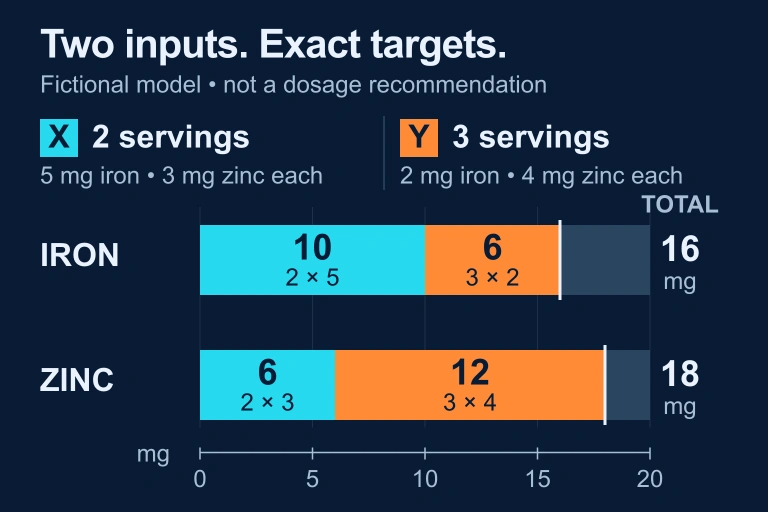
Two servings of X and three of Y give iron contributions 10+6=16 mg and zinc contributions 6+12=18 mg in stacked bars.

Question 1 of 5

What is \( \det\begin{bmatrix} 4 & 3 \\ 2 & 5 \end{bmatrix} \)?

Question 2 of 5

If \( \det(A) = 0 \), which statement is true?

Question 3 of 5

Find \( A^{-1} \) for \( A = \begin{bmatrix} 2 & 1 \\ 5 & 3 \end{bmatrix} \).

Question 4 of 5

If \( \det(A) = 5 \) and \( \det(B) = 3 \), what is \( \det(AB) \)?

Question 5 of 5

What is \( (AB)^{-1} \) expressed in terms of \( A^{-1} \) and \( B^{-1} \)?