Implicitly
Defined Functions
Explore equations where \(y\) is not isolated: learn to identify, graph, and reason about relationships defined by equations like \(x^2 + y^2 = 1\).
What Is an Implicit Equation?
Most equations you have seen are written in explicit form: the output variable is isolated on one side. For example, \(y = 3x + 2\) tells you exactly how to compute \(y\) from \(x\).
An implicit equation mixes both variables together without isolating either one. The equation \(x^2 + y^2 = 25\) relates \(x\) and \(y\), but neither variable stands alone.
Explicit vs Implicit Form
Example: \(y = x^2 - 4\)
Example: \(x^2 + y^2 = 25\)
Why Do Implicit Equations Matter?
Many important curves cannot be expressed as a single explicit function. Circles, ellipses, and higher-degree curves naturally arise in implicit form.
The Unit Circle: A Classic Example
From Equation to Function
An implicit equation may define one or more functions. We say \(y\) is an implicitly defined function of \(x\) when we restrict the equation to a portion of its graph that passes the vertical line test.
The Vertical Line Test Rule
Relation vs Function
| Relation | Function | |
|---|---|---|
| Definition | Any set of \((x, y)\) pairs | Each \(x\) maps to exactly one \(y\) |
| Vertical Line Test | May fail | Always passes |
| Example | \(x^2 + y^2 = 9\) | \(y = \sqrt{9 - x^2}\) |
| Graph | Full circle | Upper semicircle only |
How to Determine a Function
Example 1: Circle Equation
Given the implicit equation \(x^2 + y^2 = 16\), find the implicitly defined function for the upper semicircle.
Example 2: Ellipse
Given \(\frac{x^2}{9} + \frac{y^2}{4} = 1\), identify the implicitly defined function for the lower half.
Example 3: Hyperbola
Consider \(y^2 - x^2 = 1\). This is a hyperbola opening up and down.
When You Cannot Solve for \(y\)
Some implicit equations resist algebraic solution. Consider \(x^3 + y^3 = 6xy\) (the folium of Descartes). There is no neat formula for \(y\) in terms of \(x\).
Domain and Range
Finding the domain and range of an implicitly defined function requires analyzing which values of \(x\) produce real values of \(y\).
Common Mistakes
Summary Table
| Implicit Equation | Upper Branch | Domain |
|---|---|---|
| \(x^2 + y^2 = r^2\) | \(y = \sqrt{r^2 - x^2}\) | \([-r, r]\) |
| \(\frac{x^2}{a^2} + \frac{y^2}{b^2} = 1\) | \(y = b\sqrt{1 - \frac{x^2}{a^2}}\) | \([-a, a]\) |
| \(y^2 - x^2 = 1\) | \(y = \sqrt{1 + x^2}\) | \((-\infty, \infty)\) |
| \(xy = k\) | \(y = \frac{k}{x}\) | \(x \neq 0\) |
Worked practice: Practice Problems — applied elliptical tunnel
Work through this original lesson problem, then reveal the solution and illustrations.
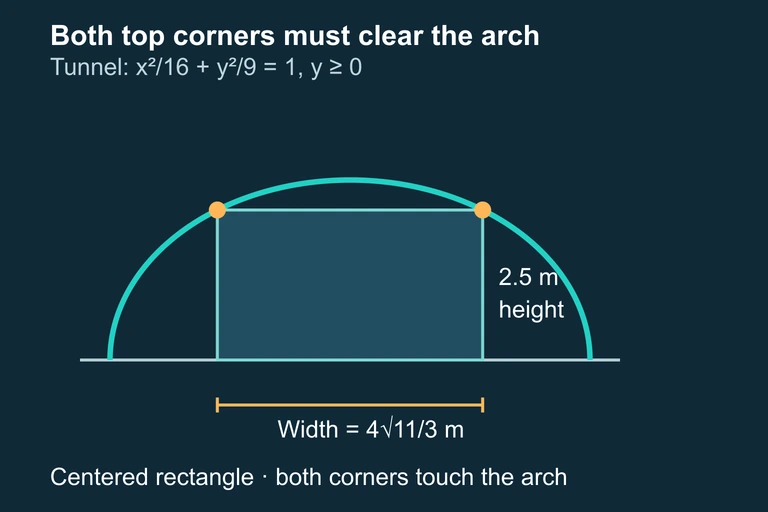
An engineer models the cross-section of an elliptical tunnel using the implicit equation x²/16 + y²/9 = 1, where x and y are measured in meters and y ≥ 0 represents the height above ground level. (a) Write the parametric equations for the full ellipse. (b) Determine the explicit function y = f(x) for the tunnel's upper profile and state its domain. (c) A vehicle that is 2.5 meters tall needs to pass through the tunnel. Find the maximum width of a lane centered at x = 0 such that the vehicle can pass. Justify your answer with calculations. (d) Explain why the implicit equation, rather than the explicit form alone, is valuable for an engineer designing this tunnel.
Show answer and explanation
Point 1 (1 pt) — Parametric equations: With a = 4 and b = 3, the parametric form is x = 4 cos(t), y = 3 sin(t), for 0 ≤ t < 2π. For just the upper half (tunnel profile), restrict to 0 ≤ t ≤ π. Point 2 (1 pt) — Explicit upper branch: From x²/16 + y²/9 = 1, solve: y² = 9(1 − x²/16) = 9(16 − x²)/16. Since y ≥ 0, y = (3/4)√(16 − x²). The domain is −4 ≤ x ≤ 4, since 16 − x² ≥ 0 requires |x| ≤ 4. Point 3 (2 pts) — Maximum lane width: The vehicle has height 2.5 m. Set y = 2.5 and solve for x: 2.5 = (3/4)√(16 − x²) → 10/3 = √(16 − x²) → 100/9 = 16 − x² → x² = 16 − 100/9 = 144/9 − 100/9 = 44/9 → x = ±√(44/9) = ±(2√11)/3 ≈ ±2.211 m. The maximum width of a centered lane is 2 × (2√11)/3 = (4√11)/3 ≈ 4.42 meters. At any horizontal distance from center less than about 2.21 m, the tunnel height exceeds 2.5 m, so the vehicle can pass. Point 4 (1 pt) — Why implicit form is valuable: The implicit equation x²/16 + y²/9 = 1 describes the entire cross-section in a single compact expression, making it easy to check whether any point (x, y) lies inside, on, or outside the tunnel boundary. This is critical for engineering design: verifying clearance involves substituting coordinates directly into F(x, y) = x²/16 + y²/9 − 1 and checking whether the result is ≤ 0. The explicit form only provides the upper half and requires choosing the correct branch, which is more cumbersome for full boundary analysis.
Question 1 of 5
Which equation is written in implicit form?
Question 2 of 5
The equation \(x^2 + y^2 = 36\) implicitly defines \(y = \sqrt{36 - x^2}\) on what domain?
Question 3 of 5
The equation \(y^2 = x\) defines how many functions of \(x\)?
Question 4 of 5
For the ellipse \(\frac{x^2}{16} + \frac{y^2}{9} = 1\), what is the range of the implicitly defined upper-half function?
Question 5 of 5
Why does the full graph of \(x^2 + y^2 = 25\) fail to be a function?