Exponential Function
Context & Data Modeling
Learn to identify, build, and apply exponential models from real-world contexts and data sets using \( f(x) = ab^x \).
What Is an Exponential Function?
An exponential function has the general form \( f(x) = ab^x \), where \( a \neq 0 \), \( b > 0 \), and \( b \neq 1 \). The output is multiplied by a constant ratio \( b \) for every unit increase in \( x \).
Growth vs Decay
Why Exponential Models Matter
Many real-world quantities change by a constant percentage over equal time intervals. Exponential functions capture this behavior naturally:
The General Exponential Model
Alternate Representations
Exponential functions can be rewritten in equivalent forms depending on the context:
Linear vs Exponential
| Linear | Exponential | |
|---|---|---|
| General Form | \( f(x) = mx + b \) | \( f(x) = ab^x \) |
| Rate of Change | Constant additive: \( +m \) | Constant multiplicative: \( \times b \) |
| Test on Data | Constant first differences | Constant successive ratios |
| Graph Shape | Straight line | Curved, concave up/down |
| Long-term Behavior | Grows without bound linearly | Grows/decays much faster |
How to Build an Exponential Model
A cell culture where more cells create more growth events

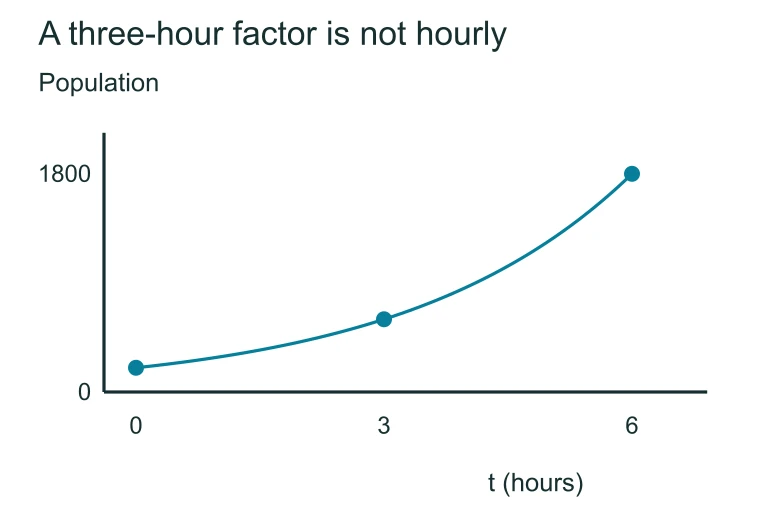
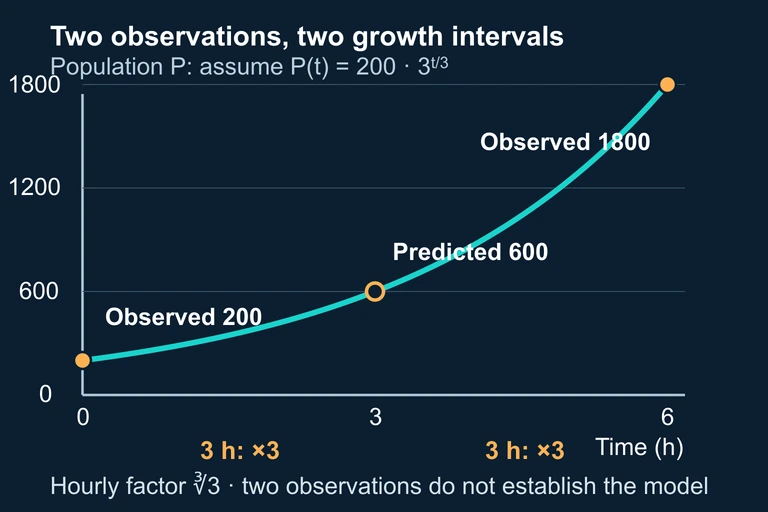
For P(t) = 200×3^(t/3), population triples every 3 hours. The hourly growth factor is 3^(1/3), about 1.442.Tripling model
For P(t) = 200×3^(t/3), population triples every 3 hours. The hourly growth factor is 3^(1/3), about 1.442.Building from Data Tables
Given equally spaced input values, compute successive ratios to confirm exponential behavior and extract the base:
| \( x \) | 0 | 1 | 2 | 3 | 4 |
|---|---|---|---|---|---|
| \( f(x) \) | 5 | 15 | 45 | 135 | 405 |
| Ratio | — | 3 | 3 | 3 | 3 |
Example 1: Bacterial Growth
A colony of bacteria starts with 200 cells and doubles every 3 hours. Write a model for the population \( P(t) \) after \( t \) hours.
Example 2: Radioactive Decay
A 500-gram sample of a substance has a half-life of 8 years. Find the amount \( A(t) \) remaining after \( t \) years.
Example 3: Finding \( a \) and \( b \) from Two Points
An exponential function passes through \( (1, 12) \) and \( (4, 324) \). Find the model.
Interpreting Parameters in Context
A car purchased for $25,000 depreciates at 12% per year. The model is \( V(t) = 25000 \cdot (0.88)^t \).
Transformations of Exponential Functions
The general transformed exponential has the form \( f(x) = a \cdot b^{x - h} + k \), where \( h \) is a horizontal shift and \( k \) shifts the asymptote.
Common Mistakes to Avoid
Summary of Key Ideas
| Concept | Key Formula / Idea |
|---|---|
| Standard Form | \( f(x) = ab^x \) |
| Growth Factor | \( b = 1 + r \) where \( r \) is the rate |
| Decay Factor | \( b = 1 - r \) where \( r \) is the rate |
| Identify from Data | Constant successive ratios |
| Two-Point Method | Divide outputs to find \( b \), then solve for \( a \) |
| Asymptote (basic) | \( y = 0 \); shifted: \( y = k \) |
| Domain / Range | All reals / \( (0, \infty) \) when \( a > 0 \) |
Worked Example — Building a Model from Data
A biologist measures a bacterial colony every 3 hours. At t = 0 hours the population is 200 cells, and at t = 6 hours it is 1,800 cells. Assuming exponential growth, construct the model P(t) = abᵗ where t is measured in hours, then predict the population at t = 10 hours. Bacterial Colony Growth Model Step 1 — Identify Given Information We are given two data points: (t₁, P₁) = (0, 200) and (t₂, P₂) = (6, 1800). The model form is P(t) = abᵗ. Step 2 — Find the Initial Value a Since one of our data points has t = 0, we can directly determine a. When t = 0: P(0) = a · b⁰ = a · 1 = a. Therefore a = 200. a = 200 Step 3 — Solve for the Base b Using the second point: 1800 = 200 · b⁶. Divide both sides by 200: b⁶ = 9. Take the sixth root: b = 9^(1/6) = (3²)^(1/6) = 3^(1/3) ≈ 1.4422. b = 3^(1/3) ≈ 1.4422 Step 4 — Write the Complete Model The exponential model is P(t) = 200 · (3^(1/3))ᵗ = 200 · 3^(t/3). This form reveals that the population triples every 3 hours. P(t) = 200 · 3^(t/3) Step 5 — Predict at t = 10 P(10) = 200 · 3^(10/3) = 200 · 3^(3.333…). We compute 3^3 = 27 and 3^(1/3) ≈ 1.4422, so 3^(10/3) = 27 × 1.4422 ≈ 38.94. Therefore P(10) ≈ 200 × 38.94 ≈ 7,788 cells. P(10) ≈ 7,788 cells Interpretation Check On the AP exam, you will often be asked to interpret the parameters in context. Here: "The initial population is 200 cells" (interpretation of a) and "The population is multiplied by approximately 1.44 each hour" or equivalently "The population triples every 3 hours" (interpretation of b).
Question 1 of 5
A town's population is modeled by \( P(t) = 8000 \cdot (1.03)^t \), where \( t \) is in years. What does 1.03 represent?
Question 2 of 5
Given the data \( (0, 6), (1, 18), (2, 54), (3, 162) \), which function models this data?
Question 3 of 5
A substance decays so that 40% remains after 10 years. If the initial amount is 200 grams, which model is correct?
Question 4 of 5
An exponential function passes through \( (2, 48) \) and \( (5, 6) \). What is the value of the base \( b \)?
Question 5 of 5
Which statement about \( g(x) = 3 \cdot 2^{x-1} + 5 \) is true?