01 / 20

Equivalent Representations
of Trigonometric Functions

Master identities, cofunction relationships, and transformations that reveal how trig expressions can be rewritten in equivalent forms.

AP Precalculus

What Are Equivalent Representations?

Two trigonometric expressions are equivalent if they produce the same output for every input in their shared domain. The expressions may look completely different, yet they describe the identical function.

Identity
An equation true for all values in the domain, e.g. \(\sin^2\theta + \cos^2\theta = 1\)
Transformation
A shift or reflection that rewrites one trig function as another, e.g. \(\cos\theta = \sin\!\left(\frac{\pi}{2}-\theta\right)\)

The Unit Circle Foundation

\(\theta\)
P
\(\cos\theta\)
\(\sin\theta\)
x y 1 1

Every point on the unit circle satisfies \(x^2 + y^2 = 1\). Since \(x = \cos\theta\) and \(y = \sin\theta\), we immediately get the Pythagorean identity:

Three Families of Identities

Pythagorean
\(\sin^2\theta + \cos^2\theta = 1\)
\(1 + \tan^2\theta = \sec^2\theta\)
\(1 + \cot^2\theta = \csc^2\theta\)
Reciprocal
\(\csc\theta = \dfrac{1}{\sin\theta}\)
\(\sec\theta = \dfrac{1}{\cos\theta}\)
\(\cot\theta = \dfrac{1}{\tan\theta}\)
Quotient
\(\tan\theta = \dfrac{\sin\theta}{\cos\theta}\)

\(\cot\theta = \dfrac{\cos\theta}{\sin\theta}\)

Cofunction Identities

Two functions are cofunctions if they satisfy \(f(\theta) = g\!\left(\frac{\pi}{2} - \theta\right)\). This relationship comes from the complementary angles in a right triangle.

1
\(\sin\theta = \cos\!\left(\dfrac{\pi}{2} - \theta\right)\)
2
\(\cos\theta = \sin\!\left(\dfrac{\pi}{2} - \theta\right)\)
3
\(\tan\theta = \cot\!\left(\dfrac{\pi}{2} - \theta\right)\)
4
\(\sec\theta = \csc\!\left(\dfrac{\pi}{2} - \theta\right)\)

Visualizing the Cofunction Shift

Even and Odd Properties

A function is even if \(f(-\theta)=f(\theta)\) and odd if \(f(-\theta)=-f(\theta)\). These properties give us another family of equivalent representations.

Even Functions
\(\cos(-\theta) = \cos\theta\)
\(\sec(-\theta) = \sec\theta\)

Symmetric about the y-axis
Odd Functions
\(\sin(-\theta) = -\sin\theta\)
\(\tan(-\theta) = -\tan\theta\)
\(\csc(-\theta) = -\csc\theta\)
\(\cot(-\theta) = -\cot\theta\)

Symmetric about the origin

Identity vs. Conditional Equation

Identity Conditional Equation
True for All values in the domain Only specific values
Example \(\sin^2\theta + \cos^2\theta = 1\) \(\sin\theta = \tfrac{1}{2}\)
Purpose Rewrite / simplify expressions Find particular solutions
Verification Works for any test value Only works at solutions

How to Simplify Using Identities

1
Convert to sine and cosine. Replace \(\tan\theta\), \(\cot\theta\), \(\sec\theta\), \(\csc\theta\) using quotient and reciprocal identities.
2
Look for Pythagorean patterns. Spot \(\sin^2\theta + \cos^2\theta\), \(1 + \tan^2\theta\), or \(1 + \cot^2\theta\) and substitute.
3
Factor or combine fractions. Use common denominators or factor out shared terms.
4
Apply even/odd or cofunction rules if negative angles or complementary angles appear.
5
Check your result by substituting a test value (e.g. \(\theta = \frac{\pi}{4}\)) into both the original and simplified forms.

Example 1: Pythagorean Substitution

Simplify: \(\sec^2\theta - \tan^2\theta\)

1
Recall the Pythagorean identity: \(1 + \tan^2\theta = \sec^2\theta\)
2
Rearrange: \(\sec^2\theta - \tan^2\theta = 1\)

Example 2: Converting to Sine and Cosine

Simplify: \(\dfrac{\tan\theta}{\sec\theta}\)

1
Rewrite using quotient and reciprocal identities: \(\dfrac{\frac{\sin\theta}{\cos\theta}}{\frac{1}{\cos\theta}}\)
2
Simplify the complex fraction: \(\dfrac{\sin\theta}{\cos\theta} \cdot \cos\theta = \sin\theta\)

Example 3: Factoring with Identities

Simplify: \(\dfrac{\sin^2\theta - 1}{\sin\theta - 1}\)

1
Factor the numerator as a difference of squares: \(\sin^2\theta - 1 = (\sin\theta - 1)(\sin\theta + 1)\)
2
Cancel the common factor \((\sin\theta - 1)\): result is \(\sin\theta + 1\)
3
Note: We could also write \(\sin^2\theta - 1 = -\cos^2\theta\) using the Pythagorean identity, giving: \(\dfrac{-\cos^2\theta}{\sin\theta - 1}\)

Example 4: Cofunction + Even/Odd

Show that \(\sin\!\left(\frac{\pi}{2} + \theta\right) = \cos\theta\)

1
Rewrite the argument: \(\frac{\pi}{2} + \theta = \frac{\pi}{2} - (-\theta)\)
2
Apply cofunction: \(\sin\!\left(\frac{\pi}{2} - (-\theta)\right) = \cos(-\theta)\)
3
Apply even property: \(\cos(-\theta) = \cos\theta\) ✓

Common Mistakes to Avoid

✕ Wrong Distribution
Writing \(\sin(\alpha + \beta) = \sin\alpha + \sin\beta\). Trig functions are not linear: the sum formula is needed.
✕ Squaring Errors
Confusing \(\sin^2\theta\) with \(\sin(\theta^2)\). Always write \((\sin\theta)^2 = \sin^2\theta\).
✕ Forgetting Domains
Cancelling factors like \((\sin\theta - 1)\) without noting the restriction \(\sin\theta \neq 1\).

Summary of Key Identities

Category Identity Rewritten Form
Pythagorean \(\sin^2\theta + \cos^2\theta\) \(1\)
Pythagorean \(\sec^2\theta - \tan^2\theta\) \(1\)
Quotient \(\dfrac{\sin\theta}{\cos\theta}\) \(\tan\theta\)
Cofunction \(\sin\!\left(\frac{\pi}{2} - \theta\right)\) \(\cos\theta\)
Even/Odd \(\cos(-\theta)\) \(\cos\theta\)
Even/Odd \(\sin(-\theta)\) \(-\sin\theta\)

The Unit Circle as a Rosetta Stone

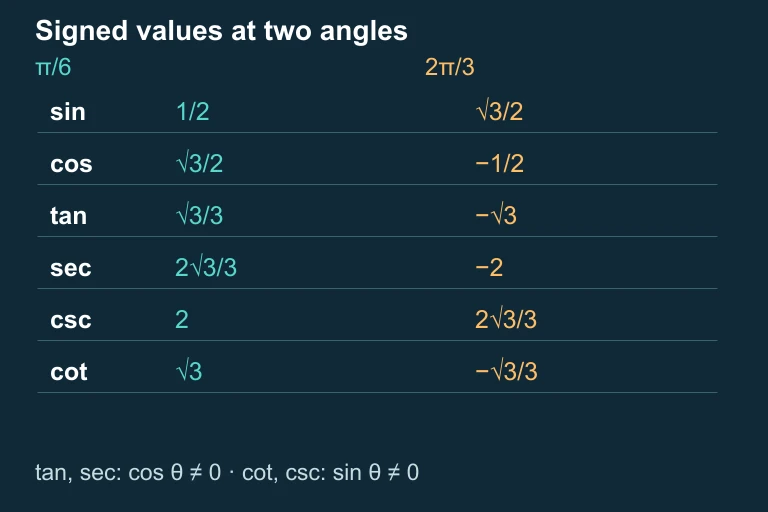
The unit circle is the geometric setting for these equivalent representations. On a circle of radius 1, the point at angle θ has coordinates (cos θ, sin θ), so cos²θ + sin²θ = 1. Signed coordinate changes preserve this identity in every quadrant; ordinary segment lengths are their absolute values. When cos θ ≠ 0, the terminal line intersects x = 1 at (1, tan θ). The directed radial parameter is sec θ and the ordinary length is |sec θ|. In quadrant II the intersection lies on the backward extension of the ray. When sin θ ≠ 0, the terminal line intersects y = 1 at (cot θ, 1), with directed radial parameter csc θ. Thus tan and sec are undefined at cos θ = 0; cot and csc are undefined at sin θ = 0. The native diagram illustrates the first-quadrant sine, cosine, tangent and secant construction; the supplemental two-angle view and table extend it to all six functions. First-quadrant unit-circle construction: the horizontal and vertical coordinate legs give cos θ and sin θ, while the x = 1 tangent construction gives tan θ and sec θ. For general angles, use directed coordinates and parameters; ordinary lengths are non-negative. Cotangent and cosecant use the separate y = 1 tangent construction. These constructions explain the identities. In the pictured first quadrant, similar triangles give sec θ = 1/cos θ; extending the argument with directed coordinates preserves the signs in other quadrants. The separate y = 1 construction similarly gives csc θ = 1/sin θ. The Pythagorean identity follows from the unit radius. Equivalent representations are different ways of measuring the same geometric reality.
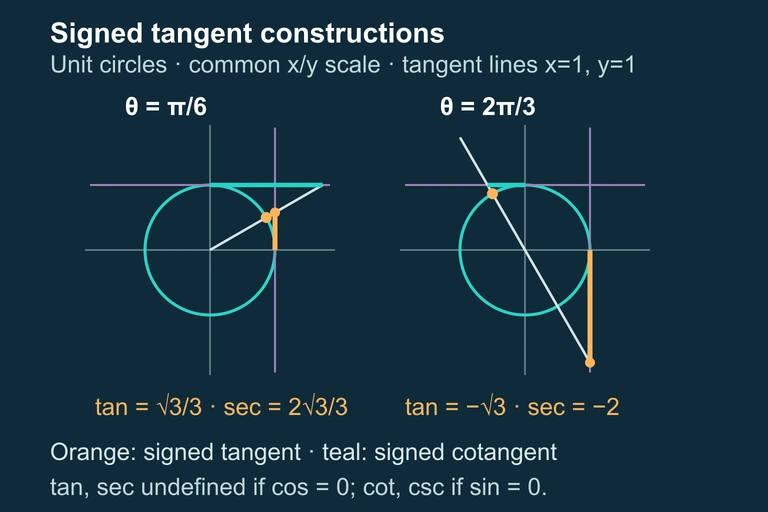
Unit-circle tangent constructions at π/6 and 2π/3, with x=1 and y=1 reference lines and signed trigonometric quantities.
Directed tangent and reciprocal constructions retain trigonometric signs across quadrants; ordinary positive lengths alone cannot encode those signs.
Six trigonometric values for π/6 and 2π/3, including the negative tangent, cotangent and secant values in quadrant II and denominator restrictions.

Question 1 of 5

Which expression is equivalent to \(\csc^2\theta - \cot^2\theta\)?

Question 2 of 5

The expression \(\cos\!\left(\frac{\pi}{2} - \theta\right)\) is equivalent to:

Question 3 of 5

Simplify: \(\dfrac{\sin\theta \cdot \sec\theta}{\tan\theta}\)

Question 4 of 5

Which property does \(\tan(-\theta) = -\tan\theta\) illustrate?

Question 5 of 5

Which expression is NOT equivalent to \(\cos^2\theta\)?