Conic
Sections
Explore the four curves formed by slicing a cone: circles, ellipses, parabolas, and hyperbolas. Master their standard equations and key properties.
What Are Conic Sections?
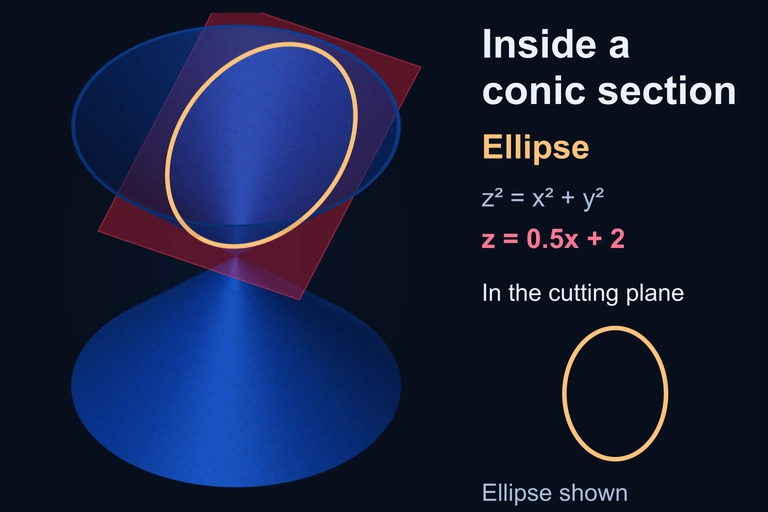
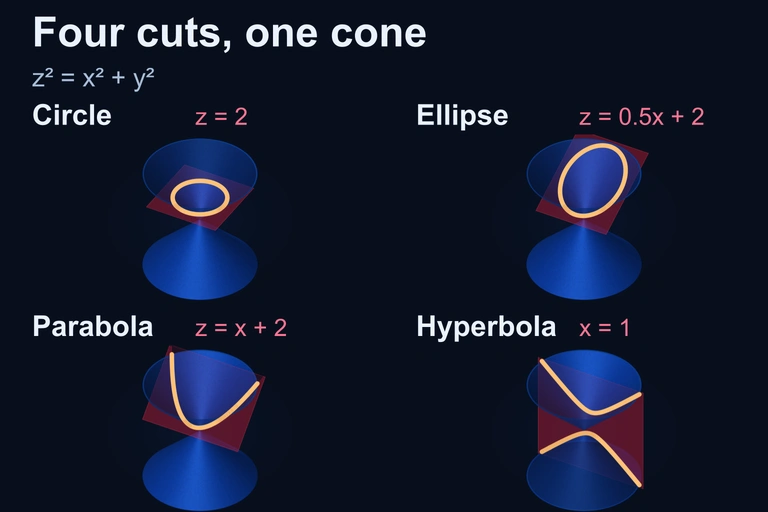
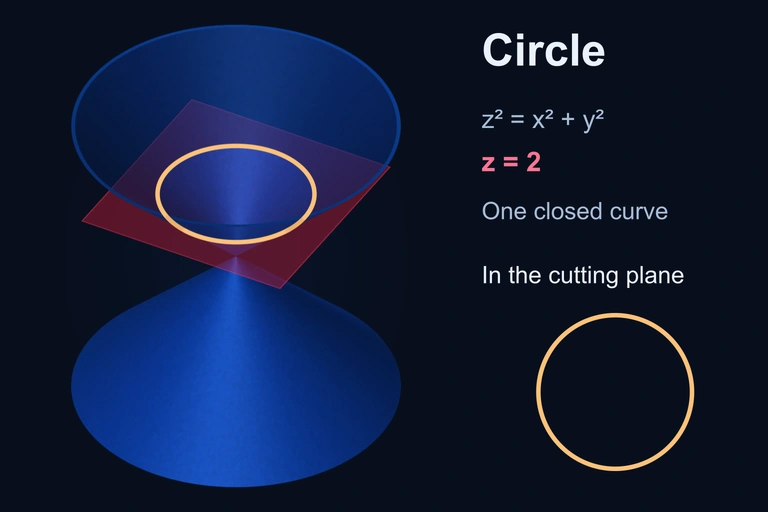
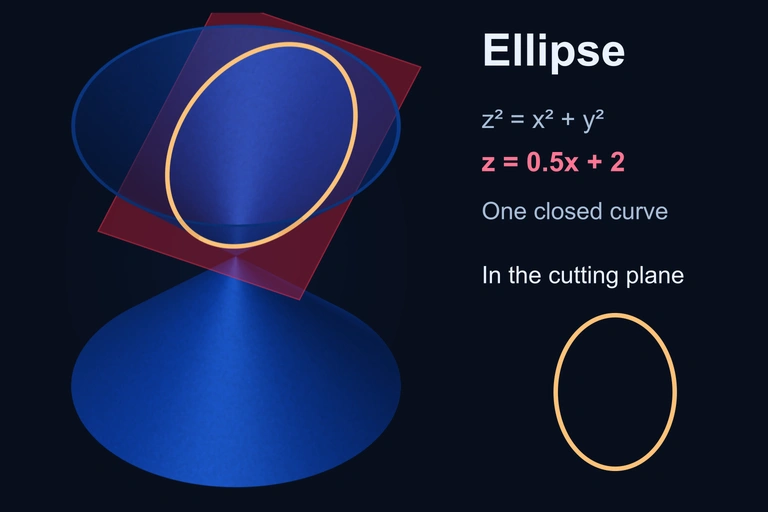
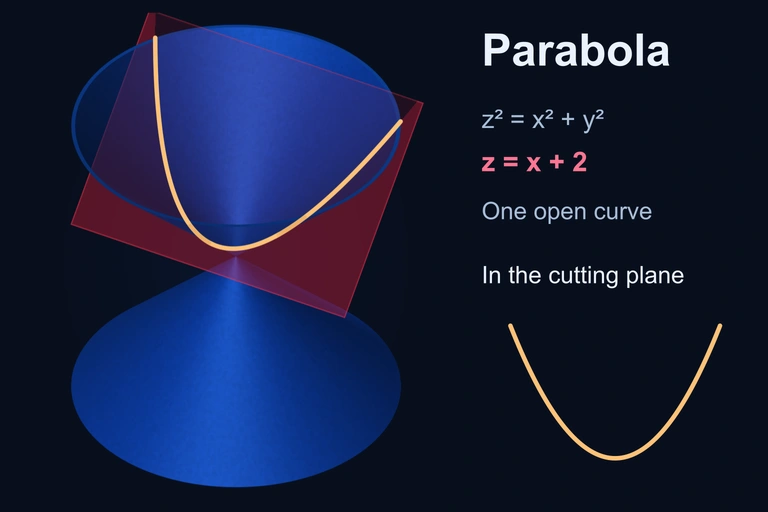
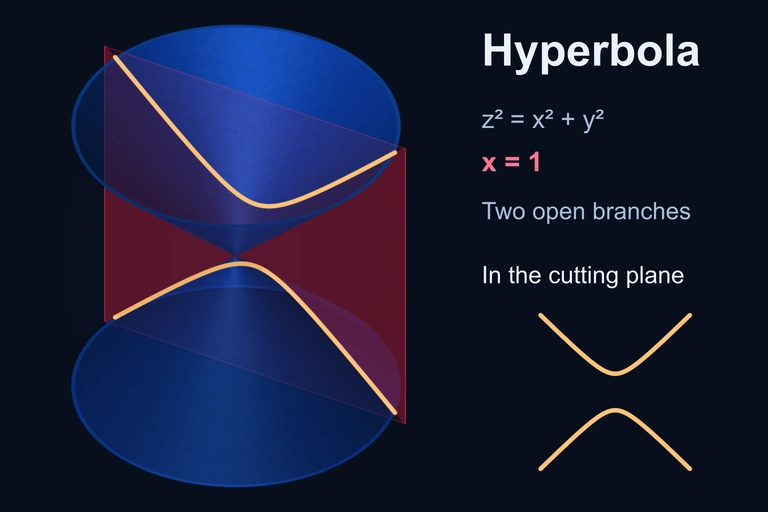
A conic section is the curve produced when a plane intersects a double-napped cone. By changing the angle of the cut, you obtain four distinct shapes: a circle, an ellipse, a parabola, or a hyperbola.
The General Equation
All conic sections satisfy the general second-degree equation:
The discriminant \(B^2 - 4AC\) determines which conic you have:
Why Conics Matter
Conic sections appear everywhere in science, engineering, and nature. Understanding them unlocks powerful modeling tools.
The Circle
A circle is the set of all points equidistant from a fixed center. It is a special case of the ellipse where \(a = b\).
The Ellipse
An ellipse is the set of all points where the sum of distances to two foci is constant: \(d_1 + d_2 = 2a\).
The Parabola
A parabola is the set of all points equidistant from a focus and a directrix line. The value \(p\) determines how "wide" or "narrow" the curve opens.
The Hyperbola
A hyperbola is the set of all points where the difference of distances to two foci is constant: \(|d_1 - d_2| = 2a\).
Ellipse vs. Hyperbola
| Ellipse | Hyperbola | |
|---|---|---|
| Equation sign | \(+\) between terms | \(-\) between terms |
| Definition | Sum of distances = \(2a\) | Difference of distances = \(2a\) |
| Foci relation | \(c^2 = a^2 - b^2\) | \(c^2 = a^2 + b^2\) |
| Shape | Closed curve | Two open branches |
| Asymptotes | None | Horizontal: \(y - k = \pm\frac{b}{a}(x - h)\) Vertical: \(y - k = \pm\frac{a}{b}(x - h)\) |
| Discriminant | \(B^2 - 4AC < 0\) | \(B^2 - 4AC > 0\) |
Converting to Standard Form
To identify and graph a conic, complete the square to convert from general form to standard form.
Example: Identify the Circle
Convert to standard form: \(x^2 + y^2 - 6x + 4y - 12 = 0\)
Example: Identify the Ellipse
Convert to standard form: \(4x^2 + 9y^2 - 16x + 54y + 61 = 0\)
Example: Identify the Hyperbola
Convert to standard form: \(9x^2 - 4y^2 - 36x - 8y - 4 = 0\)
Common Mistakes to Avoid
Summary of All Conics
| Property | Circle | Ellipse | Parabola | Hyperbola |
|---|---|---|---|---|
| Standard Form | \((x-h)^2+(y-k)^2=r^2\) | \(\frac{(x-h)^2}{a^2}+\frac{(y-k)^2}{b^2}=1\) (Horiz) \(\frac{(y-k)^2}{a^2}+\frac{(x-h)^2}{b^2}=1\) (Vert) |
\((x-h)^2=4p(y-k)\) (Vert) \((y-k)^2=4p(x-h)\) (Horiz) |
\(\frac{(x-h)^2}{a^2}-\frac{(y-k)^2}{b^2}=1\) (Horiz) \(\frac{(y-k)^2}{a^2}-\frac{(x-h)^2}{b^2}=1\) (Vert) |
| Key Relation | \(a = b = r\) | \(c^2 = a^2 - b^2\) | Focus at dist \(|p|\) | \(c^2 = a^2 + b^2\) |
| Eccentricity | \(e = 0\) | \(0 < e < 1\) | \(e = 1\) | \(e > 1\) |
| Shape | Closed, round | Closed, oval | Open, one branch | Open, two branches |
Core Principles & Definitions
Every conic section can be understood as the set of points satisfying a specific geometric relationship involving distances to fixed elements—a focus (a fixed point) and a directrix (a fixed line). The ratio of the distance from any point on the curve to the focus versus its distance to the directrix is the eccentricity (e), and this single parameter determines the conic's type. Equivalently, conics are defined as the intersection of a plane with a right circular double cone—the angle of the cutting plane relative to the cone's axis determines which curve results. Circle (e = 0): All points equidistant from a single center. A circle is a special ellipse where both foci coincide, giving eccentricity exactly zero. Ellipse (0 < e < 1): The locus of points whose sum of distances to two foci is constant. Eccentricity between 0 and 1 produces a closed, oval curve. Parabola (e = 1): Each point is equidistant from the focus and the directrix. The curve is open and unbounded with exactly one branch. Hyperbola (e > 1): The locus of points whose absolute difference of distances to two foci is constant. Two separate branches open in opposite directions. KEY TAKEAWAY
Question 1 of 5
What type of conic section is represented by the equation \(x^2 + y^2 - 10x + 6y + 18 = 0\)?
Question 2 of 5
For the ellipse \(\dfrac{(x-1)^2}{25} + \dfrac{(y+4)^2}{16} = 1\), what is the value of \(c\)?
Question 3 of 5
Which equation represents a parabola?
Question 4 of 5
What are the asymptotes of the hyperbola \(\dfrac{x^2}{16} - \dfrac{y^2}{9} = 1\)?
Question 5 of 5
The discriminant \(B^2 - 4AC\) of a conic equation equals 0. What type of conic is this?