Worked practice: Practice Problems — applied pharmaceutical researcher
Work through this original lesson problem, then reveal the solution and illustrations.
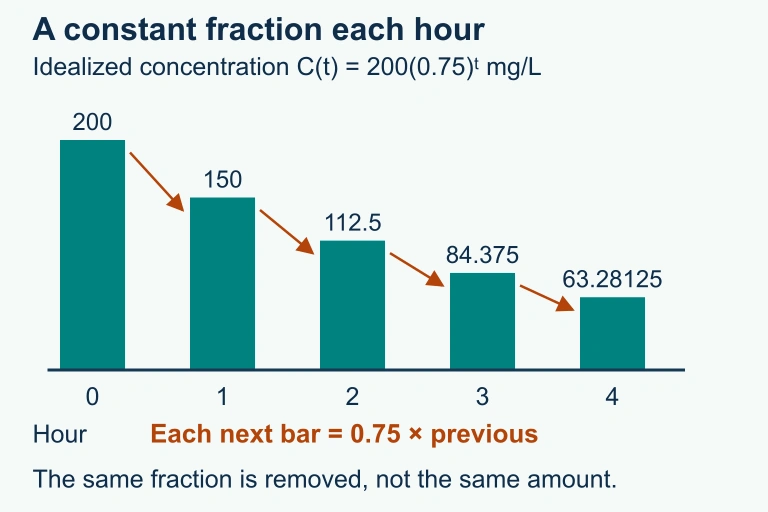
A pharmaceutical researcher models the concentration C(n) of a drug in a patient's bloodstream, measured every hour. After the initial dose, the data collected are: n: 0 1 2 3 4 C(n): 200 150 112.5 84.375 63.28125 (a) Show that the concentration follows a geometric sequence and determine the common ratio. (b) Write an explicit formula for C(n). (c) Determine after how many whole hours the concentration first drops below 20 mg/L. (d) Explain why a linear (arithmetic) model would be inappropriate for this scenario.
Show answer and explanation
Point 1 (Geometric verification): Compute successive ratios: 150/200 = 0.75, 112.5/150 = 0.75, 84.375/112.5 = 0.75, 63.28125/84.375 = 0.75. All ratios are constant, confirming a geometric sequence with r = 0.75. Point 2 (Explicit formula): C(n) = 200 · (0.75)ⁿ, where n represents the number of hours after the dose. Point 3 (Finding the hour): Solve 200 · (0.75)ⁿ < 20, which gives (0.75)ⁿ < 0.1. Taking logarithms: n > ln(0.1)/ln(0.75) = (−2.3026)/(−0.2877) ≈ 8.004. So after 9 whole hours, the concentration first drops below 20 mg/L (since at n = 8 the concentration is approximately 20.03, and at n = 9 it is approximately 15.02). Point 4 (Why not arithmetic): An arithmetic model would subtract a fixed amount each hour. The first differences are −50, −37.5, −28.125, −21.09375, which are not constant. A linear model would eventually predict negative concentrations, which is physically impossible. The geometric model naturally approaches zero without crossing it, matching the biology of exponential drug clearance. Point 5 (Communication): Clear and correct mathematical notation throughout, with logical reasoning and justification of the sequence type using computed ratios.
Connection to Continuous Functions & Advanced Theory
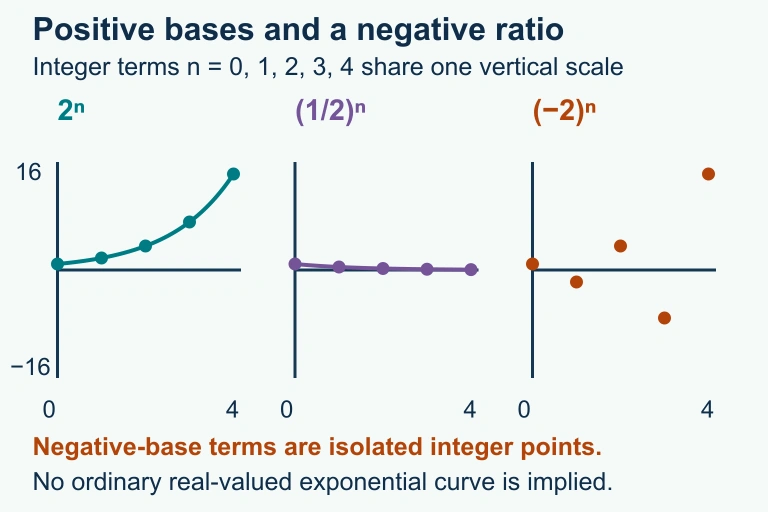
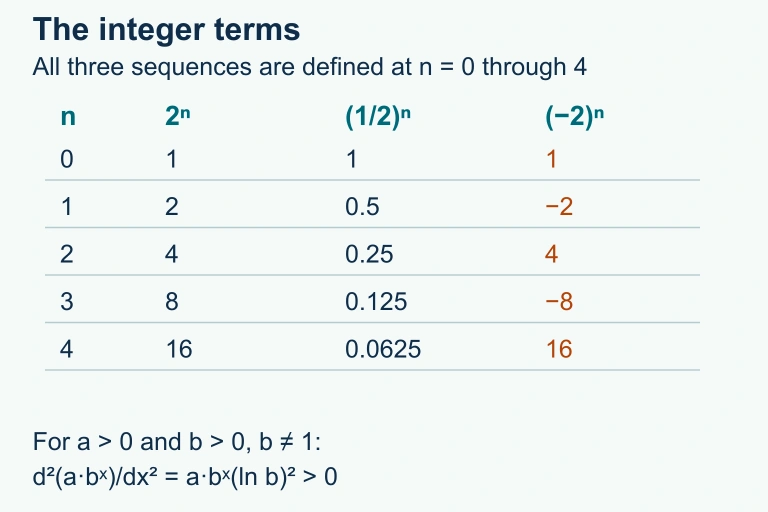
The sequence-to-function bridge is one of the most important conceptual links in AP Precalculus. Every arithmetic sequence with common difference d defines a linear function whose slope equals d, and every geometric sequence with positive common ratio r defines an ordinary real exponential interpolation whose base equals r. A negative ratio still defines an integer-index sequence, but not an ordinary real exponential function on all real inputs. This correspondence has deeper implications when you advance to calculus, where the derivative of a linear function is a constant (paralleling the constant first difference) and the derivative of an exponential function is proportional to the function itself (paralleling the constant ratio). Concept in Sequences | Concept in Continuous Functions | Calculus Extension Common difference d | Slope m in f(x) = mx + b | f′(x) = m (constant derivative) Positive common ratio r > 0 | Base b in g(x) = a · bˣ | g′(x) = a · bˣ · ln(b) (proportional to g) Constant first differences | Constant average rate of change | Zero second derivative (no concavity) Constant successive ratios | Constant percentage rate of change over equal intervals | For a > 0, b > 0 and b ≠ 1, g″(x) = a·bˣ·(ln b)² > 0: growth and decay are both concave up. Neither constant | Neither linear nor exponential; consider polynomial, logistic, etc. | Requires higher-order analysis An important AP Precalculus topic is the semi-log plot. When a positive geometric sequence with a₀ > 0 and r > 0 is plotted on a standard scale, it curves. However, if you take the logarithm of each term, the resulting values form an arithmetic sequence because log(a₀ · rⁿ) = log(a₀) + n · log(r), which is linear in n with common difference log(r). This transformation—plotting the log of the output against the input—is exactly what a semi-log scale does, and it is the standard graphical test for exponential behavior on the AP exam. A linear pattern on a semi-log plot supports an exponential candidate; finite data do not uniquely establish that model. Looking Ahead In AP Calculus, the idea that the derivative of an exponential function is proportional to the function itself leads directly to the study of differential equations of the form dy/dx = ky. For positive r, the parameter k in that equation is precisely ln(r) from the geometric sequence perspective, completing the circle from discrete multiplicative change to continuous exponential growth.