
SECTION 1
Historical Context & Motivation
For centuries, mathematicians and physicists grappled with quantities that could not be captured by a single number. A temperature of 25°C is fully described by its magnitude alone, but a wind blowing at 30 km/h only tells half the story—you also need to know which way it blows. The formal language of vectors arose precisely to handle quantities that possess both magnitude and direction, unifying ideas from geometry, physics, and algebra into a single powerful framework.
1799 • Wessel's Geometric Representation
1843 • Hamilton's Quaternions
1844 • Grassmann's Theory of Extension
1881–1884 • Gibbs & Heaviside Formalize Vectors
1888 • Peano's Axioms for Vector Spaces
The central question these developments addressed was deceptively simple: how can we do arithmetic with quantities that have direction? Scalars obey familiar rules on the number line, but directed quantities live in higher-dimensional spaces and require new operations—addition that follows the parallelogram law, multiplication that produces both scalar and vector results, and decomposition into perpendicular components. Mastering these operations is essential for AP Precalculus and for every quantitative discipline that follows.
SECTION 2
Core Principles & Definitions
A vector is a mathematical object defined by a magnitude (length) and a direction. In contrast, a scalar is fully specified by a single real number. Vectors are typically written in boldface (v) or with an arrow notation (v⃗), while their magnitude is written as |v| or ‖v‖. Two vectors are equal if and only if they share the same magnitude and direction, regardless of where they are positioned in the plane.
Component Form
Magnitude
Direction Angle
Vector Addition
Scalar Multiplication
SECTION 3
Visual Explanation — Vectors in the Coordinate Plane
The diagram above illustrates several foundational ideas simultaneously. Each vector originates at the origin and terminates at the point given by its components, so the cyan vector u = ⟨3, 2⟩ ends at the coordinate (3, 2). The pink dashed lines reveal that any vector can be decomposed into horizontal and vertical components using right-triangle geometry. The direction angle θ of u is measured from the positive x-axis, and in this case θ = tan⁻¹(2/3) ≈ 33.7°. Notice that the tip-to-tail method for addition produces the same resultant regardless of which vector is placed first—a visual confirmation of the commutativity of vector addition.
SECTION 4
Mathematical Framework
The algebraic treatment of vectors in ℝ² rests on a small collection of formulas that translate geometric operations into arithmetic. Every operation on vectors can be performed component-wise, making computation straightforward once the vector is expressed in component form.
MAGNITUDE
For v = ⟨a, b⟩, the magnitude ‖v‖ is the distance from the origin to the point (a, b), derived directly from the Pythagorean theorem.
DIRECTION ANGLE
The reference angle from tan⁻¹(|b/a|) is placed into the correct quadrant by inspecting the signs of a and b. If a < 0, add 180°; if a > 0 and b < 0, add 360°.
UNIT VECTOR
Dividing any nonzero vector by its magnitude produces a unit vector in the same direction with ‖û‖ = 1. The standard basis vectors i = ⟨1, 0⟩ and j = ⟨0, 1⟩ are the unit vectors along the x- and y-axes.
POLAR ↔ COMPONENT CONVERSION
Given magnitude ‖v‖ and direction angle θ, the horizontal component is ‖v‖ cos θ and the vertical component is ‖v‖ sin θ. This is the bridge between polar (magnitude-direction) form and component form.
The dot product of two vectors u = ⟨u₁, u₂⟩ and v = ⟨v₁, v₂⟩ is defined as u · v = u₁v₁ + u₂v₂. This scalar quantity equals ‖u‖‖v‖ cos α, where α is the angle between the vectors. The dot product is zero precisely when the vectors are perpendicular (orthogonal), making it a powerful tool for testing geometric relationships algebraically.
 Add the boat’s velocity relative to the water to the current’s velocity relative to the ground. Components give a ground speed of about 16.52 km/h, directed 8.70° north of east.
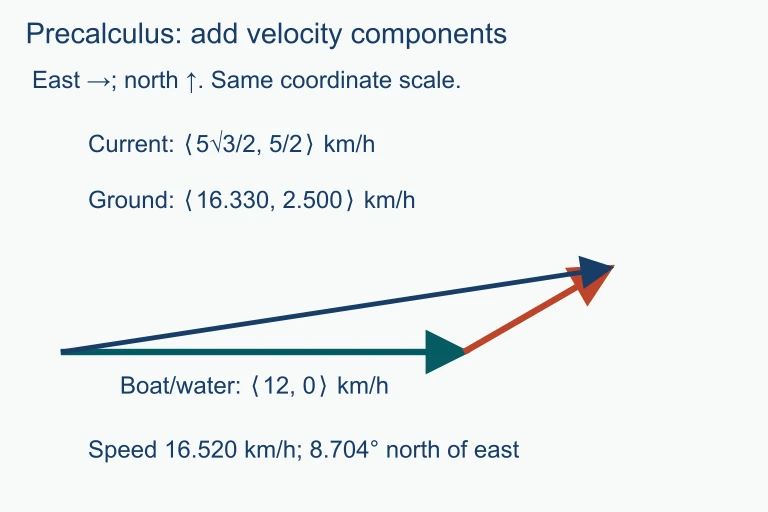 Add the boat’s velocity relative to the water to the current’s velocity relative to the ground. Components give a ground speed of about 16.52 km/h, directed 8.70° north of east.
SECTION 5
Detailed Breakdown of Vector Operations
Understanding vectors fully requires fluency with several interrelated operations. The table below organizes the key operations, their algebraic definitions, and their geometric interpretations so that you can see how each formula connects back to a visual idea.
| Operation | Algebraic Definition | Geometric Meaning |
|---|---|---|
| Addition | ⟨a₁ + a₂, b₁ + b₂⟩ | Tip-to-tail displacement; diagonal of parallelogram |
| Subtraction | ⟨a₁ − a₂, b₁ − b₂⟩ | Vector from the head of v to the head of u |
| Scalar multiplication | ⟨ka, kb⟩ | Stretches or shrinks by |k|; reverses if k < 0 |
| Magnitude | √(a² + b²) | Length of the arrow (Pythagorean theorem) |
| Dot product | u₁v₁ + u₂v₂ | ‖u‖‖v‖ cos α; measures alignment / orthogonality |
| Unit vector | v / ‖v‖ | Direction preserved, magnitude normalized to 1 |
Summary of fundamental vector operations in ℝ²
The left panel drives home how scalar multiplication affects a vector: multiplying by a positive scalar greater than 1 stretches the vector while preserving direction, whereas a negative scalar reverses direction. The right panel is especially important for AP Precalculus because it demonstrates the polar-to-component conversion that appears frequently on the exam. When a problem states "a force of 50 N at 60°," you should immediately decompose it as ⟨50 cos 60°, 50 sin 60°⟩ = ⟨25, 25√3⟩. Mastering this conversion eliminates the most common source of errors on vector problems.
SECTION 6
Worked Example
A boat is heading due east at 12 km/h, but a river current pushes it in the direction 30° north of east at 5 km/h. Find the resultant velocity vector, its magnitude (the boat's actual speed), and the direction angle of the boat's true path.
Worked example
- 1
Step 1 — Express each velocity in component form
The boat's velocity is vb = ⟨12, 0⟩ (due east means θ = 0°). The current's velocity is vc = ⟨5 cos 30°, 5 sin 30°⟩ = ⟨5 × (√3/2), 5 × (1/2)⟩ = ⟨5√3/2, 5/2⟩ ≈ ⟨4.330, 2.500⟩.vb = ⟨12, 0⟩; vc ≈ ⟨4.330, 2.500⟩ - 2
Step 2 — Add component-wise to find the resultant
vr = vb + vc = ⟨12 + 5√3/2, 0 + 5/2⟩ = ⟨12 + 5√3/2, 5/2⟩ ≈ ⟨16.330, 2.500⟩.vr ≈ ⟨16.330, 2.500⟩ - 3
Step 3 — Compute the magnitude (speed)
‖vr‖ = √(16.330² + 2.500²) = √(266.668 + 6.250) = √272.918 ≈ 16.52 km/h.Speed ≈ 16.52 km/h - 4
Step 4 — Compute the direction angle
θ = tan⁻¹(2.500 / 16.330) = tan⁻¹(0.1531) ≈ 8.7°. Both components are positive (Quadrant I), so no adjustment is needed.Direction ≈ 8.7° north of east
SECTION 7
Comparing Representations & Common Pitfalls
Vectors can be represented in two primary ways—component form and magnitude-direction (polar) form—and each has strengths depending on the task at hand. Choosing the right representation at the right time is a hallmark of mathematical fluency.
| Feature | Component Form ⟨a, b⟩ | Magnitude-Direction (‖v‖, θ) |
|---|---|---|
| Addition / subtraction | Easy — add/subtract components | Requires conversion to components first |
| Scalar multiplication | Multiply each component by k | Multiply magnitude by |k|; negate angle if k < 0 |
| Physical intuition | Less intuitive for real-world descriptions | Natural — "50 N at 60°" is immediate |
| Dot product | Direct — u₁v₁ + u₂v₂ | Requires knowing the angle between vectors |
| Common error | Forgetting to check signs of components | Using tan⁻¹ without quadrant adjustment |
Comparison of component form vs. magnitude-direction form
SECTION 8
Connection to Advanced Theory
The two-dimensional vectors you study in AP Precalculus are the gateway to a vast mathematical landscape. In subsequent courses—calculus, linear algebra, physics—vectors generalize to higher dimensions, gain new operations, and become the language of change, force, and transformation.
| AP Precalculus Concept | Advanced Extension |
|---|---|
| Vectors in ℝ² | Vectors in ℝ³ and ℝⁿ; abstract vector spaces over arbitrary fields |
| Dot product u · v | Inner products, projections, least-squares regression, and Fourier analysis |
| Magnitude and unit vectors | Norms in functional analysis; normalization in machine learning |
| Component form ⟨a, b⟩ | Matrix columns as vectors; linear transformations T(v) = Av |
| Direction angle θ | Argument of complex numbers; polar coordinates in multivariable calculus |
How AP Precalculus vector concepts extend into higher mathematics
In three dimensions, a new operation called the cross product produces a vector perpendicular to both inputs, enabling the computation of torques, surface normals, and magnetic forces. Meanwhile, matrices—another topic in this AP Precalculus unit—can be viewed as collections of column vectors, and the operations you learn here (addition, scalar multiplication, dot product) extend seamlessly to matrix algebra. Building rock-solid intuition with two-dimensional vectors now will pay dividends throughout your mathematical career.
SECTION 9
Practice Problems
Question 1: CONCEPTUAL
- A. A vector has magnitude only, while a scalar has both magnitude and direction.
- B. A vector can be negative, but a scalar is always positive.
- C. A vector has both magnitude and direction, while a scalar has magnitude only.
- D. A vector is always larger than a scalar because it has more components.
- E. A vector and a scalar differ only in notation; they carry the same information.
Show answer (C)
Question 2: BASIC CALCULATION
- A. ‖u‖ = 7; û = ⟨−3/7, 4/7⟩
- B. ‖u‖ = 5; û = ⟨−3/5, 4/5⟩
- C. ‖u‖ = 25; û = ⟨−3/25, 4/25⟩
- D. ‖u‖ = 5; û = ⟨3/5, −4/5⟩
- E. ‖u‖ = 1; û = ⟨−3, 4⟩
Show answer (B)
Question 3: INTERMEDIATE
- A. ⟨40√3, 40⟩
- B. ⟨−40, 40√3⟩
- C. ⟨−40√3, 40⟩
- D. ⟨−40√3, −40⟩
- E. ⟨40, −40√3⟩
Show answer (C)
Question 4: APPLIED
Show answer
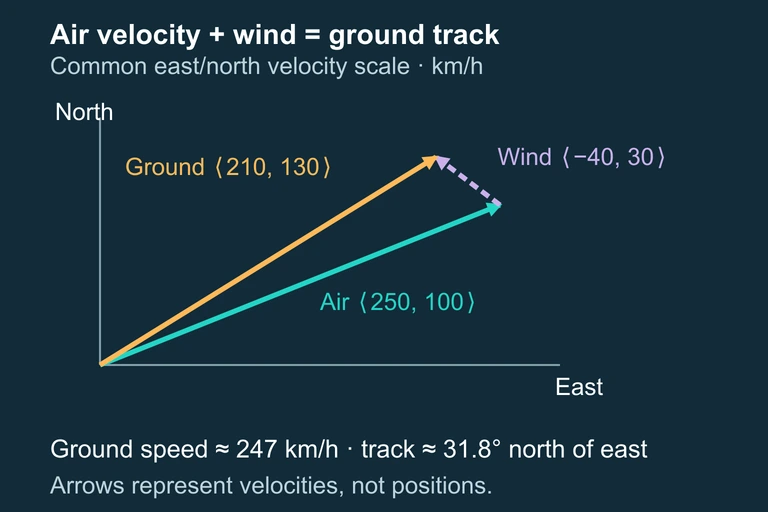 Aircraft air velocity and wind add to ground velocity in one east–north frame; heading and ground-track direction differ.
Question 5: CRITICAL THINKING