
SECTION 1
Historical Context & Motivation
The need to solve trigonometric equations is as old as trigonometry itself. Ancient astronomers in Babylon, Greece, and India sought to predict celestial positions—problems that invariably reduce to finding unknown angles satisfying relationships among chord lengths and arc measures. When Hipparchus of Nicaea compiled the first known table of chords around 150 BCE, he was essentially constructing an inverse lookup that allowed one to solve equations of the form crd(θ) = k for the angle θ. The difficulty, then as now, is that trigonometric functions are periodic: a single equation can have infinitely many solutions, and identifying the correct subset within a given domain requires both algebraic precision and geometric insight.
c. 150 BCE • Hipparchus' Chord Tables
c. 500 CE • Indian Sine Tables
1748 • Euler's Analytic Framework
1800s • Fourier & Harmonic Analysis
Today, solving trigonometric equations and inequalities is a cornerstone of precalculus and appears throughout calculus, physics, and engineering. The fundamental challenge remains: given the periodic and bounded nature of sine, cosine, and tangent, how do we systematically find all solutions on a specified interval, and how do we determine where a trigonometric expression is positive, negative, or exceeds a threshold? These questions drive the techniques you will master in this lesson.
SECTION 2
Core Principles & Definitions
Before diving into technique, it is essential to internalize the structural properties of trigonometric functions that govern how their equations and inequalities behave. A trigonometric equation is any equation in which the unknown appears inside a trigonometric function—for example, 2 sin(x) − 1 = 0 or cos²(x) = 3/4. A trigonometric inequality replaces the equality sign with an inequality: sin(x) > 1/2 or tan(x) ≤ −1. The following principles underpin every solution strategy.
Periodicity
Bounded Range
Reference Angles & Symmetry
Algebraic Reduction
Interval Awareness
KEY TAKEAWAY
SECTION 3
Visual Explanation: The Unit Circle & Solution Sets
The unit circle provides the most powerful visual framework for understanding trigonometric equations and inequalities. When you solve sin(x) = 1/2, you are asking: at which angles does the y-coordinate on the unit circle equal 1/2? The diagram below illustrates this geometric interpretation, showing how a single horizontal line y = 1/2 intersects the circle at exactly two points per revolution, yielding the two fundamental solutions π/6 and 5π/6 on the interval [0, 2π).
Notice the symmetry: the two solutions are equidistant from the y-axis, located in Quadrants I and II where sine is positive. This pattern generalizes: for any value k with −1 < k < 1, the equation sin(x) = k yields two solutions per period—one in the first or fourth quadrant (the reference angle α = sin⁻¹(|k|)) and one in the supplementary or reflex position determined by the sign of k and the relevant quadrants. For inequalities, the solution set becomes an arc (interval of angles) rather than isolated points.
SECTION 4
Mathematical Framework
The general solution formulas encode the periodicity of each trigonometric function. Once you identify the principal solutions within one period, these formulas generate every solution on the real line. When a specific domain is given, you select only those values of the integer parameter n that produce angles within the domain.
GENERAL SOLUTION — SINE
Valid for −1 ≤ k ≤ 1. Here sin⁻¹(k) denotes the principal value in [−π/2, π/2]. The two families of solutions correspond to Quadrants I & II (for k > 0) or Quadrants III & IV (for k < 0).
GENERAL SOLUTION — COSINE
Valid for −1 ≤ k ≤ 1. The ± reflects the even symmetry of cosine: if α is a solution, so is −α (equivalently, 2π − α within [0, 2π)).
GENERAL SOLUTION — TANGENT
Valid for all real k. Tangent has period π, so only one family of solutions is needed. The principal value tan⁻¹(k) lies in (−π/2, π/2).
Solving Trigonometric Inequalities
Trigonometric inequalities require you to find the set of angles for which a trigonometric expression lies above or below a threshold. The general strategy is: (1) solve the corresponding equation to find the boundary angles, (2) use the unit circle or the graph to determine which arcs satisfy the inequality, and (3) express the solution as a union of intervals, adding multiples of the period if a general solution is requested. For example, to solve sin(x) > 1/2 on [0, 2π), first note that sin(x) = 1/2 at x = π/6 and x = 5π/6. Since sin is positive and exceeds 1/2 between these angles (the upper arc), the solution is the open interval (π/6, 5π/6).
QUADRATIC TRIG EQUATION — SUBSTITUTION
Solve the quadratic in u, then discard any roots with |u| > 1. For each valid root u₀, solve sin(x) = u₀ using the general sine formula. The same technique applies with cos(x) or tan(x) as the substitution variable.
SECTION 5
Detailed Breakdown of Solution Methods
The technique you choose depends on the structure of the equation. Below is a classification of the most common types encountered on the AP Precalculus exam, along with the recommended approach for each. The accompanying diagram shows the graph of y = sin(x) alongside a constant line, illustrating how solutions to both equations and inequalities are read off the graph.
| Equation Type | Example | Strategy |
|---|---|---|
| Linear | 2 sin(x) − 1 = 0 | Isolate the trig function, then use inverse trig and the unit circle to find all solutions in the domain. |
| Quadratic | 2cos²(x) − cos(x) − 1 = 0 | Substitute u = cos(x), factor or use the quadratic formula, discard extraneous roots with |u| > 1, then back-substitute. |
| Multiple Angle | sin(2x) = √3/2 | Let u = 2x, solve sin(u) = √3/2, then divide all solutions by 2. Adjust the domain: if x ∈ [0, 2π), then u ∈ [0, 4π). |
| Identity-Based | sin(x) + cos(x) = 1 | Square both sides (checking for extraneous solutions) or rewrite using the auxiliary angle method: a sin(x) + b cos(x) = R sin(x + φ). |
| Factored/Zero Product | sin(x)(2cos(x) − 1) = 0 | Apply the zero-product property: set each factor equal to zero and solve independently. Combine solution sets. |
Classification of trigonometric equation types and recommended solution strategies
SECTION 6
Worked Example
Let's work through a multi-step problem that combines algebraic manipulation with unit-circle reasoning, typical of what appears on the AP Precalculus exam.
Solve 2cos²(x) − cos(x) − 1 = 0 on [0, 2π)
- 1
Step 1 — Recognize the Quadratic Structure
The equation 2cos²(x) − cos(x) − 1 = 0 is quadratic in cos(x). Let u = cos(x), giving us the standard quadratic 2u² − u − 1 = 0. - 2
Step 2 — Factor the Quadratic
Factor: 2u² − u − 1 = (2u + 1)(u − 1) = 0. This yields two roots: u = −1/2 and u = 1.cos(x) = −1/2 or cos(x) = 1 - 3
Step 3 — Check Feasibility
Both values lie within [−1, 1], so both are feasible. No extraneous roots need to be discarded. - 4
Step 4 — Solve cos(x) = 1
On the unit circle, cos(x) = 1 only at x = 0. Since the domain is [0, 2π) and 0 is included, this gives one solution.x = 0 - 5
Step 5 — Solve cos(x) = −1/2
The reference angle is cos⁻¹(1/2) = π/3. Since cosine is negative in Quadrants II and III, the solutions are x = π − π/3 = 2π/3 and x = π + π/3 = 4π/3.x = 2π/3 and x = 4π/3 - 6
Step 6 — Combine and State the Solution Set
Gathering all solutions on [0, 2π), we obtain the complete solution set.x ∈ {0, 2π/3, 4π/3}
Verification Tip
SECTION 7
Common Strategies, Strengths & Pitfalls
Different solution strategies have distinct advantages and limitations. Choosing the right approach saves time and reduces errors, especially under exam conditions. The following table compares the major approaches and highlights the most common mistakes students make.
| Strategy | Strengths | Pitfalls / Limitations |
|---|---|---|
| Unit Circle Lookup | Fast for standard angles (multiples of π/6, π/4, π/3). Gives exact answers. Visual intuition for inequalities. | Limited to memorized values. Students often forget Quadrant III and IV solutions. |
| Algebraic Substitution | Handles quadratic and higher-degree trig equations systematically. Leverages familiar polynomial techniques. | Must check |u| ≤ 1 for sin/cos. Forgetting to back-substitute or losing solutions when squaring both sides. |
| Graphical / Calculator | Excellent for inequalities and verifying algebraic work. Shows solution structure at a glance. | Approximate answers only (unless exact angles are recognizable). Requires careful window settings. |
| Identity Rewriting | Converts complex expressions into simpler forms. Essential for equations mixing sin and cos. | Choosing the wrong identity can complicate the problem. Squaring may introduce extraneous solutions. |
Comparison of solution strategies for trigonometric equations
COMMON EXAM PITFALL
SECTION 8
Connection to Calculus & Advanced Topics
Trigonometric equations and inequalities appear at the foundation of several calculus and advanced mathematics topics. The skills you build here—identifying periodicity, working with inverse trig functions, and handling multi-valued solutions—transfer directly to integration bounds, differential equations, and Fourier analysis. The table below shows how precalculus-level trig equation techniques connect to their calculus counterparts.
| AP Precalculus Skill | Calculus / Advanced Connection |
|---|---|
| Solving sin(x) = k, cos(x) = k for all solutions | Finding x-intercepts and critical points of trigonometric functions in calculus; setting f′(x) = 0 when f involves trig functions. |
| Solving trig inequalities on an interval | Determining integration bounds for area between curves (e.g., area between sin(x) and a horizontal line). |
| General solutions with +2nπ or +nπ | Understanding periodicity in differential equations; solutions to y″ + y = 0 are sinusoidal with periodic structure. |
| Quadratic substitution for trig equations | u-substitution in integration; Weierstrass substitution (t = tan(x/2)) for rational trig integrals. |
| Reference angles and symmetry | Exploiting symmetry to simplify definite integrals: ∫₋ₐᵃ even function = 2∫₀ᵃ, and recognizing that odd trig integrals vanish over symmetric intervals. |
How precalculus trig equation skills extend into calculus
Looking further ahead, Fourier analysis—the decomposition of arbitrary periodic functions into sums of sines and cosines—relies fundamentally on solving systems of trigonometric equations. In physics and engineering, the oscillatory solutions to wave equations and circuit equations are expressed in trigonometric form, and determining resonance conditions, phase shifts, and amplitude thresholds all reduce to the kinds of trigonometric equations and inequalities you are learning to solve now.
SECTION 9
Practice Problems
Question 1: CONCEPTUAL
- A. k = 0
- B. k = 1/2
- C. k = −1
- D. k = −1/2
- E. k = √2/2
Show answer (C)
Question 2: BASIC CALCULATION
- A. x = π/3 and x = 2π/3
- B. x = 4π/3 and x = 5π/3
- C. x = 2π/3 and x = 4π/3
- D. x = 5π/6 and x = 7π/6
- E. x = 5π/3 only
Show answer (B)
Question 3: INTERMEDIATE
- A. 2 solutions
- B. 3 solutions
- C. 4 solutions
- D. 5 solutions
- E. 6 solutions
Show answer (C)
Question 4: APPLIED
4 ptsShow answer
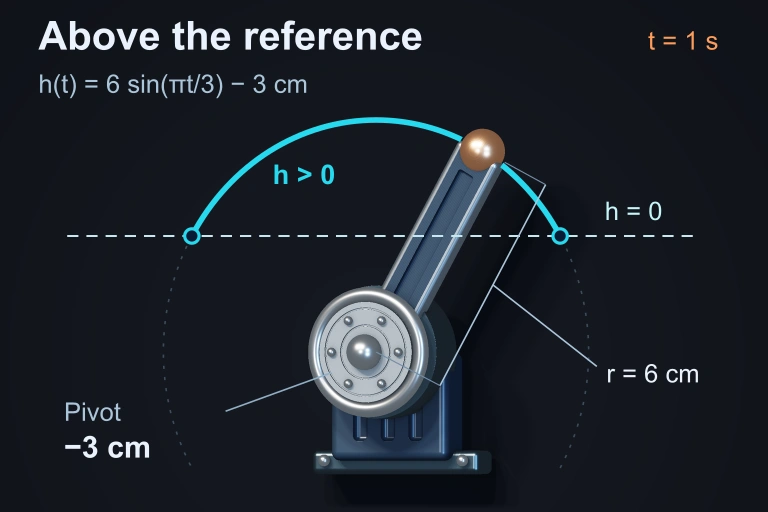
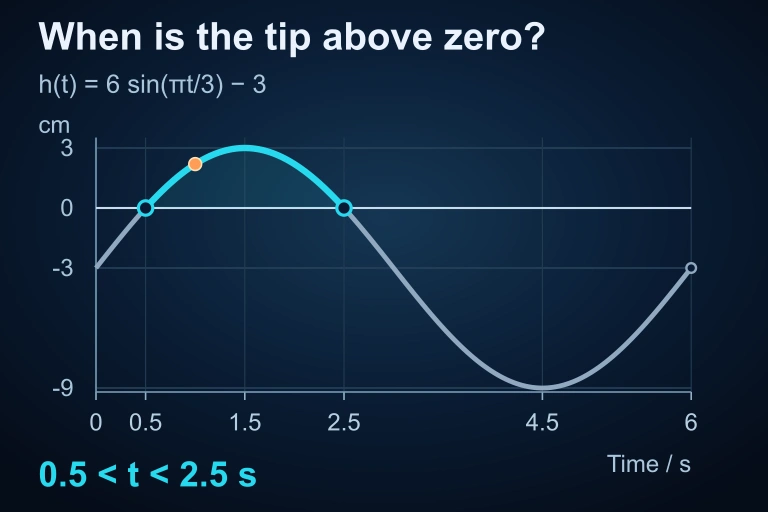 Height h(t)=6sin(πt/3)−3 over one cycle, with maximum 3, minimum −9 and zeros at t=0.5 and 2.5. The positive-height interval is (0.5,2.5).
Question 5: CRITICAL THINKING
3 ptsShow answer
SUMMARY
Lesson Summary
Summary
Solving trigonometric equations begins by isolating the trigonometric function and then using inverse trigonometric functions and unit circle symmetry to identify all solutions within the specified domain. The key structural fact is periodicity: sine and cosine repeat every 2π (yielding two solutions per period for non-extreme values), while tangent repeats every π (one solution per period). For equations with compound arguments like sin(2x), adjust the domain accordingly before solving. Algebraic substitution transforms quadratic trig equations into standard polynomial form—just remember to discard roots outside [−1, 1] and to back-substitute.
For trigonometric inequalities, first solve the corresponding equation to find boundary angles, then use the graph or unit circle to determine which arcs satisfy the inequality. Express solutions as intervals of angles, paying careful attention to whether endpoints are included (≤, ≥) or excluded (<, >). Always verify solutions by substitution, and remember that these techniques form the foundation for calculus-level applications such as finding critical points, integration bounds, and solving differential equations.