

SECTION 1
Historical Context & Motivation
Long before the tangent function appeared in modern textbooks, ancient astronomers and surveyors needed a way to relate the length of a shadow to the height of the object casting it. The concept of a tangent — from the Latin tangens, meaning "touching" — originated in the geometric idea of a line segment touching a circle at exactly one point and extending to an external line. This geometric tangent segment's length turns out to equal the ratio of the sine to the cosine for the corresponding central angle, giving rise to the trigonometric function we study today. Unlike sine and cosine, which were primarily motivated by the geometry of chords in circles, the tangent function grew directly out of practical problems in shadow reckoning and astronomical computation, making it one of the earliest trigonometric tools applied outside pure geometry.
~800 CE • Islamic Golden Age
~1150 • Bhāskara II in India
1583 • Thomas Fincke's Geometria Rotundi
1748 • Euler's Introductio
From shadow tables to Euler's analytic reformulation, the tangent function has evolved into a fundamental building block of trigonometry. Its behavior differs markedly from sine and cosine: it is unbounded, has vertical asymptotes, and repeats with period π rather than 2π. Understanding these distinctive features — and why they arise from the ratio sin θ / cos θ — is the central question this lesson addresses.
SECTION 2
Core Principles & Definitions
The tangent function can be understood from multiple perspectives — the unit circle, right-triangle ratios, and the analytic quotient of sine and cosine. Each viewpoint reinforces the others and reveals different aspects of the function's behavior. The following foundational ideas capture the essential properties you will need for the AP Precalculus exam.
Quotient Identity
Period of π
Odd Symmetry
Unbounded Range
Unit-Circle Interpretation
KEY TAKEAWAY
SECTION 3
Visualizing the Tangent Function
The graph of y = tan x reveals a fundamentally different shape from the familiar sinusoidal curves of sine and cosine. Rather than oscillating between fixed bounds, the tangent curve sweeps from −∞ to +∞ within each period of length π, separated by vertical asymptotes where cosine equals zero. The diagram below shows three full periods of the tangent function centered at the origin.
Several key features are visible in this graph. First, the x-intercepts occur at x = nπ for every integer n, since sin(nπ) = 0 while cos(nπ) ≠ 0. Second, the curve is strictly increasing on every interval between consecutive asymptotes — there are no local maxima or minima. Third, the midpoint of each branch (the inflection point) coincides with the x-intercept, reflecting the odd symmetry of the function about each of these points. Finally, as x approaches any asymptote, the function values grow without bound in magnitude, which is why the tangent function has no finite amplitude.
SECTION 4
Mathematical Framework
A rigorous understanding of the tangent function requires both its defining identity and the general form used in transformations. The equations below form the analytical backbone of every AP Precalculus problem involving tangent.
FUNDAMENTAL DEFINITION
Defined for all θ where cos θ ≠ 0, i.e., θ ≠ π/2 + nπ for any integer n. The domain of the parent function is { x ∈ ℝ : x ≠ π/2 + nπ, n ∈ ℤ }, and the range is (−∞, ∞).
GENERAL TRANSFORMED FORM
a = vertical stretch/compression (no amplitude, but controls steepness). b = horizontal stretch factor; the period becomes π/|b|. c = horizontal (phase) shift. d = vertical shift, which moves the center of each branch up or down.
PERIOD FORMULA
For the parent function (b = 1), the period is π. If b = 2, the period shrinks to π/2; if b = 1/3, the period stretches to 3π. The asymptotes are spaced one half-period apart from the center of each branch.
ASYMPTOTE LOCATIONS (GENERAL FORM)
These are the values of x where cos(b(x − c)) = 0. For the parent function y = tan x, this simplifies to x = π/2 + nπ. The asymptotes serve as boundaries of each monotonically increasing branch.
A few additional identities are worth internalizing. The Pythagorean identity 1 + tan²θ = sec²θ connects tangent to secant, and the cofunction identity tan(π/2 − θ) = cot θ relates tangent to cotangent. The tangent addition formula, tan(α + β) = (tan α + tan β) / (1 − tan α · tan β), is essential for verifying identities and solving equations where arguments are combined. Each of these formulas derives directly from the quotient definition and the corresponding sine/cosine identities.
SECTION 5
Transformations & Key Values
Mastery of the tangent function on the AP exam requires fluency with standard angle values and the ability to read transformed graphs. The table below summarizes exact tangent values at key angles, while the subsequent diagram illustrates how the parameters a, b, c, and d alter the parent curve.
| θ (radians) | θ (degrees) | sin θ | cos θ | tan θ |
|---|---|---|---|---|
| 0 | 0° | 0 | 1 | 0 |
| π/6 | 30° | 1/2 | √3/2 | √3/3 |
| π/4 | 45° | √2/2 | √2/2 | 1 |
| π/3 | 60° | √3/2 | 1/2 | √3 |
| π/2 | 90° | 1 | 0 | undefined |
| 2π/3 | 120° | √3/2 | −1/2 | −√3 |
| 3π/4 | 135° | √2/2 | −√2/2 | −1 |
| π | 180° | 0 | −1 | 0 |
Exact values of tan θ at standard angles
The diagram highlights three critical transformation effects. The parameter d = −1 in the cyan curve shifts the entire graph downward, moving the inflection point from (0, 0) to (0, −1) without changing the period or asymptote locations. In contrast, the amber curve shows the combined effect of b = 2 (period shrinks to π/2) and a = 1/2 (the curve approaches its asymptotes more gradually). When analyzing transformed tangent graphs on the AP exam, always identify the asymptotes first, then locate the midpoint of each branch to determine the phase and vertical shifts.
SECTION 6
Worked Example
The following worked example walks through a complete problem involving identification of all key features of a transformed tangent function — exactly the type of analysis required on the AP Precalculus exam.
Finding Key Features of y = 3 tan(2x − π) + 1
- 1
Step 1 — Rewrite in Standard Form
Factor out the coefficient of x inside the argument: y = 3 tan(2(x − π/2)) + 1. Now we can directly read off the parameters: a = 3, b = 2, c = π/2, d = 1.y = 3 tan(2(x − π/2)) + 1 - 2
Step 2 — Determine the Period
Apply the period formula: Period = π/|b| = π/|2| = π/2. The tangent curve completes one full branch every π/2 units along the x-axis, which is half the parent tangent's period.Period = π/2 - 3
Step 3 — Locate the Vertical Asymptotes
Vertical asymptotes occur where the argument equals π/2 + nπ, i.e., 2(x − π/2) = π/2 + nπ. Solving: x − π/2 = π/4 + nπ/2, so x = 3π/4 + nπ/2 for n ∈ ℤ. The first few asymptotes are at x = π/4, 3π/4, 5π/4, and so on.Asymptotes: x = 3π/4 + nπ/2, n ∈ ℤ (e.g., x = π/4, 3π/4, 5π/4, …) - 4
Step 4 — Find the Center of Each Branch (Phase & Vertical Shift)
The midpoint between consecutive asymptotes at x = π/4 and x = 3π/4 is x = π/2 = c. At x = π/2, the argument is 2(π/2 − π/2) = 0, so y = 3 tan(0) + 1 = 0 + 1 = 1. The center of the principal branch is the point (π/2, 1), confirming a phase shift of π/2 to the right and a vertical shift of 1 upward.Center of principal branch: (π/2, 1) - 5
Step 5 — Determine One-Quarter and Three-Quarter Points
Quarter points help sketch the curve. At one quarter-period to the right of the center: x = π/2 + (1/4)(π/2) = π/2 + π/8 = 5π/8. The argument is 2(5π/8 − π/2) = 2(π/8) = π/4, so y = 3 tan(π/4) + 1 = 3(1) + 1 = 4. Similarly, one quarter-period to the left: x = π/2 − π/8 = 3π/8, giving y = 3 tan(−π/4) + 1 = 3(−1) + 1 = −2.Quarter points: (3π/8, −2) and (5π/8, 4) - 6
Step 6 — State Domain and Range
The domain excludes all asymptote locations: { x ∈ ℝ : x ≠ 3π/4 + nπ/2, n ∈ ℤ }. Because the tangent function can take all real values and vertical shifts/stretches do not bound it, the range remains all real numbers.Domain: ℝ \ {3π/4 + nπ/2}; Range: (−∞, ∞)
SECTION 7
Tangent vs. Sine & Cosine
A frequent source of confusion on the AP Precalculus exam is the assumption that tangent behaves like sine and cosine. While all three are trigonometric functions defined on the unit circle, their graphical and algebraic properties differ in important ways. The comparison table below highlights the distinctions you must keep clear.
| Property | y = sin x / y = cos x | y = tan x |
|---|---|---|
| Period | 2π | π |
| Range | [−1, 1] | (−∞, ∞) |
| Amplitude | |a| (well-defined) | Not defined — unbounded |
| Vertical Asymptotes | None | At x = π/2 + nπ |
| Symmetry | sin: odd; cos: even | Odd |
| Domain | All real numbers | ℝ \ {π/2 + nπ} |
| Monotonicity per Period | Increases then decreases (or vice versa) | Strictly increasing on each branch |
| Zeros | sin: x = nπ; cos: x = π/2 + nπ | x = nπ (same as sin) |
Comparison of fundamental properties
KEY TAKEAWAY
SECTION 8
Connections to Calculus & Advanced Theory
The tangent function plays a pivotal role in calculus and beyond. Understanding its precalculus properties now lays the groundwork for the derivative and integral formulas you will encounter in AP Calculus AB/BC, as well as more advanced applications in differential equations and complex analysis.
| Concept | Precalculus Foundation | Calculus / Advanced Extension |
|---|---|---|
| Slope of terminal ray | tan θ = y/x on the unit circle gives the slope of the line from the origin | The derivative of tan x is sec²x, connecting the rate of change of slope to the secant function |
| Vertical asymptotes | Identified where cos x = 0; one-sided behavior → ±∞ | Formal limits: lim(x→π/2⁻) tan x = +∞; classification of infinite discontinuities |
| Inverse function | Restricting domain to (−π/2, π/2) makes tan x one-to-one, enabling arctan | ∫ 1/(1 + x²) dx = arctan x + C, a fundamental integral formula |
| Period and symmetry | Period π; odd function; monotonically increasing on each branch | Fourier series and partial fraction decompositions exploit periodicity and symmetry |
| Tangent addition formula | tan(α + β) = (tan α + tan β)/(1 − tan α tan β) | Basis for tangent half-angle substitution (Weierstrass substitution) in integral calculus |
Precalculus to calculus bridge
Perhaps the most significant forward connection is the inverse tangent function (arctan or tan⁻¹). Because tangent is strictly increasing on (−π/2, π/2), this restricted domain produces a well-defined inverse whose range is the open interval (−π/2, π/2). The arctan function appears throughout calculus — in antiderivatives, in polar-to-rectangular conversions, and in the computation of angles from slope data. On the AP Precalculus exam, you may be asked to state the domain restriction that makes tangent invertible and to evaluate compositions like tan(arctan x) or arctan(tan x) with careful attention to the restricted domain.
SECTION 9
Practice Problems
Question 1: CONCEPTUAL
- A. The sine function equals zero at those values of x.
- B. The cosine function equals zero at those values of x, making the quotient sin x / cos x undefined.
- C. The tangent function has an amplitude that exceeds the maximum value of sine.
- D. The tangent function is even, and even functions always have vertical asymptotes.
- E. The tangent function is defined only on a restricted domain of (−π/2, π/2).
Show answer (B)
Question 2: BASIC CALCULATION
- A. 2π/3
- B. π/3
- C. 3π
- D. π/2
- E. π/6
Show answer (B)
Question 3: INTERMEDIATE
- A. x = −π/12 and x = 5π/12
- B. x = 5π/12 and x = 11π/12
- C. x = π/6 and x = 2π/3
- D. x = π/3 and x = 5π/6
- E. x = −π/6 and x = π/3
Show answer (A)
Question 4: APPLIED
4 ptsShow answer
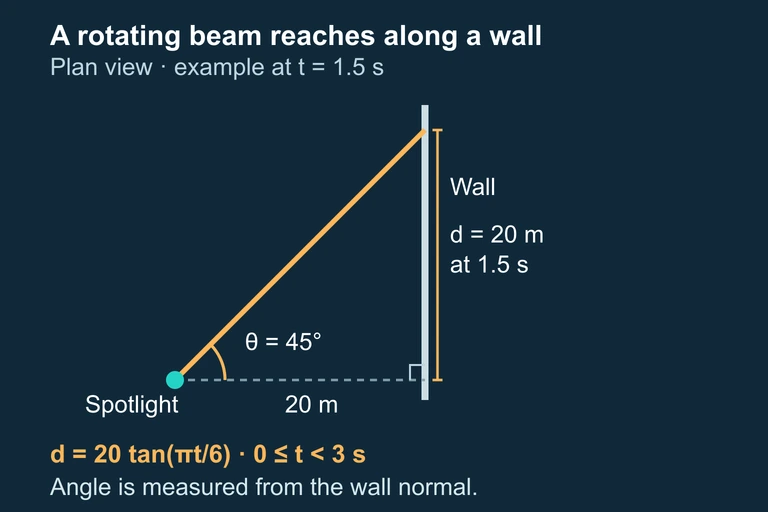 The wall spot follows d=20 tan(πt/6) before the light ray becomes parallel to the wall; the angle is from the wall-normal direction.
Question 5: CRITICAL THINKING
3 ptsShow answer
SUMMARY
Lesson Summary
Summary
The tangent function is defined as the quotient sin θ / cos θ, giving it a fundamentally different character from sine and cosine. It has a period of π (half that of sine and cosine), is an odd function with rotational symmetry about the origin, and has an unbounded range of (−∞, ∞). Vertical asymptotes occur at every value where cos x = 0, specifically at x = π/2 + nπ, and between consecutive asymptotes the function is strictly increasing.
Under the general transformation y = a tan(b(x − c)) + d, the parameter b determines the period (π/|b|), c shifts the graph horizontally, d shifts the graph vertically, and a controls the steepness without creating an amplitude. To analyze a transformed tangent graph, first locate the asymptotes, then find the midpoint (inflection point) of each branch, and finally use quarter-point evaluations to sketch the curve. Mastery of these features prepares you for both multiple-choice and free-response questions on the AP Precalculus exam.