
SECTION 1
Historical Context & Motivation
The sine and cosine functions are among the oldest mathematical tools still in active use, with roots stretching back thousands of years to civilizations that needed to measure angles for astronomy, architecture, and navigation. The word sine derives from the Latin sinus, itself a mistranslation of the Arabic jayb, which rendered the Sanskrit jyā meaning 'half-chord.' Ancient Indian mathematicians, particularly Āryabhaṭa (c. 500 CE), compiled tables of half-chord values that are functionally equivalent to modern sine tables, enabling precise astronomical calculations centuries before Europe developed comparable methods.
c. 1800 BCE • Babylonian Chord Tables
c. 150 CE • Ptolemy's Chord Table
c. 500 CE • Āryabhaṭa's Sine Table
1706 • Radian Measure & Modern Notation
1822 • Fourier's Theorem
The central question that drives this lesson is deceptively simple: given an angle θ, what are the exact values of sin θ and cos θ? On the AP Precalculus exam, you must recall these values quickly for standard angles, understand how the unit circle generates them, and reason about their signs across all four quadrants. A deep grasp of these values unlocks graphing, identities, inverse functions, and polar coordinates.
SECTION 2
Core Principles & Definitions
Sine and cosine values originate from the unit circle—a circle of radius 1 centered at the origin of the coordinate plane. When a terminal ray rotates counterclockwise from the positive x-axis through an angle θ, it intersects the unit circle at a point (x, y). By definition, cos θ = x and sin θ = y. This elegant construction converts angle measurement into coordinate geometry, and it generalizes far beyond the acute angles of right-triangle trigonometry.
Unit Circle Definition
Pythagorean Identity
Quadrant Sign Patterns
Reference Angles
Periodicity
KEY TAKEAWAY
SECTION 3
The Unit Circle — Visual Explanation
The diagram above captures the essential geometry: every point on the unit circle can be written as (cos θ, sin θ). Notice the symmetry—points in Quadrant I have mirrors in every other quadrant, and the coordinates differ only in sign. The reference angle determines the absolute values of the coordinates, while the quadrant dictates the signs. For instance, 30° and 150° share the reference angle 30° and therefore the same |sin| and |cos| values, but cos 150° is negative because x < 0 in Quadrant II. Internalizing this visual pattern allows you to derive any standard sine or cosine value on demand.
SECTION 4
Mathematical Framework
The exact values of sine and cosine at the standard angles derive from two classical geometric constructions: the 30-60-90 triangle and the 45-45-90 triangle. When these triangles are inscribed in the unit circle with the hypotenuse as the radius (length 1), their leg lengths directly yield the sine and cosine of each angle.
UNIT CIRCLE DEFINITION
θ is the angle in standard position (measured counterclockwise from the positive x-axis). The point (x, y) is the intersection of the terminal side with the unit circle.
PYTHAGOREAN IDENTITY
This follows directly from the equation of the unit circle. It holds for every real number θ and is the foundation for all other Pythagorean identities.
30-60-90 TRIANGLE RATIOS
Derived by bisecting an equilateral triangle of side 2. The short leg (opposite 30°) equals 1, and the longer leg (opposite 60°) equals √3, so dividing by the hypotenuse 2 gives the unit-circle coordinates.
45-45-90 TRIANGLE RATIOS
An isosceles right triangle with legs of length 1 has hypotenuse √2. Scaling so the hypotenuse equals 1 gives legs of 1/√2 = √2/2, which are both the sine and cosine of 45°.
Combining these triangle results with the quadrant sign rules produces the full table of exact values. For angles beyond 360° or less than 0°, apply coterminal angle reduction: subtract or add multiples of 2π (or 360°) until the angle lies in [0, 2π). Then identify the reference angle and attach the appropriate sign.
SECTION 5
Complete Table of Standard Values
The table below lists every standard angle from 0 to 2π with its exact sine and cosine value. These are the values you should commit to memory for the AP exam. Rather than rote memorization, notice the structural patterns: the sine column for 0° through 90° reads 0, 1/2, √2/2, √3/2, 1, and the cosine column reads those same values in reverse order.
| θ (degrees) | θ (radians) | sin θ | cos θ |
|---|---|---|---|
| 0° | 0 | 0 | 1 |
| 30° | π/6 | 1/2 | √3/2 |
| 45° | π/4 | √2/2 | √2/2 |
| 60° | π/3 | √3/2 | 1/2 |
| 90° | π/2 | 1 | 0 |
| 120° | 2π/3 | √3/2 | −1/2 |
| 135° | 3π/4 | √2/2 | −√2/2 |
| 150° | 5π/6 | 1/2 | −√3/2 |
| 180° | π | 0 | −1 |
| 210° | 7π/6 | −1/2 | −√3/2 |
| 225° | 5π/4 | −√2/2 | −√2/2 |
| 240° | 4π/3 | −√3/2 | −1/2 |
| 270° | 3π/2 | −1 | 0 |
| 300° | 5π/3 | −√3/2 | 1/2 |
| 315° | 7π/4 | −√2/2 | √2/2 |
| 330° | 11π/6 | −1/2 | √3/2 |
| 360° | 2π | 0 | 1 |
Exact sine and cosine values for all standard angles on the unit circle
Pattern Recognition Tip
SECTION 6
Worked Example
Finding sin(5π/3) and cos(5π/3)
- 1
Step 1 — Convert to Degrees (Optional Clarity Check)
5π/3 radians × (180°/π) = 300°. This confirms the angle is in Quadrant IV, since 270° < 300° < 360°.θ = 300°, Quadrant IV - 2
Step 2 — Find the Reference Angle
The reference angle for a Quadrant IV angle is 360° − θ = 360° − 300° = 60°. In radians: 2π − 5π/3 = π/3.Reference angle = 60° = π/3 - 3
Step 3 — Recall Exact Values for the Reference Angle
From the 30-60-90 triangle: sin 60° = √3/2 and cos 60° = 1/2.sin(π/3) = √3/2, cos(π/3) = 1/2 - 4
Step 4 — Apply Quadrant Signs
In Quadrant IV, x > 0 and y < 0, so cosine is positive and sine is negative.sin(5π/3) = −√3/2 , cos(5π/3) = 1/2
Finding cos(−7π/4)
- 1
Step 1 — Find a Coterminal Angle
Add 2π to the negative angle: −7π/4 + 2π = −7π/4 + 8π/4 = π/4. So −7π/4 is coterminal with π/4.Coterminal angle = π/4 (Quadrant I) - 2
Step 2 — Evaluate Directly
Since π/4 is in Quadrant I, both sine and cosine are positive. cos(π/4) = √2/2 from the 45-45-90 triangle.cos(−7π/4) = √2/2
SECTION 7
Symmetry Properties & Common Pitfalls
Understanding the symmetry relationships between sine and cosine greatly reduces the amount of information you need to memorize and helps you avoid sign errors on the exam. The table below summarizes the most important identities that arise from the unit circle's geometric symmetry.
| Symmetry Type | Identity | Geometric Meaning |
|---|---|---|
| Even/Odd | cos(−θ) = cos θ ; sin(−θ) = −sin θ | Reflecting across the x-axis negates y but preserves x. |
| Supplementary | sin(π − θ) = sin θ ; cos(π − θ) = −cos θ | Reflecting across the y-axis negates x but preserves y. |
| Cofunction | sin(π/2 − θ) = cos θ ; cos(π/2 − θ) = sin θ | Complementary angles swap the roles of the two legs in a right triangle. |
| Periodicity | sin(θ + 2π) = sin θ ; cos(θ + 2π) = cos θ | A full revolution returns to the same point on the unit circle. |
| Anti-supplementary | sin(π + θ) = −sin θ ; cos(π + θ) = −cos θ | The diametrically opposite point has both coordinates negated. |
Key symmetry identities derived from unit circle geometry
COMMON EXAM PITFALL
SECTION 8
Connections to Advanced Topics
Mastering sine and cosine function values is not an isolated skill—it serves as the foundation for nearly every topic that follows in trigonometry and calculus. The table below maps how knowledge of these exact values feeds directly into more advanced material you will encounter in AP Precalculus and beyond.
| This Lesson's Concept | Advanced Application |
|---|---|
| Exact values of sin θ and cos θ | Evaluating limits such as lim(x→π/6) [sin x / (1 − 2 cos x)] in calculus without a calculator |
| Quadrant sign rules | Solving trigonometric equations like 2 sin²θ − 1 = 0 across [0, 2π) by identifying all valid quadrants |
| Reference angle technique | Evaluating inverse trigonometric functions (e.g., finding arcsin(−√2/2) = −π/4) |
| Cofunction identities | Converting between sine and cosine representations for sinusoidal modeling (phase shifts) |
| Unit circle coordinates | Plotting polar curves r = f(θ) by converting to Cartesian form using x = r cos θ, y = r sin θ |
In AP Calculus, you will need to evaluate derivatives and integrals of trigonometric functions at exact angle values without a calculator—an impossible task if you cannot recall sin(π/3) or cos(5π/6) on the spot. Similarly, in polar coordinate work later in AP Precalculus, every point is expressed using trigonometric values, making fluency with the unit circle non-negotiable. Investing effort now pays compounding dividends across every subsequent course in mathematics.
SECTION 9
Practice Problems
Question 1: CONCEPTUAL
- A. sin θ ≥ 0 for all θ in [0, π]
- B. cos θ ≥ 0 for all θ in [0, π]
- C. sin θ = cos θ for all θ
- D. sin²θ + cos²θ = 2
- E. sin θ > cos θ for all θ in (0, π/2)
Show answer (A)
Question 2: BASIC CALCULATION
- A. √3/2
- B. 1/2
- C. −1/2
- D. −√3/2
- E. −√2/2
Show answer (C)
Question 3: INTERMEDIATE
- A. 0
- B. √2
- C. −√2
- D. √2/2
- E. −√2/2
Show answer (A)
Question 4: APPLIED
4 ptsShow answer
Question 5: CRITICAL THINKING
3 ptsShow answer
 For a wheel of radius 30 m centered 35 m above ground, let α be the counterclockwise angle from the lowest point. H = 35 − 30 cos α, so α = 2π/3 gives H = 50 m.
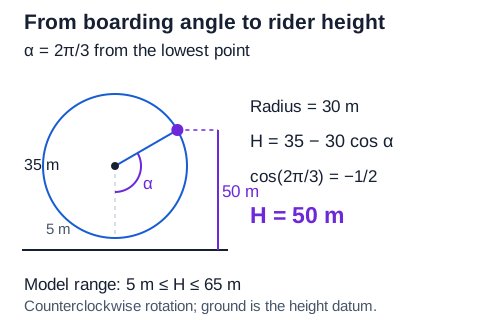 For a wheel of radius 30 m centered 35 m above ground, let α be the counterclockwise angle from the lowest point. H = 35 − 30 cos α, so α = 2π/3 gives H = 50 m.Open full diagram
SUMMARY
Lesson Summary
Summary
The unit circle defines sin θ and cos θ as the y- and x-coordinates, respectively, of the point where the terminal side of angle θ intersects the circle x² + y² = 1. The Pythagorean identity cos²θ + sin²θ = 1 follows directly from this definition. Exact values at standard angles (multiples of π/6, π/4, π/3, and π/2) come from the 30-60-90 and 45-45-90 special triangles inscribed in the unit circle.
To evaluate sine or cosine at any standard angle: first find a coterminal angle in [0, 2π), then determine the reference angle and use the quadrant sign rules (ASTC) to assign the correct positive or negative sign. Mastery of these exact values and the symmetry identities (even/odd, cofunction, periodicity) forms the essential foundation for solving trigonometric equations, graphing sinusoidal functions, and working with polar coordinates throughout AP Precalculus.