
SECTION 1
Historical Context & Motivation
Long before the Cartesian coordinate plane became the default language of analytic geometry, mathematicians grappled with a fundamental limitation: a single equation in x and y can describe the shape of a curve, but it cannot easily encode how and when a point moves along that curve. The idea of introducing an independent parameter—a third variable, typically denoted t—resolved this by expressing both x and y as separate functions of t, thereby capturing position, direction, and speed in one elegant framework. This parametric viewpoint proved indispensable for problems in mechanics, astronomy, and engineering where time-dependent motion along a known path is the central concern.
c. 300 BCE • Greek Geometric Loci
1637 • Descartes' Analytic Geometry
1686 • Newton's Principia & Parametric Motion
1748 • Euler's Introductio
20th–21st c. • Computer Graphics & Robotics
The central question this lesson addresses is straightforward yet powerful: given a pair of equations x(t) and y(t), how do we recognize, construct, and manipulate parametric representations of the two most fundamental curves—lines and circles? Understanding these cases builds the fluency you need for the AP Precalculus exam and lays essential groundwork for parametric curves in calculus and physics.
SECTION 2
Core Principles & Definitions
A parametric equation replaces the implicit relationship between x and y with two explicit functions of an independent variable t: we write x = f(t) and y = g(t). As t varies over a specified interval, the ordered pair (x, y) traces a curve in the Cartesian plane. The parameter t is often interpreted as time, but it can represent any continuously varying quantity—an angle, a distance, or simply an abstract real number. This decoupling of x and y provides information that a Cartesian equation alone cannot: the direction of traversal, the starting and ending points, and the relative speed at which the curve is drawn.
The Parameter t
Eliminating the Parameter
Direction & Orientation
Parametric Lines
Parametric Circles
KEY TAKEAWAY
SECTION 3
Visual Explanation — Parametric Circle
In the diagram above, observe that when t = 0 the point sits at the rightmost position (h + r, k), corresponding to cos 0 = 1 and sin 0 = 0. As t increases through π/2, the point rises to the top of the circle at (h, k + r). The full traversal from t = 0 to t = 2π returns the point to its starting position, completing exactly one loop. This counterclockwise orientation is the standard convention; replacing t with −t in the parametric equations reverses the direction to clockwise. Note also that the dashed violet outline represents the full Cartesian circle (x − h)² + (y − k)² = r², while the cyan arrow conveys the additional information the parametric form provides—direction and position as functions of the parameter.
SECTION 4
Mathematical Framework
Parametric Lines
A line in the plane can be described parametrically by specifying an initial point (x₀, y₀) and a direction vector ⟨a, b⟩. As t ranges over all real numbers, the equations below generate every point on the line. Restricting the domain of t to an interval [t₁, t₂] produces a line segment.
PARAMETRIC LINE EQUATIONS
where (x₀, y₀) is a known point on the line, ⟨a, b⟩ is the direction vector, and t ∈ ℝ. The slope of the line is m = b/a provided a ≠ 0.
To eliminate the parameter from parametric line equations, solve x = x₀ + at for t, obtaining t = (x − x₀)/a, then substitute into y = y₀ + bt to get y − y₀ = (b/a)(x − x₀). This is precisely the point-slope form of the line. Note that when a = 0 the line is vertical (x = x₀ for all t), and the Cartesian form is simply x = x₀.
Parametric Circles
PARAMETRIC CIRCLE EQUATIONS
where (h, k) is the center, r > 0 is the radius, and t ∈ [0, 2π) traces the full circle counterclockwise. Replacing t with −t produces clockwise traversal.
Elimination of the parameter for the circle relies on the Pythagorean identity. From x = h + r cos t, we get cos t = (x − h)/r. From y = k + r sin t, we get sin t = (y − k)/r. Squaring and adding: cos²t + sin²t = (x − h)²/r² + (y − k)²/r² = 1, which yields the standard Cartesian form below.
CARTESIAN CIRCLE (STANDARD FORM)
Derived by eliminating t from the parametric form using cos²t + sin²t = 1.
SEMICIRCLE & PARTIAL-ARC VARIATIONS
Restricting t to a sub-interval [α, β] ⊂ [0, 2π) traces an arc. For example, t ∈ [0, π] traces the upper semicircle; t ∈ [π, 2π] traces the lower semicircle.
SECTION 5
Detailed Breakdown — Parametric Lines
The diagram illustrates several features that distinguish parametric lines from their Cartesian counterparts. First, the initial point (1, 2) is explicitly anchored at t = 0, something a Cartesian equation like y = (3/2)x + 1/2 does not convey. Second, the direction vector ⟨2, 3⟩ tells us that for every unit increase in t, the x-coordinate advances by 2 and the y-coordinate by 3. The orange arrow on the line encodes the direction of travel as t increases. If the problem restricts t to [0, 1], only the segment from (1, 2) to (3, 5) is produced.
| t | x = 1 + 2t | y = 2 + 3t | Point (x, y) |
|---|---|---|---|
| −1 | −1 | −1 | (−1, −1) |
| 0 | 1 | 2 | (1, 2) |
| 1 | 3 | 5 | (3, 5) |
| 2 | 5 | 8 | (5, 8) |
Sample values for the parametric line x = 1 + 2t, y = 2 + 3t
An important subtlety is that infinitely many parametrizations can represent the same line. For instance, x = 3 + 4t, y = 5 + 6t passes through (3, 5) with direction ⟨4, 6⟩ = 2⟨2, 3⟩, which is parallel to the original direction vector and therefore traces the same line—just at twice the speed. Similarly, x = 1 − 2t, y = 2 − 3t traces the identical geometric line but in the opposite direction. On the AP exam, questions may ask you to determine whether two parametric representations describe the same curve, or they may test whether you can write parametric equations given a point and a slope.
SECTION 6
Worked Example
Eliminating the Parameter from a Parametric Circle
- 1
Step 1 — State the Parametric Equations
A curve is defined by x = 3 + 4 cos t and y = −1 + 4 sin t for t ∈ [0, 2π). We want to find the Cartesian equation and identify the curve.x(t) = 3 + 4 cos t, y(t) = −1 + 4 sin t - 2
Step 2 — Isolate the Trigonometric Expressions
Subtract the center coordinates from each equation to isolate the cosine and sine terms: cos t = (x − 3)/4 and sin t = (y + 1)/4.cos t = (x − 3)/4 , sin t = (y + 1)/4 - 3
Step 3 — Apply the Pythagorean Identity
Since cos²t + sin²t = 1 for all real t, substitute the expressions from Step 2: [(x − 3)/4]² + [(y + 1)/4]² = 1. Multiply both sides by 16 to clear the denominators.(x − 3)² + (y + 1)² = 16 - 4
Step 4 — Identify the Curve
The Cartesian equation (x − 3)² + (y + 1)² = 16 is the standard form of a circle with center (3, −1) and radius r = 4. Since t ranges over [0, 2π), the full circle is traced exactly once in the counterclockwise direction.Circle: center (3, −1), radius 4
Converting a Parametric Line to Cartesian Form
- 1
Step 1 — State the Parametric Equations
A line is defined by x = −2 + 5t and y = 7 − 3t for t ∈ ℝ. We seek the slope-intercept form y = mx + b.x(t) = −2 + 5t, y(t) = 7 − 3t - 2
Step 2 — Solve for t in Terms of x
From x = −2 + 5t, isolate t: t = (x + 2)/5.t = (x + 2)/5 - 3
Step 3 — Substitute into y(t)
Replace t in y = 7 − 3t with (x + 2)/5: y = 7 − 3·(x + 2)/5 = 7 − (3x + 6)/5 = (35 − 3x − 6)/5 = (29 − 3x)/5.y = −(3/5)x + 29/5 - 4
Step 4 — Verify
At t = 0, (x, y) = (−2, 7). Check: y = −(3/5)(−2) + 29/5 = 6/5 + 29/5 = 35/5 = 7. ✓ The slope is m = −3/5, consistent with the direction vector ⟨5, −3⟩.Line: y = −(3/5)x + 29/5, slope = −3/5
SECTION 7
Parametric vs. Cartesian — Strengths & Limitations
| Feature | Parametric Form | Cartesian Form |
|---|---|---|
| Shape Information | Yes — the curve's geometric shape can be recovered by eliminating t. | Yes — directly describes the set of (x, y) satisfying the equation. |
| Direction of Traversal | Yes — the sign and rate of change of t determine orientation. | No — the equation is static and encodes no direction. |
| Vertical Lines | Easy: x = c, y = t for t ∈ ℝ. | Not a function of x; requires x = c as a separate case. |
| Partial Curves / Arcs | Restrict the domain of t to trace only the desired portion. | Requires additional inequality constraints on x and y. |
| Uniqueness | Not unique — infinitely many parametrizations for the same curve. | Essentially unique (up to algebraic rearrangement). |
| AP Exam Context | Tested explicitly in the Functions with Parameters unit; key for FRQs. | Foundational throughout all units; used for elimination verification. |
Comparing parametric and Cartesian representations
KEY TAKEAWAY
SECTION 8
Connections to Advanced Topics
The parametric framework you develop in AP Precalculus extends naturally into several areas of calculus and beyond. In AP Calculus BC, you will compute derivatives and integrals of parametrically defined curves: dy/dx = (dy/dt)/(dx/dt), and the arc length of a parametric curve over [a, b] is given by the integral of √[(dx/dt)² + (dy/dt)²] dt. Understanding how parametric circles and lines behave now gives you a head start on those computations.
| AP Precalculus Topic | Advanced Extension |
|---|---|
| Parametric lines: x = x₀ + at, y = y₀ + bt | Vector-valued functions r(t) = ⟨x₀ + at, y₀ + bt⟩ in multivariable calculus; line integrals |
| Parametric circles: x = h + r cos t, y = k + r sin t | Euler's formula = cos t + i sin t; polar coordinates r = f(θ); curvature analysis |
| Eliminating the parameter | Implicit differentiation; converting between coordinate systems (polar ↔ Cartesian ↔ parametric) |
| Direction and orientation | Tangent vectors, velocity and acceleration in physics; arc length parametrization |
How AP Precalculus parametric topics connect to advanced coursework
In physics, parametric equations for circles model uniform circular motion: a particle at position (r cos ωt, r sin ωt) has angular velocity ω, and differentiating yields velocity and centripetal acceleration vectors. Parametric lines, meanwhile, describe objects moving at constant velocity in a straight path. These connections underscore that the material in this lesson is not merely abstract—it is the mathematical language of motion.
SECTION 9
Practice Problems
Question 1: CONCEPTUAL
- A. The curve is a circle with radius 5 centered at the origin.
- B. The curve is traced counterclockwise starting at (5, 0).
- C. The curve passes through (0, 5) and (0, −5).
- D. The radius of the circle is 5 units.
- E. The curve is symmetric about both axes.
Show answer (B)
Question 2: BASIC CALCULATION
- A. 3/2
- B. −3/2
- C. −2/3
- D. 2/3
- E. −1/3
Show answer (C)
Question 3: INTERMEDIATE
- A. (x − 2)² + (y + 4)² = 9; full circle
- B. (x − 2)² + (y + 4)² = 9; left semicircle (x ≤ 2)
- C. (x − 2)² + (y + 4)² = 9; right semicircle (x ≥ 2)
- D. (x − 2)² + (y + 4)² = 3; left semicircle (x ≤ 2)
- E. (x − 2)² + (y + 4)² = 9; upper semicircle (y ≥ −4)
Show answer (B)
Question 4: APPLIED
4 ptsShow answer
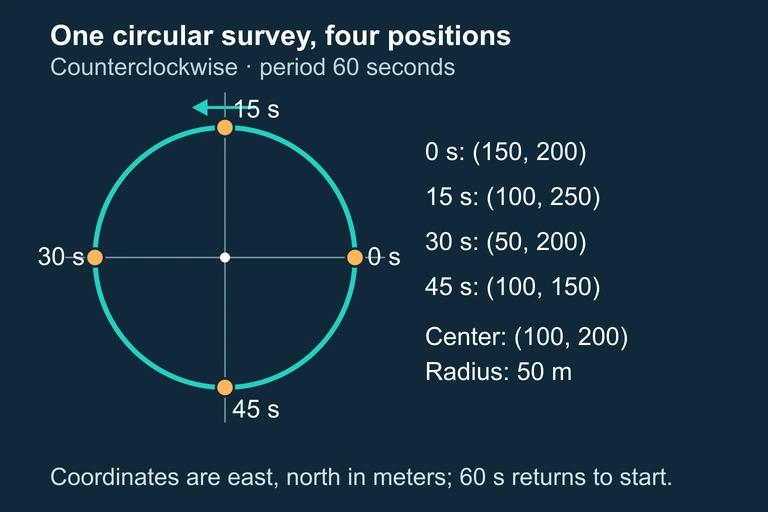 The drone completes one counterclockwise 50 m-radius survey circle in 60 seconds around the stated center.
Question 5: CRITICAL THINKING
3 ptsShow answer
SUMMARY
Lesson Summary
Summary
A parametric equation expresses a curve as a pair of functions x = f(t) and y = g(t) driven by an independent parameter t. For parametric lines, the form x = x₀ + at, y = y₀ + bt encodes an initial point and a direction vector ⟨a, b⟩, with slope m = b/a. Eliminating the parameter recovers the Cartesian equation by solving for t in one equation and substituting into the other.
For parametric circles, the form x = h + r cos t, y = k + r sin t describes a circle of radius r centered at (h, k), traced counterclockwise as t increases. The Pythagorean identity cos²t + sin²t = 1 is the key tool for eliminating t, yielding the standard Cartesian form (x − h)² + (y − k)² = r². Restricting the domain of t traces arcs and semicircles. Remember that the parametric form carries richer information than its Cartesian counterpart—direction of traversal, starting point, speed, and the portion of the curve traced—all of which are tested on the AP Precalculus exam.