
SECTION 1
Historical Context & Motivation
The idea of describing a curve by expressing each coordinate as a separate function of an independent variable — a parameter — grew out of centuries of effort to model physical motion mathematically. When a projectile arcs through the air, its horizontal and vertical positions change according to different rules, yet both depend on the single quantity of elapsed time. Capturing that dependence required a framework richer than the familiar y = f(x) relationship, because a single Cartesian equation cannot easily encode when a point occupies a given position or how fast it is moving at that instant.
1637 • Descartes' Coordinate Geometry
1687 • Newton's Principia
1748 • Euler's Analysin Infinitorum
1850s • Vector Kinematics Mature
The central question this lesson addresses is straightforward yet powerful: if a curve is defined by x(t) and y(t), how do we determine the rate at which y changes with respect to x, and what does that rate tell us about the curve's slope, direction, and behavior? Answering this question without calculus — using average rates, difference quotients, and limiting reasoning — is at the heart of the AP Precalculus treatment of parametric functions.
SECTION 2
Core Principles & Definitions
A parametric function consists of two component functions, x(t) and y(t), whose outputs are paired to produce points (x, y) in the Cartesian plane as the parameter t varies over a specified domain. The parameter t is not merely an abstract label; it frequently represents time, an angle measure, or some other quantity that controls the progression along the curve. Because x and y are each defined independently in terms of t, we gain information that a single rectangular equation y = f(x) cannot easily convey — including the direction of traversal, the speed of the tracing point, and even the possibility that the curve crosses itself.
Parametric Equations
Direction of Motion
Average Rate of Change
Rates with Respect to t
dy/dx from Parametric Rates
KEY TAKEAWAY
SECTION 3
Visual Explanation — Tracing a Parametric Curve
The diagram above displays the parametric curve defined by x(t) = t² − 1 and y(t) = 2t over the interval −2 ≤ t ≤ 2. Each colored dot corresponds to a specific value of t, and the cyan arrow indicates the direction in which the curve is traced as t increases. Observe that the two points at t = −2 and t = 2 share the same x-coordinate (x = 3) but have opposite y-coordinates (−4 and 4, respectively). This illustrates a crucial advantage of the parametric representation: the direction and timing of traversal are explicitly encoded, whereas the rectangular equation x = y²/4 − 1 describes the same geometric shape but provides no sense of progression. Understanding how the coordinates evolve simultaneously with t is essential for analyzing rates of change on parametric curves.
SECTION 4
Mathematical Framework
In a standard Cartesian function y = f(x), the average rate of change over an interval is simply Δy/Δx. For parametric functions, both x and y depend on the parameter t, so the rate of change of y with respect to x must be constructed from the individual rates at which each coordinate changes with respect to t. This section develops the key formulas, beginning with average rates and building toward the slope ratio that governs the tangent line.
AVERAGE RATE OF CHANGE OF x WITH RESPECT TO t
Measures how rapidly the horizontal coordinate changes per unit change in the parameter. A positive value means the point moves rightward; negative means leftward.
AVERAGE RATE OF CHANGE OF y WITH RESPECT TO t
Measures how rapidly the vertical coordinate changes per unit change in the parameter. A positive value means the point moves upward; negative means downward.
AVERAGE RATE OF CHANGE OF y WITH RESPECT TO x (PARAMETRIC SLOPE)
The slope of the secant line between two points on the parametric curve. This is the ratio of the vertical rate to the horizontal rate, each measured with respect to the parameter. The formula requires Δx ≠ 0 — i.e., x(t₂) ≠ x(t₁).
The third equation is the cornerstone of parametric rate analysis. By computing Δy/Δt and Δx/Δt separately and then forming their ratio, we obtain the slope of the secant line connecting two points on the curve. As the interval in t shrinks, this ratio approaches the instantaneous slope of the tangent line — a concept central to calculus. In AP Precalculus, we work with finite intervals and average rates, but the conceptual link to the tangent slope is important for interpreting results.
When Δx/Δt = 0
SECTION 5
Slope Analysis on Parametric Curves
Beyond computing a single average rate, analyzing how Δy/Δx behaves across different intervals of t reveals critical information about the shape and behavior of a parametric curve. The sign of Δy/Δt tells us whether the point is rising or falling, the sign of Δx/Δt tells us whether it is moving right or left, and their ratio Δy/Δx gives the overall slope of the path. Tracking these signs across intervals produces a complete picture of the curve's geometry, including any points where the tangent is horizontal (Δy/Δt = 0 while Δx/Δt ≠ 0) or vertical (Δx/Δt = 0 while Δy/Δt ≠ 0).
| Sign of Δy/Δt | Sign of Δx/Δt | Slope Δy/Δx | Geometric Meaning |
|---|---|---|---|
| Positive | Positive | Positive | Curve rises as it moves right |
| Positive | Negative | Negative | Curve rises as it moves left |
| Negative | Positive | Negative | Curve falls as it moves right |
| Negative | Negative | Positive | Curve falls as it moves left |
| Zero | Nonzero | Zero | Horizontal tangent (local extremum in y) |
| Nonzero | Zero | Undefined | Vertical tangent (local extremum in x) |
Sign analysis for parametric slopes
The table above is an essential reference. When you encounter an AP Precalculus question that asks whether a parametric curve is increasing or decreasing at a certain parameter value, begin by determining the signs of Δy/Δt and Δx/Δt over the interval of interest. Their ratio immediately tells you the slope of the secant, and the sign analysis tells you the direction in which the curve is being traced.
SECTION 6
Worked Example
Consider the parametric equations x(t) = 3t − 1 and y(t) = t² + 2. We wish to find the average rate of change of y with respect to x over the interval t = 1 to t = 4, and then interpret the result geometrically.
Average Rate of Change on a Parametric Curve
- 1
Step 1 — Evaluate the component functions at t₁ = 1
Compute x(1) = 3(1) − 1 = 2 and y(1) = (1)² + 2 = 3. So the point on the curve when t = 1 is (2, 3).P₁ = (2, 3) - 2
Step 2 — Evaluate the component functions at t₂ = 4
Compute x(4) = 3(4) − 1 = 11 and y(4) = (4)² + 2 = 18. So the point on the curve when t = 4 is (11, 18).P₂ = (11, 18) - 3
Step 3 — Compute Δy/Δt and Δx/Δt
Δy/Δt = (18 − 3) / (4 − 1) = 15/3 = 5. This means y increases by 5 units per unit increase in t on average. Δx/Δt = (11 − 2) / (4 − 1) = 9/3 = 3. This means x increases by 3 units per unit increase in t on average.Δy/Δt = 5, Δx/Δt = 3 - 4
Step 4 — Form the ratio Δy/Δx
Δy/Δx = (Δy/Δt) / (Δx/Δt) = 5/3. Equivalently, Δy/Δx = (18 − 3) / (11 − 2) = 15/9 = 5/3. Both approaches yield the same result, confirming the formula.Δy/Δx = 5/3 - 5
Step 5 — Interpret geometrically
The average rate of change 5/3 is the slope of the secant line joining (2, 3) and (11, 18). Because both Δy/Δt and Δx/Δt are positive, the point moves upward and to the right as t increases from 1 to 4. On average, for every 3 units the point moves horizontally, it rises 5 units vertically.Secant slope = 5/3 (rising to the right)
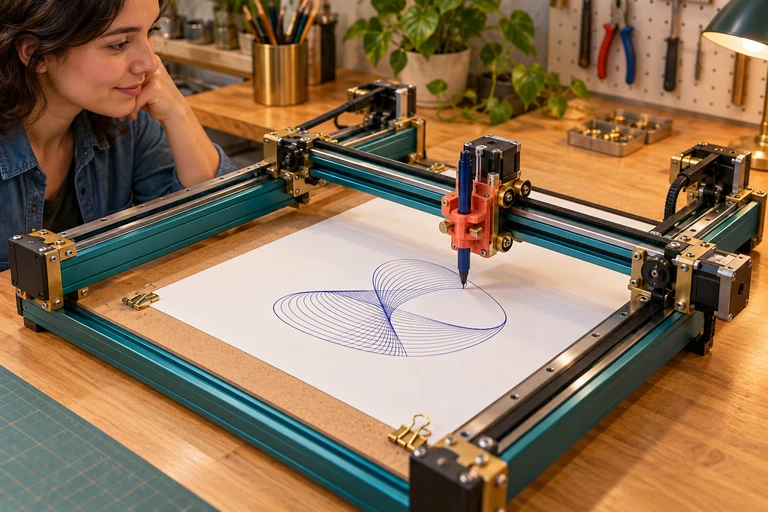 On t ∈ [1,4], x = 3t − 1 and y = t² + 2 have average rates 3 and 5. Their ratio gives a y-versus-x secant slope of 5/3.
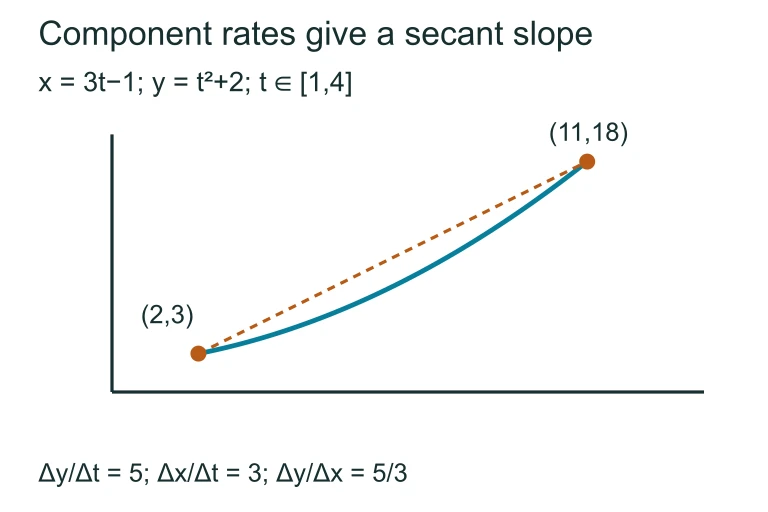 On t ∈ [1,4], x = 3t − 1 and y = t² + 2 have average rates 3 and 5. Their ratio gives a y-versus-x secant slope of 5/3.
SECTION 7
Parametric vs. Rectangular Representations
Students often wonder why parametric equations are necessary when a Cartesian equation y = f(x) seems simpler. The answer lies in the additional information that parametric form carries and the broader class of curves it can describe. The following table highlights the key differences between the two representations, particularly as they relate to rates of change.
| Feature | Rectangular y = f(x) | Parametric x(t), y(t) |
|---|---|---|
| Direction of traversal | Not encoded; convention is left-to-right | Explicitly given by increasing t |
| Self-intersecting curves | Cannot represent (fails vertical line test) | Easily represented; different t-values yield the same (x, y) |
| Vertical tangent lines | Problematic — slope is undefined | Naturally handled — Δx/Δt = 0 while Δy/Δt ≠ 0 |
| Speed information | Not available | Available via Δx/Δt and Δy/Δt individually |
| Rate of change computation | Δy/Δx directly from function values | Δy/Δx = (Δy/Δt) / (Δx/Δt) requires two computations |
Comparison of rectangular and parametric representations
KEY TAKEAWAY
SECTION 8
Connection to Calculus & Advanced Theory
The average-rate framework studied in AP Precalculus is a direct precursor to the derivative-based analysis of parametric curves in AP Calculus BC and multivariable calculus. Recognizing the conceptual parallels now strengthens your foundation for more advanced coursework. The table below maps each AP Precalculus concept to its calculus counterpart.
| AP Precalculus Concept | Calculus Extension |
|---|---|
| Δy/Δt = [y(t₂) − y(t₁)] / (t₂ − t₁) | dy/dt = lim(Δt→0) Δy/Δt — the derivative of y with respect to t |
| Δx/Δt = [x(t₂) − x(t₁)] / (t₂ − t₁) | dx/dt = lim(Δt→0) Δx/Δt — the derivative of x with respect to t |
| Δy/Δx = (Δy/Δt) / (Δx/Δt) | dy/dx = (dy/dt) / (dx/dt) — the chain rule for parametric derivatives |
| Secant line slope between two points | Tangent line slope at a single point (instantaneous rate) |
| Sign analysis of Δy/Δt, Δx/Δt | Velocity vector ⟨dx/dt, dy/dt⟩ and speed √[(dx/dt)² + (dy/dt)²] |
From precalculus averages to calculus instantaneous rates
Notice that every calculus formula in the right column is obtained by taking the limit as Δt → 0 of the corresponding precalculus expression in the left column. This means the conceptual reasoning you develop now — decomposing motion into component rates, forming ratios, analyzing signs — transfers directly into calculus. The only new ingredient is the limit. In multivariable calculus and physics, the parameter t becomes the backbone of vector-valued functions r(t) = ⟨x(t), y(t)⟩, and the derivative r′(t) = ⟨x′(t), y′(t)⟩ becomes the velocity vector, fully encoding speed and direction at every instant.
SECTION 9
Practice Problems
Question 1: CONCEPTUAL
- A. The particle moves to the right and upward.
- B. The particle moves to the right and downward.
- C. The particle moves to the left and upward.
- D. The particle moves to the left and downward.
- E. The particle moves along a vertical line.
Show answer (B)
Question 2: BASIC CALCULATION
- A. 13/8
- B. 9/8
- C. 8/13
- D. 13
- E. 13/9
Show answer (A)
Question 3: INTERMEDIATE
- A. −1
- B. 1
- C. 0
- D. Undefined
- E. 4/π
Show answer (A)
Question 4: APPLIED
4 ptsShow answer
Question 5: CRITICAL THINKING
3 ptsShow answer
SUMMARY
Lesson Summary
Summary
A parametric function defines a curve through two component functions x(t) and y(t) that depend on an independent parameter t, often representing time. This representation encodes not just the shape of the curve but also the direction of traversal and the individual horizontal and vertical rates Δx/Δt and Δy/Δt. The average rate of change of y with respect to x is computed as the ratio (Δy/Δt) / (Δx/Δt), which equals Δy/Δx — the slope of the secant line connecting two parametric points.
Sign analysis of the component rates reveals whether the curve is rising or falling and moving left or right. When Δy/Δt = 0 and Δx/Δt ≠ 0, the tangent is horizontal; when Δx/Δt = 0 and Δy/Δt ≠ 0, the tangent is vertical. These ideas form the precalculus foundation for the parametric derivative dy/dx = (dy/dt) / (dx/dt) studied in calculus. Mastering the ratio-of-rates framework and direction analysis will serve you well on the AP exam and beyond.