
SECTION 1
Historical Context & Motivation
For most of your mathematical career, curves have been defined by a single equation relating x and y, such as y = x² or x² + y² = 1. This Cartesian approach works well for many graphs, but it silently imposes a limitation: every curve must pass the vertical-line test or be broken into pieces that do. Parametric functions arose from the need to describe trajectories and complex curves where both coordinates change simultaneously as a function of an independent third quantity — the parameter. This framework allows mathematicians and scientists to model motion, trace curves that loop back on themselves, and encode direction and speed alongside shape.
~300 BCE • Greek Curve Tracing
1637 • Descartes' Coordinate System
1696 • Brachistochrone Problem
1800s • Formalization in Analysis
Modern Era • Computer Graphics & Engineering
The central question parametric functions answer is deceptively simple: How can we describe a curve when a single equation in x and y is insufficient or inconvenient? By assigning each coordinate its own function of a shared parameter, we gain the power to trace curves of arbitrary complexity — including those that cross themselves, reverse direction, or encode the timing with which a point moves.
SECTION 2
Core Principles & Definitions
A parametric function consists of a pair of equations, x(t) and y(t), each expressing a coordinate as a function of a third variable t called the parameter. While t often represents time, it can be any independent real-valued quantity — an angle, an arc length, or an abstract variable. The ordered pair (x(t), y(t)) traces a curve in the Cartesian plane as t varies over its domain, and the resulting path is called a parametric curve.
Parameter (t)
Parametric Equations
Eliminating the Parameter
Orientation & Direction
KEY TAKEAWAY
SECTION 3
Visual Explanation
The diagram illustrates several essential ideas. First, a single Cartesian curve can be parameterized in infinitely many ways — for instance, x(t) = 2 cos(2t) and y(t) = sin(2t) trace the same ellipse but at twice the speed. Second, the parameter determines starting point and direction: reversing the sign of t inside the cosine and sine would reverse the orientation from counterclockwise to clockwise. Third, the parameter domain [0, 2π] is precisely chosen so that the ellipse is traced exactly once; extending the domain would cause the point to retrace the same path.
SECTION 4
Mathematical Framework
Parametric Form
PARAMETRIC EQUATIONS
where f and g are continuous functions of the parameter t, and [a, b] is the parameter interval.
The pair (f(t), g(t)) generates an ordered set of points in the xy-plane. Each value of t yields exactly one point, but different t-values may produce the same point — this is how curves can cross themselves. The functions f and g need not be of the same type; one could be polynomial and the other trigonometric, producing intricate curves like Lissajous figures.
Eliminating the Parameter
ELIMINATION TECHNIQUE (TRIG IDENTITY)
If x = a cos(t) and y = b sin(t), substitute cos(t) = x/a and sin(t) = y/b into the Pythagorean identity.
ELIMINATION TECHNIQUE (ALGEBRAIC)
Solve one parametric equation for t and substitute into the other. The result is a Cartesian equation, but domain restrictions from the original parameter interval must be carried over.
Slope of a Parametric Curve
PARAMETRIC SLOPE
This follows from the chain rule. When dx/dt = 0 and dy/dt ≠ 0, the tangent line is vertical. When both derivatives are zero, further analysis is required.
AP Exam Note
SECTION 5
Common Parametric Curves
Certain families of parametric equations appear frequently on the AP exam and in applications. Recognizing these standard forms accelerates problem-solving and deepens your understanding of how the parameter shapes the curve.
| Curve | Parametric Equations | Cartesian Form |
|---|---|---|
| Line | x = x₀ + at, y = y₀ + bt | y − y₀ = (b/a)(x − x₀) |
| Circle | x = r cos(t), y = r sin(t) | x² + y² = r² |
| Ellipse | x = a cos(t), y = b sin(t) | x²/a² + y²/b² = 1 |
| Parabola (horizontal) | x = t², y = t | x = y² |
| Projectile | x = v₀ cos(θ) · t, y = v₀ sin(θ) · t − ½gt² | y = x tan(θ) − gx²/(2v₀²cos²θ) |
Common parametric curve families and their Cartesian equivalents
When analyzing any parametric curve on the AP exam, begin by identifying the family it belongs to. If both x(t) and y(t) are linear in t, the curve is a line segment (or ray). If they involve sin(t) and cos(t), suspect a circle or ellipse and use the Pythagorean identity to eliminate t. If one coordinate is t and the other is a function of t, you can often substitute directly. Always check the parameter domain: a circle parameterized with t ∈ [0, π] traces only the upper semicircle, not the full loop.
SECTION 6
Worked Example
A particle moves in the xy-plane so that its position at time t is given by x(t) = 3t − 2 and y(t) = t² − 4t + 1 for t ∈ [0, 5]. Find the Cartesian equation of the path, the direction of motion, and the slope of the curve at t = 2.
Parametric-to-Cartesian Conversion and Slope
- 1
Step 1 — Solve x(t) for t
From x = 3t − 2, solve for t: t = (x + 2)/3. This expression is valid for all real x, and as t ranges over [0, 5], x ranges from 3(0) − 2 = −2 to 3(5) − 2 = 13.t = (x + 2)/3, x ∈ [−2, 13] - 2
Step 2 — Substitute into y(t)
Replace t in y = t² − 4t + 1 with (x + 2)/3: y = ((x + 2)/3)² − 4((x + 2)/3) + 1 = (x + 2)²/9 − 4(x + 2)/3 + 1. Expand: y = (x² + 4x + 4)/9 − (4x + 8)/3 + 1. Multiply through by 9: 9y = x² + 4x + 4 − 12x − 24 + 9 = x² − 8x − 11. Therefore y = (x² − 8x − 11)/9.y = (x² − 8x − 11)/9 for x ∈ [−2, 13] - 3
Step 3 — Determine direction of motion
Since dx/dt = 3 > 0 for all t, the x-coordinate is always increasing. The particle moves from left to right across the Cartesian plane as t increases from 0 to 5.Direction: left to right (x increasing) - 4
Step 4 — Compute dy/dx at t = 2
Use the parametric slope formula: dy/dx = (dy/dt)/(dx/dt). Compute dy/dt = 2t − 4 and dx/dt = 3. At t = 2: dy/dt = 2(2) − 4 = 0 and dx/dt = 3. Therefore dy/dx = 0/3 = 0.dy/dx|_{t=2} = 0 (horizontal tangent) - 5
Step 5 — Interpret the result
At t = 2 the position is (x, y) = (4, −3). The slope is zero, meaning the parabolic path has a horizontal tangent — a local minimum of y with respect to x. This is consistent with y(t) = t² − 4t + 1 achieving its minimum at t = 2.At (4, −3): horizontal tangent, vertex of the parabolic path
 Eliminating t from x = 3t − 2 and y = t² − 4t + 1 gives y = (x² − 8x − 11)/9. The original interval t ∈ [0,5] restricts x to [−2,13].
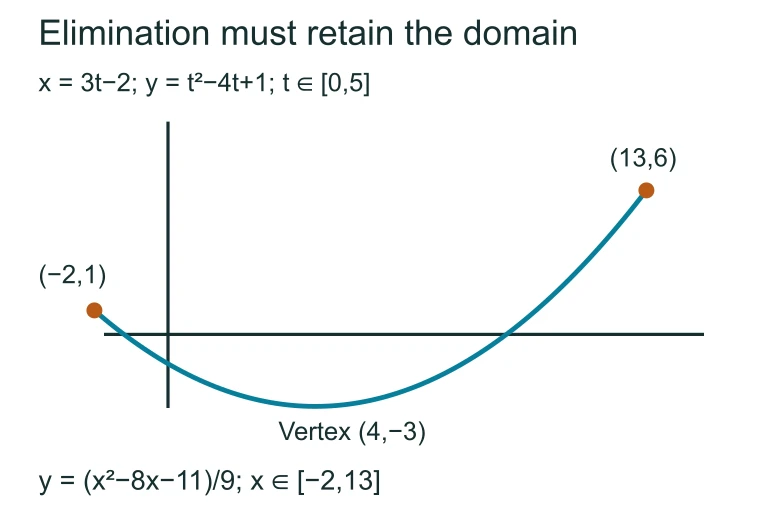 Eliminating t from x = 3t − 2 and y = t² − 4t + 1 gives y = (x² − 8x − 11)/9. The original interval t ∈ [0,5] restricts x to [−2,13].
SECTION 7
Parametric vs. Cartesian Representations
Understanding the trade-offs between parametric and Cartesian forms is crucial both for the AP exam and for selecting the right representation in applied contexts. Neither form is universally superior; each has strengths that complement the other's weaknesses.
| Feature | Parametric Form | Cartesian Form |
|---|---|---|
| Direction / orientation | Encodes direction as t increases | No directional information |
| Self-intersecting curves | Handled naturally (different t-values, same point) | Fails vertical-line test; must split into pieces |
| Slope computation | dy/dx = (dy/dt)/(dx/dt) — requires chain rule | Direct differentiation: dy/dx = f′(x) |
| Motion modeling | Natural: t = time, position = (x(t), y(t)) | Requires implicit time tracking |
| Simplicity | Two equations required | One equation; often more compact |
| Domain restrictions | Encoded in the parameter interval [a, b] | Must state x- or y-domain separately |
Parametric vs. Cartesian: when to use each representation
KEY TAKEAWAY
SECTION 8
Connections to Vectors, Polar, and Calculus
Parametric functions sit at the intersection of several advanced mathematical topics. In AP Precalculus, you encounter them alongside vectors and polar coordinates, and if you continue to AP Calculus BC, you will see how differentiation and integration extend naturally to parametric curves. Understanding these connections transforms parametric functions from an isolated technique into a gateway to richer mathematics.
| Topic | Connection to Parametric Functions |
|---|---|
| Vectors | A parametric curve r(t) = ⟨x(t), y(t)⟩ is a vector-valued function. The derivative r′(t) = ⟨x′(t), y′(t)⟩ is the velocity vector tangent to the curve. |
| Polar coordinates | Every polar equation r = f(θ) can be written parametrically as x = f(θ) cos(θ), y = f(θ) sin(θ), with θ as the parameter. |
| AP Calculus BC | Arc length, area, and second derivatives of parametric curves are core BC topics. The formula dy/dx = (dy/dt)/(dx/dt) extends to d²y/dx² = (d/dt)(dy/dx) / (dx/dt). |
| Computer graphics | Bézier curves and splines used in animation and CAD are piecewise parametric curves. Understanding parameterization is essential for anyone pursuing engineering or design. |
As you progress through AP Precalculus and beyond, notice how parametric thinking unifies ideas: polar curves become parametric through coordinate conversion, projectile motion in physics is inherently parametric, and even complex-valued functions can be viewed as parametric curves in the complex plane. Mastering the parameter concept now provides a versatile lens for future coursework in multivariable calculus, differential equations, and linear algebra.
SECTION 9
Practice Problems
Question 1: CONCEPTUAL
- A. They trace different curves in the plane.
- B. They trace the same curve, but the second traces it twice.
- C. They trace the same curve with the same orientation and speed.
- D. They trace the same curve with the same orientation, but the second traces it at twice the speed.
- E. They trace the same curve but in opposite orientations.
Show answer (D)
Question 2: BASIC CALCULATION
- A. y = 2(x − 3)² − 1
- B. y = 2(x + 3)² − 1
- C. y = 2x² + 12x + 17
- D. y = (x − 3)² − 1
- E. y = 2x² − 1
Show answer (A)
Question 3: INTERMEDIATE
- A. Starts at (4, 0); traces counterclockwise
- B. Starts at (0, 3); traces clockwise
- C. Starts at (0, 3); traces counterclockwise
- D. Starts at (4, 3); traces clockwise
- E. Starts at (0, −3); traces counterclockwise
Show answer (B)
Question 4: APPLIED
4 ptsShow answer
Question 5: CRITICAL THINKING
3 ptsShow answer
SUMMARY
Lesson Summary
Summary
Parametric functions express a curve as a pair of equations x = f(t) and y = g(t), where the parameter t is an independent variable (often time). This representation encodes not only the shape of a curve but also its orientation and the speed at which a point traverses it. To convert to Cartesian form, eliminate the parameter by solving one equation for t and substituting into the other, or by using identities like cos²t + sin²t = 1. Always carry forward any domain restrictions imposed by the parameter interval.
The slope of a parametric curve is computed as dy/dx = (dy/dt)/(dx/dt). Standard parametric families include lines (both coordinates linear in t), circles and ellipses (trigonometric parameterizations), and projectile trajectories (polynomial in t with gravity). Parametric form connects directly to vectors (position vector r(t) = ⟨x(t), y(t)⟩) and polar coordinates (every polar curve r = f(θ) converts to parametric form), making it one of the most versatile tools in precalculus and beyond.