

SECTION 1
Historical Context & Motivation
Before the invention of electronic calculators, multiplying large numbers—such as those encountered in astronomical calculations and navigation—was a painstaking, error-prone process. The development of logarithms transformed these arduous multiplications into simple additions, effectively compressing the scale of computation. This insight, that exponents could be manipulated to simplify arithmetic, stands as one of the most consequential ideas in the history of mathematics and laid the groundwork for everything from slide rules to the decibel scale to modern information theory.
1614 • Napier Publishes Mirifici Logarithmorum
1624 • Briggs Creates Common Logarithm Tables
1668 • Natural Logarithm Emerges
1728 • Euler Formalizes the Connection
1935 • Richter Scale Introduced
At its core, the logarithm answers a deceptively simple question: to what power must a given base be raised to produce a specific result? This question arises naturally whenever we need to solve an equation in which the unknown appears as an exponent. As you study logarithmic expressions in the context of AP Precalculus, you will develop the algebraic fluency needed to rewrite, simplify, and evaluate these expressions—skills that form the foundation for modeling exponential growth and decay across every quantitative discipline.
SECTION 2
Core Principles & Definitions
A logarithmic expression encodes the exponent needed to reach a target value from a given base. The statement logb(a) = c is equivalent to saying bc = a. Understanding this equivalence between logarithmic and exponential forms is the single most important idea in this unit, because every property and simplification technique flows directly from the laws of exponents. The following foundational ideas organize the study of logarithmic expressions and will recur throughout the course.
Definition as an Inverse
Common & Natural Logs
Domain Restrictions
Logarithmic Properties
Change of Base Formula
KEY TAKEAWAY
SECTION 3
Visual Explanation — The Logarithmic Graph
The graph of a logarithmic function reveals the key behaviors that govern logarithmic expressions. Because the logarithm is the inverse of the exponential function, its graph is a reflection of bˣ across the line y = x. The following diagram shows y = 2ˣ, y = log₂(x), and the line y = x on the same coordinate plane, making the inverse relationship visually explicit.
Several features of the logarithmic graph deserve explicit attention. First, the curve passes through (1, 0) regardless of the base, because b⁰ = 1 for every valid base b. Second, the function increases without bound as x → ∞, but it does so extremely slowly—this decelerating growth is the hallmark of logarithmic behavior and is precisely what makes logarithms so useful for compressing wide-ranging data. Third, as x approaches 0 from the right, the function plunges toward −∞, producing a vertical asymptote at x = 0. Together, these features define the shape that will inform how you interpret and manipulate logarithmic expressions throughout this course.
SECTION 4
Mathematical Framework — Properties of Logarithms
Every property of logarithms is derived directly from the corresponding law of exponents. Recognizing this connection ensures that you never have to memorize logarithmic rules as isolated facts; instead, you can reconstruct any property by converting back to exponential form. The four central properties are presented below, each paired with the exponential law from which it originates.
PRODUCT RULE
Derived from bm × bn = bm+n. The logarithm of a product equals the sum of the logarithms.
QUOTIENT RULE
Derived from bm / bn = bm−n. The logarithm of a quotient equals the difference of the logarithms.
POWER RULE
Derived from (bm)n = bmn. An exponent on the argument of a logarithm can be brought out front as a coefficient.
CHANGE OF BASE
Allows conversion between any two bases. Most commonly, a = 10 or a = e, enabling calculator evaluation via (x) = ln(x) / ln(b).
Two additional identities are worth highlighting because they appear frequently in simplification. First, (b) = 1 because b¹ = b, and (1) = 0 because b⁰ = 1. Second, the inverse compositions = x and () = x confirm that the exponential and logarithmic functions undo each other. Mastering these identities is essential for efficiently simplifying complex logarithmic expressions on the AP exam.
SECTION 5
Properties in Action — Expanding & Condensing
Two complementary skills form the practical backbone of working with logarithmic expressions: expanding a single logarithm into a sum or difference of simpler logarithms, and condensing multiple logarithmic terms back into one. Expanding is useful when analyzing or differentiating expressions, while condensing is the preferred direction when solving equations because it reduces the number of logarithmic terms. The diagram below shows both processes applied to the same expression, forming a visual "bridge" between the two forms.
COMMON MISTAKE
SECTION 6
Worked Example — Simplifying a Logarithmic Expression
The following example demonstrates how to apply multiple logarithmic properties in a single problem, a skill tested frequently on the AP Precalculus exam. We will condense the expression 3 ln(x) − ½ ln(y) + ln(4) into a single natural logarithm.
Condense: 3 ln(x) − ½ ln(y) + ln(4)
- 1
Step 1 — Apply the Power Rule
Convert each coefficient into an exponent on the corresponding argument. The power rule states that c × (M) = (Mc). Apply this to the first two terms: 3 ln(x) = ln(x³) and ½ ln(y) = ln(y1/2) = ln(√y). The third term, ln(4), has an implicit coefficient of 1 and remains unchanged.ln(x³) − ln(√y) + ln(4) - 2
Step 2 — Group Using Product and Quotient Rules
The sum of logarithms corresponds to the logarithm of a product, and the difference corresponds to the logarithm of a quotient. Combine the addition first: ln(x³) + ln(4) = ln(4x³). Then apply the quotient rule with the remaining subtraction: ln(4x³) − ln(√y) = ln(4x³ / √y).ln(4x³ / √y) - 3
Step 3 — Verify Domain Consistency
The original expression requires x > 0 (for ln(x)), y > 0 (for ln(y)), and these same constraints apply to the condensed form since 4x³ > 0 when x > 0, and √y > 0 when y > 0. No extraneous restrictions have been introduced, so the condensed form is equivalent on the same domain.Domain: x > 0, y > 0 ✓ - 4
Step 4 — State Final Answer
The expression 3 ln(x) − ½ ln(y) + ln(4) condenses to a single logarithm.ln(4x³ / √y)
SECTION 7
Common Pitfalls & Strategic Comparisons
Logarithmic expressions are a frequent source of errors on the AP exam, often because students conflate superficially similar algebraic operations. The table below catalogues the most common mistakes alongside the correct forms, providing a quick reference for self-checking your work.
| Incorrect Statement | Correct Statement | Why the Error Occurs |
|---|---|---|
log(M + N) = log(M) + log(N) | log(M × N) = log(M) + log(N) | Confusing addition inside the argument with multiplication; the product rule requires multiplication, not addition. |
log(M − N) = log(M) / log(N) | log(M / N) = log(M) − log(N) | Mixing up the quotient rule direction; the subtraction applies to the logarithms, and division applies inside the argument. |
(log(M))^n = n × log(M) | log(Mn) = n × log(M) | The power rule moves the exponent from inside the argument, not from outside the entire logarithm. (log(M))² ≠ 2 log(M). |
log(M) / log(N) = log(M/N) | log(M) / log(N) = logN(M) (change of base) | Dividing two logarithms is a change-of-base operation, not the quotient rule. The quotient rule requires subtracting logarithms, not dividing them. |
Common errors when manipulating logarithmic expressions
STRATEGIC TIP
SECTION 8
Connection to Advanced Theory
The skills you develop manipulating logarithmic expressions in AP Precalculus form the direct prerequisites for several topics you will encounter in calculus and beyond. In AP Calculus, the natural logarithm function becomes central: the derivative of ln(x) is 1/x, and the integral of 1/x is ln|x| + C—two of the most frequently tested results on the BC exam. More broadly, logarithmic expressions appear in differential equations (separable equations often yield logarithmic solutions), information theory (entropy is defined using logarithms), and complexity analysis in computer science (binary search runs in O(log₂ n) time).
| AP Precalculus Skill | Advanced Application |
|---|---|
| Expanding/condensing using log properties | Logarithmic differentiation of products and quotients in Calculus |
| Change of base formula | Converting between log scales (e.g., bits vs. nats) in information theory and statistics |
| Evaluating log expressions and understanding domain | Solving separable differential equations (e.g., logistic growth, radioactive decay) |
| Recognizing inverse relationship with exponentials | Proving that the integral of 1/x is ln|x| + C via the Fundamental Theorem of Calculus |
How precalculus logarithmic skills map to advanced coursework
The takeaway is practical: every hour you invest in building fluency with logarithmic expressions pays compound dividends across your STEM coursework. The properties are not merely exam content—they are the algebraic grammar of exponential phenomena, and exponential phenomena are everywhere.
SECTION 9
Practice Problems
Question 1: CONCEPTUAL
- A. 3⁵ = 125
- B. 5³ = 125
- C. 125³ = 5
- D. 5¹²⁵ = 3
- E. 125⁵ = 3
Show answer (B)
Question 2: BASIC CALCULATION
- A. −3
- B. −2
- C. 3
- D. −4
- E. 1/3
Show answer (A)
Question 3: INTERMEDIATE
- A. log(x²√y / 3)
- B. log(2x − 3 + y/2)
- C. log(x² / (3√y))
- D. log(x² + √y − 3)
- E. log(3x²√y)
Show answer (A)
Question 4: APPLIED
4 ptsShow answer
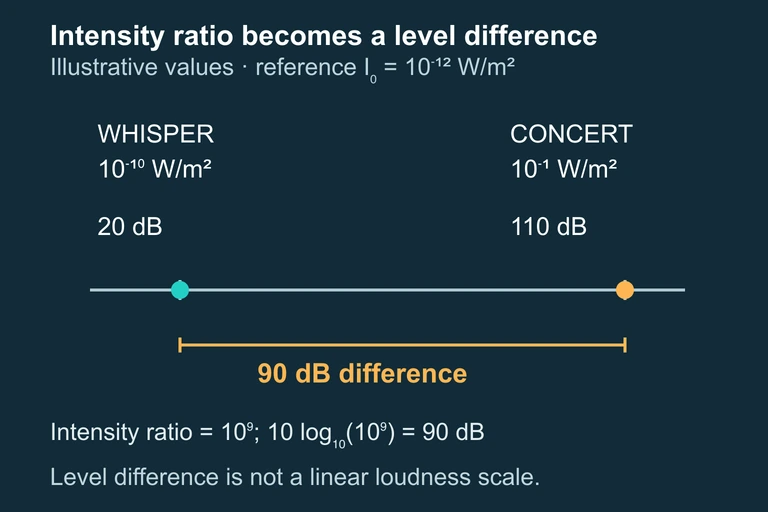 The stipulated concert and whisper intensities differ by a factor 10^9, corresponding to 90 dB; the scenes are illustrative rather than measurements.
Question 5: CRITICAL THINKING
3 ptsShow answer
SUMMARY
Summary — Logarithmic Expressions
Summary
A logarithmic expression encodes the exponent to which a base must be raised to produce a given argument, and its definition—(a) = c ⟺ = a—serves as the bridge between logarithmic and exponential forms. The four essential properties—the product rule, quotient rule, power rule, and change of base formula—are derived from the laws of exponents and enable both expanding single logarithms into sums and differences and condensing multiple logarithmic terms into one.
The domain restriction (argument must be positive) and the vertical asymptote at x = 0 are graphical reflections of the fact that no real power of a positive base can produce zero or a negative number. On the AP exam, fluency means moving seamlessly between expanded and condensed forms, avoiding common traps such as distributing a logarithm over addition, and checking your work with numerical substitution. These skills carry forward into calculus, where logarithmic differentiation, integration of 1/x, and solutions of separable differential equations all depend on the algebraic foundations established here.