
SECTION 1
Historical Context & Motivation
Trigonometric functions were originally developed to solve problems in astronomy and surveying, where practitioners needed to relate observed angles to measurable distances. However, the reverse problem—finding an unknown angle given a ratio of sides—arose just as naturally, and it was this need that eventually drove mathematicians to formalize what we now call inverse trigonometric functions. Because the sine, cosine, and tangent functions are periodic, they fail the horizontal line test and are not one-to-one on their natural domains; constructing genuine inverses therefore required a deliberate choice of restricted intervals. The history of these functions is intertwined with the broader story of how mathematicians learned to treat angles as numbers and trigonometric expressions as functions subject to algebraic and analytic rules.
~150 CE • Ptolemy's Chord Tables
~500 CE • Indian Half-Chord (Jyā) Inversion
1706 • Jones Introduces π Notation
1736 • Euler's Analytic Treatment
1772 • Lagrange's arc-Notation
The central question that inverse trigonometric functions answer is deceptively simple: given a ratio, what angle produced it? Yet answering this rigorously requires confronting the periodicity of sine, cosine, and tangent—each ratio corresponds to infinitely many angles. The resolution, as we will see, lies in carefully restricting the domain of each parent function so that a unique inverse exists, a technique central to precalculus and essential for understanding later work with identities, equations, and calculus.
SECTION 2
Core Principles & Definitions
An inverse function reverses the input–output relationship of its parent: if f(a) = b, then f−1(b) = a. For a function to possess an inverse, it must be one-to-one (injective). Since no standard trigonometric function is one-to-one over its entire real-line domain, mathematicians select a principal branch—a maximal interval on which the function is one-to-one and still attains its full range. The following foundational ideas govern how inverse trigonometric functions are defined and used.
Domain Restriction
Principal Value
Range = Restricted Domain
Composition Identities
Notation Conventions
KEY TAKEAWAY
SECTION 3
Visual Explanation — Graphs of Inverse Trig Functions
The relationship between a trigonometric function and its inverse is illuminated by graphing both on the same coordinate plane. Recall that the graph of any inverse function is obtained by reflecting the graph of the original across the line y = x. In the diagram below, the restricted sine function (solid blue curve on [−π/2, π/2]) is reflected to produce the arcsine function (solid cyan curve). Notice how the domain and range swap: the domain [−1, 1] of arcsin corresponds to the range [−1, 1] of sin on its restricted domain, and the range [−π/2, π/2] of arcsin matches sin's restricted domain.
Several features of this graph deserve emphasis. First, the arcsine function is increasing on its entire domain [−1, 1], inheriting the monotonicity of sin on [−π/2, π/2]. Second, the curve passes through the origin, confirming that arcsin(0) = 0. Third, the endpoints (−1, −π/2) and (1, π/2) have vertical tangent lines, reflecting the fact that the derivative of arcsin blows up at x = ±1—a detail that becomes significant in calculus. The same reflection technique applies to cosine and tangent to produce arccos and arctan, each with their own distinctive shape determined by the chosen restriction interval.
SECTION 4
Mathematical Framework
Each of the three primary inverse trigonometric functions is defined by specifying the restricted domain of its parent, which becomes the range of the inverse. The formal definitions below codify what we discussed conceptually in Section 2. Pay careful attention to the bracket types (square for closed, round for open), as they indicate whether endpoint values are included—a frequent source of errors on the AP exam.
ARCSINE (sin⁻¹)
The restricted sine is increasing on [−π/2, π/2] and achieves its full range [−1, 1]. Because both endpoints are attained, both the domain and range of arcsin use closed brackets.
ARCCOSINE (cos⁻¹)
The restricted cosine is decreasing on [0, π]. Thus arccos is also decreasing: arccos(−1) = π and arccos(1) = 0. The range [0, π] captures exactly the angles in the first and second quadrants (plus the boundary rays).
ARCTANGENT (tan⁻¹)
The restricted tangent on (−π/2, π/2) is continuous, increasing, and has range (−∞, ∞). Because the tangent has vertical asymptotes at ±π/2, the range of arctan uses open brackets—arctan never actually outputs ±π/2. Instead, y = π/2 and y = −π/2 are horizontal asymptotes of the arctan graph.
Composition Rules
The composition identities reveal a subtle asymmetry. For the 'inner inverse' composition, the cancellation is unconditional on the inverse's domain: sin(arcsin x) = x for every x ∈ [−1, 1], cos(arccos x) = x for every x ∈ [−1, 1], and tan(arctan x) = x for every x ∈ ℝ. However, the 'outer inverse' composition requires the angle to lie within the restricted range: arcsin(sin θ) = θ only if θ ∈ [−π/2, π/2]. If θ falls outside this interval, you must first find the reference angle in the correct range. For example, arcsin(sin(5π/6)) ≠ 5π/6; instead, since sin(5π/6) = 1/2, we get arcsin(1/2) = π/6.
COMPLEMENTARY IDENTITY
This identity reflects the co-function relationship sin θ = cos(π/2 − θ). It is useful for converting between arcsin and arccos expressions and appears frequently in simplification problems on the AP exam.
SECTION 5
Detailed Breakdown — Domains, Ranges & the Unit Circle
| Function | Input (Domain) | Output (Range) | Monotonicity | Key Feature |
|---|---|---|---|---|
| y = arcsin(x) | [−1, 1] | [−π/2, π/2] | Increasing | Odd function: arcsin(−x) = −arcsin(x) |
| y = arccos(x) | [−1, 1] | [0, π] | Decreasing | Neither odd nor even; arccos(−x) = π − arccos(x) |
| y = arctan(x) | (−∞, ∞) | (−π/2, π/2) | Increasing | Odd function; horizontal asymptotes at ±π/2 |
Summary of the three primary inverse trigonometric functions
The unit circle provides a powerful geometric interpretation. When we compute arcsin(x), we are asking: which angle in [−π/2, π/2] has a y-coordinate of x on the unit circle? Similarly, arccos(x) asks for the angle in [0, π] whose x-coordinate equals x. These perspectives are captured in the diagram below, which shows how the principal-value ranges map onto arcs of the unit circle.
Common Pitfall
SECTION 6
Worked Example
Let us work through a multi-step problem that combines several inverse trig concepts, including composition and the complementary identity. This type of problem frequently appears on the AP Precalculus exam and requires careful attention to domain and range restrictions.
Evaluate cos(arcsin(3/5)) Without a Calculator
- 1
Step 1 — Interpret the Inner Function
Let θ = arcsin(3/5). By the definition of arcsine, this means sin θ = 3/5 and θ ∈ [−π/2, π/2]. Since 3/5 > 0, θ must lie in the first quadrant, so θ ∈ (0, π/2).sin θ = 3/5, θ in Q I - 2
Step 2 — Construct a Right Triangle
Since sin θ = opposite/hypotenuse = 3/5, draw a right triangle with the side opposite θ equal to 3 and hypotenuse equal to 5. The adjacent side is found via the Pythagorean theorem: adj = √(5² − 3²) = √(25 − 9) = √16 = 4.Adjacent side = 4 - 3
Step 3 — Read Off the Cosine
From the triangle, cos θ = adjacent/hypotenuse = 4/5. Because θ is in the first quadrant, cosine is positive, so no sign adjustment is needed.cos(arcsin(3/5)) = 4/5 - 4
Step 4 — Verify via Identity
As a check, apply the algebraic identity cos(arcsin x) = √(1 − x²) for x ∈ [−1, 1]. Substituting x = 3/5: √(1 − 9/25) = √(16/25) = 4/5. ✓ The identity confirms the triangle method.Confirmed: 4/5
General Strategy
SECTION 7
Common Errors & Comparisons
Mastering inverse trigonometric functions requires not only knowing the correct definitions but also recognizing the most common mistakes students make. The table below contrasts correct reasoning with frequent errors, organized by error type. Reviewing these pitfalls before the AP exam can prevent losing points on problems you otherwise know how to solve.
| Error Type | Incorrect Reasoning | Correct Reasoning |
|---|---|---|
| Notation confusion | sin⁻¹(x) = 1/sin(x) = csc(x) | sin⁻¹(x) = arcsin(x), the inverse function; 1/sin(x) = csc(x) is the reciprocal |
| Ignoring range restriction | arcsin(sin(5π/6)) = 5π/6 | 5π/6 ∉ [−π/2, π/2], so evaluate sin(5π/6) = 1/2 first, then arcsin(1/2) = π/6 |
| Wrong quadrant for arccos | arccos(−√3/2) = −π/6 (negative angle) | arccos range is [0, π]; the answer is 5π/6 (Q II) |
| Sign error in arctan | arctan(−1) = 3π/4 | arctan range is (−π/2, π/2); 3π/4 is not in range. arctan(−1) = −π/4 |
| Domain violation | arcsin(2) = some angle | 2 ∉ [−1, 1], so arcsin(2) is undefined (no real output) |
Common errors with inverse trigonometric functions
KEY TAKEAWAY
SECTION 8
Connections to Calculus and Advanced Theory
Inverse trigonometric functions play a foundational role beyond precalculus. In AP Calculus, their derivatives generate recognizable integral forms, and in more advanced courses they appear in complex analysis and differential equations. Understanding the precalculus definitions thoroughly—particularly the domain and range conventions—removes a major conceptual barrier when students encounter these applications later.
| Precalculus Focus | Calculus / Advanced Extension |
|---|---|
| arcsin(x) has domain [−1, 1], range [−π/2, π/2] | d/dx [arcsin(x)] = 1/√(1 − x²), leading to ∫ dx/√(1 − x²) = arcsin(x) + C |
| arctan(x) has horizontal asymptotes at ±π/2 | d/dx [arctan(x)] = 1/(1 + x²), so ∫ dx/(1 + x²) = arctan(x) + C |
| cos(arcsin x) = √(1 − x²) via right triangles | Trigonometric substitution: let x = sin θ to simplify integrals containing √(1 − x²) |
| arcsin(x) + arccos(x) = π/2 | Differentiate both sides to see that d/dx[arccos(x)] = −1/√(1 − x²) |
How precalculus concepts extend to calculus
For the AP Precalculus exam specifically, you will not be asked to compute derivatives, but you should recognize that the end behavior of arctan (approaching ±π/2 as x → ±∞) makes it a model for functions with horizontal asymptotes. Additionally, the algebraic identities for compositions like sin(arccos x) and tan(arcsin x) are essential tools for simplifying trigonometric expressions—skills that appear directly in both the multiple-choice and free-response sections.
Looking Ahead
SECTION 9
Practice Problems
Question 1: CONCEPTUAL
- A. sin(x) is not continuous on its natural domain.
- B. sin(x) is periodic and therefore not one-to-one on (−∞, ∞).
- C. sin(x) has a range that is unbounded, so no inverse exists.
- D. sin(x) is not differentiable at every point in its domain.
- E. sin(x) fails to be defined for negative inputs.
Show answer (B)
Question 2: BASIC CALCULATION
- A. −π/3
- B. π/3
- C. 2π/3
- D. 4π/3
- E. 5π/3
Show answer (C)
Question 3: INTERMEDIATE
- A. 3/5
- B. −3/5
- C. 4/5
- D. −4/5
- E. 5/3
Show answer (A)
Question 4: APPLIED
4 ptsShow answer
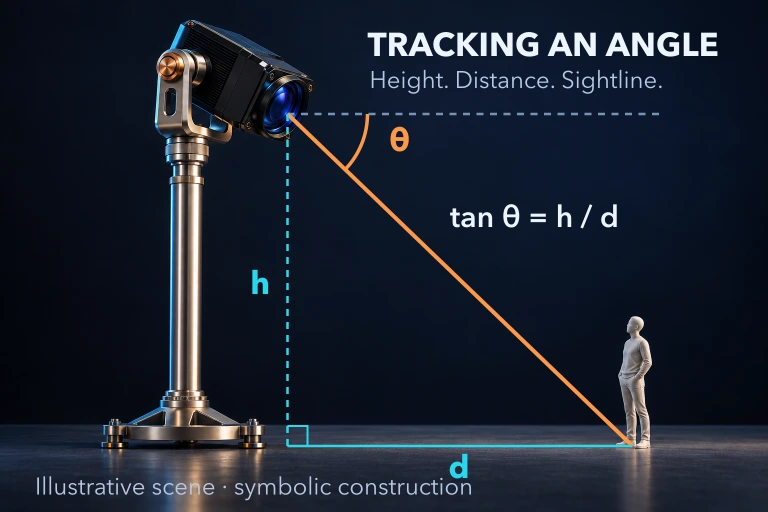
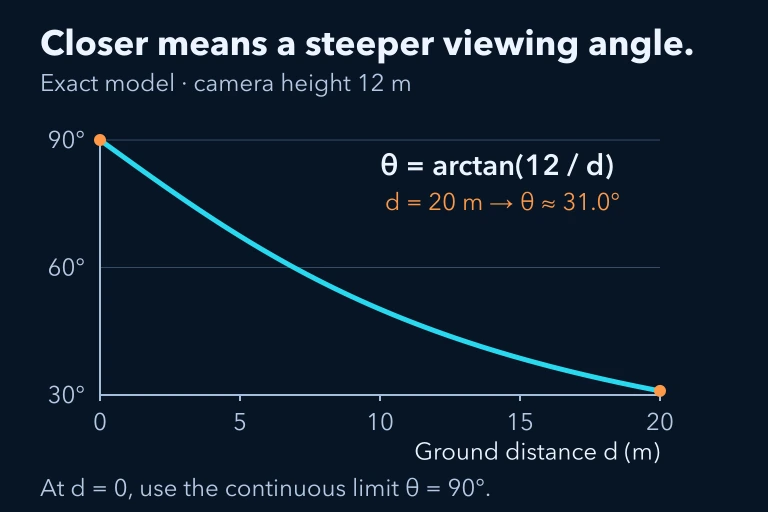 Exact 12 m camera model: angle decreases from 90° at horizontal distance zero to about 30.964° at 20 m. The endpoint at zero is defined by a continuous limit.
Question 5: CRITICAL THINKING
3 ptsShow answer
SUMMARY
Summary
Summary
Inverse trigonometric functions—arcsin, arccos, and arctan—reverse the input–output relationship of their parent trig functions by operating on restricted domains that make each parent one-to-one. The range of arcsin is [−π/2, π/2], the range of arccos is [0, π], and the range of arctan is (−π/2, π/2). These ranges ensure that every valid input maps to exactly one principal value. Graphically, each inverse trig function is the reflection of its restricted parent across the line y = x.
Key skills for the AP exam include evaluating exact values using the unit circle and special triangles, simplifying compositions like cos(arcsin x) via right-triangle reasoning or the Pythagorean identity, applying the complementary identity arcsin(x) + arccos(x) = π/2, and recognizing when arcsin(sin θ) ≠ θ because θ falls outside the principal range. Always verify that your output lies within the correct range—this single check prevents the majority of errors students make on this topic.