
SECTION 1
Historical Context & Motivation
The idea that a single trigonometric relationship can be written in multiple equivalent forms is not a modern convenience—it is woven into the very fabric of how trigonometry developed across civilizations. Ancient astronomers in Babylon and Greece needed to predict celestial positions, and they discovered that certain chord and half-chord relationships could be restated in different ways depending on the geometric configuration at hand. These early manipulations were essentially the first trigonometric identities, even though they were expressed in the language of geometry rather than algebra. The drive to simplify astronomical calculations pushed mathematicians toward increasingly elegant equivalent forms, a thread that runs unbroken from Ptolemy's Almagest through the work of Indian and Islamic scholars to the modern AP Precalculus curriculum.
~150 CE • Ptolemy's Chord Tables
~500 CE • Indian Sine and Cosine
~1400 • Islamic Algebraic Trigonometry
1748 • Euler's Formula
Today, the ability to recognize and produce equivalent representations of trigonometric functions is central to the AP Precalculus course. Whether you are simplifying an expression, solving an equation, or analyzing a graph, the core question remains the same: how can we rewrite a trigonometric expression in a form that reveals information more directly? This lesson will equip you with the identities, strategies, and reasoning patterns needed to move fluently between those forms.
SECTION 2
Core Principles & Foundational Identities
Equivalent representations rest on a small collection of foundational identities. Every transformation you perform—whether it is rewriting sin²θ as 1 − cos²θ or expressing tan θ as sin θ / cos θ—traces back to one of these core relationships. Mastering them means you can navigate freely among forms, choosing whichever representation best serves the problem at hand. The three pillars are the Pythagorean identities, the reciprocal and quotient identities, and the cofunction and even-odd identities. From these, every other algebraic manipulation follows.
Pythagorean Identities
Reciprocal & Quotient Identities
Cofunction Identities
Even-Odd Identities
KEY TAKEAWAY
SECTION 3
The Unit Circle as a Rosetta Stone
The unit circle is the geometric setting for these equivalent representations. On a circle of radius 1, the point at angle θ has coordinates (cos θ, sin θ), so cos²θ + sin²θ = 1. Signed coordinate changes preserve this identity in every quadrant; ordinary segment lengths are their absolute values. When cos θ ≠ 0, the terminal line intersects x = 1 at (1, tan θ). The directed radial parameter is sec θ and the ordinary length is |sec θ|. In quadrant II the intersection lies on the backward extension of the ray. When sin θ ≠ 0, the terminal line intersects y = 1 at (cot θ, 1), with directed radial parameter csc θ. Thus tan and sec are undefined at cos θ = 0; cot and csc are undefined at sin θ = 0. The native diagram illustrates the first-quadrant sine, cosine, tangent and secant construction; the supplemental two-angle view and table extend it to all six functions.
These constructions explain the identities. In the pictured first quadrant, similar triangles give sec θ = 1/cos θ; extending the argument with directed coordinates preserves the signs in other quadrants. The separate y = 1 construction similarly gives csc θ = 1/sin θ. The Pythagorean identity follows from the unit radius. Equivalent representations are different ways of measuring the same geometric reality.
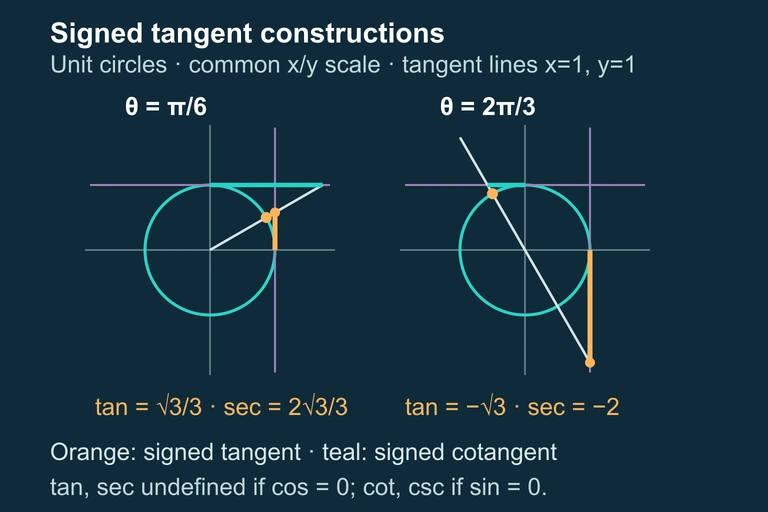 Directed tangent and reciprocal constructions retain trigonometric signs across quadrants; ordinary positive lengths alone cannot encode those signs.
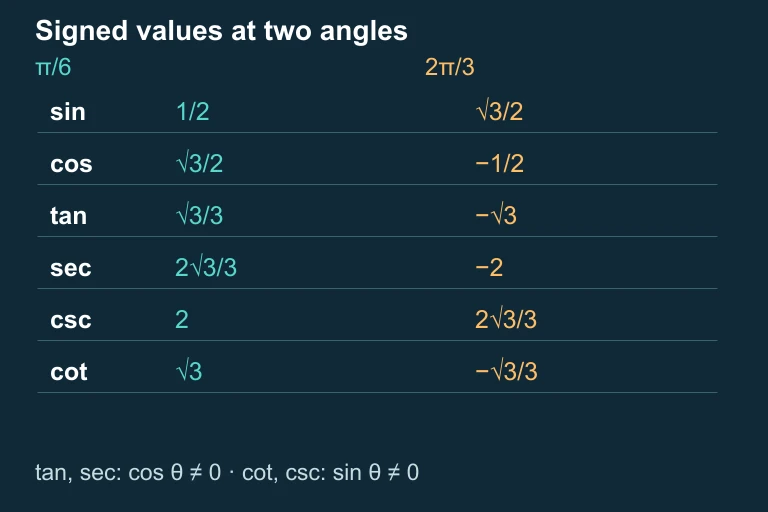 Six trigonometric values for π/6 and 2π/3, including the negative tangent, cotangent and secant values in quadrant II and denominator restrictions.
SECTION 4
Mathematical Framework — Key Identity Families
Building on the foundational identities from Section 2, we now introduce the identity families most frequently tested on the AP Precalculus exam. These fall into three categories: sum and difference identities, double-angle identities, and identities that arise from algebraic manipulation such as factoring or combining fractions. Each provides a pathway for rewriting an expression in an equivalent form.
SUM AND DIFFERENCE — SINE
The sign on the right matches the sign on the left. This identity converts a single sine of a compound angle into a sum or difference of products.
SUM AND DIFFERENCE — COSINE
Note the sign reversal: cos(α − β) uses a plus sign on the right. This identity is the basis for deriving double-angle and cofunction forms.
DOUBLE-ANGLE — COSINE (THREE FORMS)
All three are equivalent. Choose the form that matches the variable you wish to isolate. The second and third forms are obtained by substituting sin²θ = 1 − cos²θ or cos²θ = 1 − sin²θ from the Pythagorean identity.
DOUBLE-ANGLE — SINE
Derived by setting α = β = θ in the sine sum identity. This identity appears frequently when simplifying products of sine and cosine.
A critical skill on the AP exam is recognizing which direction to apply an identity. Sometimes you need to expand sin(α + β) into sin α cos β + cos α sin β; other times, you must condense 2 sin θ cos θ back into sin 2θ. The expression's context—simplifying, solving, or graphing—determines which equivalent form is most useful. For instance, if you are asked to find the zeros of f(x) = 2 sin x cos x, rewriting it as sin 2x immediately reveals that the zeros occur at x = nπ/2, a far cleaner result than solving the factored form directly.
AP Exam Tip
SECTION 5
Strategies for Rewriting Trigonometric Expressions
Knowing the identities is necessary but not sufficient; you also need a systematic approach for deciding which identity to apply and in what order. The strategies below cover the most common scenarios you will encounter on the AP Precalculus exam and in subsequent coursework. Each strategy is paired with the transformation it enables, so you can match a given expression to the appropriate technique quickly.
Let us summarize the six strategies visible in the flowchart. Strategy A (convert everything to sin and cos) is the universal fallback when you are unsure where to start. Strategy B asks whether the expression matches a double-angle template such as 2 sin θ cos θ or cos²θ − sin²θ, allowing you to collapse it into a single function of 2θ. Strategy C uses the Pythagorean identity to eliminate a squared term. Strategy D applies standard algebraic techniques—factoring a difference of squares, combining rational expressions over a common denominator—after everything has been converted to sine and cosine. Strategy E expands or condenses sum-and-difference formulas, and Strategy F handles parity and complementary-angle substitutions. On a typical AP problem you may need to chain two or three of these strategies together.
SECTION 6
Worked Example — Simplifying a Complex Expression
Consider the expression (sin²θ − cos²θ) / (sin θ − cos θ). Our goal is to simplify it to a single trigonometric function or a simple algebraic form. This problem illustrates the interplay of Strategies C and D: algebraic factoring combined with identity recognition.
Simplify (sin²θ − cos²θ) / (sin θ − cos θ)
- 1
Step 1 — Recognize Structure
The numerator sin²θ − cos²θ is a difference of squares: a² − b² = (a − b)(a + b). Set a = sin θ and b = cos θ. - 2
Step 2 — Factor the Numerator
sin²θ − cos²θ = (sin θ − cos θ)(sin θ + cos θ).Numerator = (sin θ − cos θ)(sin θ + cos θ) - 3
Step 3 — Cancel Common Factor
The denominator is sin θ − cos θ. Since this factor appears in both numerator and denominator (and we note the restriction sin θ ≠ cos θ, i.e., θ ≠ π/4 + nπ), we cancel it.(sin θ − cos θ)(sin θ + cos θ) / (sin θ − cos θ) = sin θ + cos θ - 4
Step 4 — Verify (Optional Identity Connection)
We can also note that sin²θ − cos²θ = −cos 2θ (the negative of the double-angle identity cos 2θ = cos²θ − sin²θ). This confirms the numerator has a known equivalent form, lending confidence to our result.Final Answer: sin θ + cos θ, where θ ≠ π/4 + nπ
Why Both Approaches Matter
SECTION 7
Comparing Equivalent Forms — When to Use Which
Different equivalent forms of a trigonometric expression serve different purposes. A form that is ideal for solving an equation may be awkward for graphing, and vice versa. The table below summarizes when each major representation shines and when it falls short, helping you develop the judgment needed to choose the optimal form in any given context.
| Equivalent Form | Best Used When… | Limitation / Watch Out |
|---|---|---|
| Factored form e.g., (sin θ − 1)(sin θ + 1) | Solving equations (set each factor = 0) or canceling common factors in rational trig expressions. | Does not directly reveal amplitude, period, or phase shift for graphing. |
| Single-function form e.g., −cos 2θ | Identifying period, amplitude, and transformations. Directly reveals the sinusoidal behavior of the expression. | Harder to solve algebraically if the equation involves mixed trig functions on the other side. |
| Expanded sum/difference e.g., sin α cos β + cos α sin β | Evaluating exact values when α and β are known special angles, or setting up substitutions in integrals. | Lengthy expressions can obscure the overall behavior—harder to sketch by hand. |
| All sin/cos form e.g., sin θ / cos θ instead of tan θ | Combining fractions, applying Pythagorean identities, or verifying identities where a common denominator is needed. | Loses the compactness of tangent/secant notation and can make domain restrictions less visible. |
Comparison of common equivalent forms and their ideal use cases
KEY TAKEAWAY
SECTION 8
Connections to Calculus and Polar Functions
The techniques you build in this lesson are not confined to AP Precalculus; they form the prerequisite scaffolding for calculus and for polar-coordinate analysis within the AP Precalculus course itself. In calculus, you will need to rewrite trigonometric integrands in equivalent forms before integration is even possible. For example, integrating sin²x requires the double-angle identity cos 2x = 1 − 2sin²x, rearranged to sin²x = (1 − cos 2x)/2. Without that equivalent representation, the integral cannot be evaluated using elementary techniques. Similarly, converting between rectangular and polar form—explored in the polar functions unit of this course—relies on the same Pythagorean and quotient identities.
| Concept in This Lesson | How It Extends in Calculus / Polar |
|---|---|
| Pythagorean identity: sin²θ + cos²θ = 1 | Converts r² = x² + y² to relate rectangular and polar equations; enables trig substitution in integrals. |
| Double-angle identities for cos 2θ | Used to derive power-reduction formulas essential for integrating sin²x, cos²x, and higher powers. |
| Sum/difference identities | Foundation for product-to-sum formulas used in Fourier analysis and for limits involving trig functions. |
| Reciprocal/quotient identities | Critical for differentiating tan x, sec x, csc x, cot x using the quotient rule and sine/cosine decomposition. |
How equivalent representations prepare you for advanced mathematics
Within the AP Precalculus polar unit, you will encounter equations like r = 2 cos θ. Multiplying both sides by r gives r² = 2r cos θ, and substituting x = r cos θ and x² + y² = r² yields x² + y² = 2x—the equation of a circle. Every step in this conversion hinges on the equivalent representations studied here. Mastering these identities now ensures that the polar unit, and eventually calculus, will feel like natural extensions rather than foreign territory.
SECTION 9
Practice Problems
Question 1: CONCEPTUAL
- A. cos θ
- B. −sin θ
- C. sin θ
- D. −cos θ
- E. tan θ
Show answer (C)
Question 2: BASIC CALCULATION
- A. 1/2
- B. √3/2
- C. 1
- D. √2/2
- E. √3/4
Show answer (B)
Question 3: INTERMEDIATE
- A. cos x
- B. sin x
- C. tan x
- D. csc x
- E. sec x
Show answer (B)
Question 4: APPLIED
4 ptsShow answer
Question 5: CRITICAL THINKING
2 ptsShow answer
SUMMARY
Lesson Summary
Summary
Equivalent representations of trigonometric functions allow you to rewrite a single expression in multiple forms, each suited to a different task. The foundation rests on three identity families: the Pythagorean identities (sin²θ + cos²θ = 1 and its variants), the reciprocal and quotient identities (which let you convert any trig function to sine and cosine), and the cofunction and even-odd identities (which govern complementary-angle and sign relationships). Layered on top are the sum and difference identities and the double-angle identities, which expand or condense compound-angle expressions.
Success in this topic depends on strategic thinking: use the decision flowchart to diagnose the structure of an expression, choose the right identity or algebraic technique, and transform the expression into the form that best serves your goal—whether that is solving, graphing, verifying, or simplifying. These skills transfer directly to the polar functions unit and into calculus, where equivalent representations of trigonometric integrands are prerequisites for evaluation.