Work
in Physics
Master the concept of mechanical work: from the basic dot product to line integrals of variable forces, and understand how work connects to energy transfer.
What Is Work?
In physics, work is the transfer of energy that occurs when a force acts on an object and that object undergoes a displacement. Unlike everyday language, where "work" means effort, physics requires both force and motion in the same direction.
Work Is a Scalar Quantity
Although force and displacement are vectors, their dot product yields a scalar. Work can be positive, negative, or zero depending on the angle between \( \vec{F} \) and \( \vec{d} \).
The Dot Product Definition
Three Cases of \( \theta \)
Positive work. Force and displacement in the same direction.
Zero work. Force perpendicular to displacement.
Negative work. Force opposes displacement.
Work by a Variable Force
When force is not constant, you can't simply multiply \( F \times d \). Instead, you sum infinitesimal contributions along the path:
The Work-Energy Theorem
This is one of the most powerful results in mechanics. It connects forces (dynamics) to motion (kinematics) through energy. It holds even when forces vary and when multiple forces act simultaneously.
Work vs. Energy
| Work | Energy | |
|---|---|---|
| Nature | A process (energy transfer) | A state (energy possessed) |
| Depends on | Force, displacement, angle | Mass, speed, position |
| Equation | \( W = \int \vec{F} \cdot d\vec{r} \) | \( K = \tfrac{1}{2}mv^2 \), \( U = mgh \) |
| Sign | + or − (directional) | Always \( \geq 0 \) for kinetic |
| Unit | Joule (J) | Joule (J) |
Work Done by Specific Forces
Negative when moving up, positive when falling.
Variable force: requires integration of \( -kx \).
Always negative: opposes displacement, removes kinetic energy.
Supplementary Physics C model
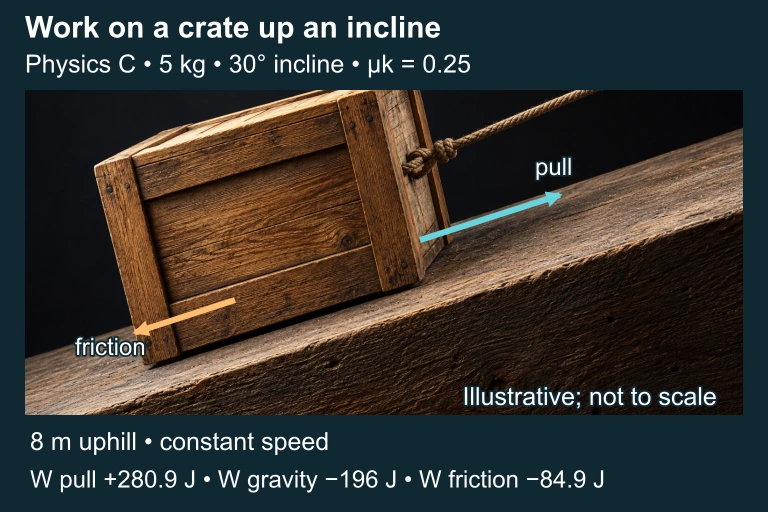
This illustration presents a separate Physics C model; compare its stated assumptions and values with the example already shown.
A 5.0 kg box is pulled 8.0 m up a 30° incline at constant velocity by a force applied parallel to the incline surface. The coefficient of kinetic friction between the box and the surface is μk = 0.25. Find (a) the work done by the applied force, (b) the work done by gravity, (c) the work done by friction, and (d) the net work done on the box. Four forces act on the box: the applied force Fapp directed up the incline, gravity mg directed straight downward, the normal force N perpendicular to the surface, and kinetic friction fk directed down the incline. Since velocity is constant, the net force (and net work) must be zero.
Show answer and explanation
Step 1 — Draw a Free-Body Diagram & Identify Forces: Four forces act on the box: the applied force Fapp directed up the incline, gravity mg directed straight downward, the normal force N perpendicular to the surface, and kinetic friction fk directed down the incline. Since velocity is constant, the net force (and net work) must be zero. Step 2 — Find the Normal Force: Balancing forces perpendicular to the incline: N = mg cos 30° = (5.0)(9.8)(cos 30°) = (5.0)(9.8)(0.866). N ≈ 42.4 N Step 3 — Find the Friction Force: fk = μkN = (0.25)(42.4). f_k ≈ 10.6 N Step 4 — Find the Applied Force (Constant Velocity): Along the incline, equilibrium requires Fapp = mg sin 30° + fk = (5.0)(9.8)(0.500) + 10.6 = 24.5 + 10.6. F_app ≈ 35.1 N Step 5a — Work Done by the Applied Force: The applied force is parallel to the displacement (θ = 0°), so Wapp = Fapp × d = (35.1)(8.0). W_app ≈ +281 J Step 5b — Work Done by Gravity: Gravity acts straight down while displacement is 8.0 m up the 30° incline. The component of gravity along the incline opposes the motion, so Wg = −mg sin 30° × d = −(24.5)(8.0). Equivalently, Wg = −mgΔh = −(5.0)(9.8)(8.0 sin 30°) = −(5.0)(9.8)(4.0). W_g ≈ −196 J Step 5c — Work Done by Friction: Friction opposes the motion (θ = 180°), so Wf = −fk × d = −(10.6)(8.0). W_f ≈ −84.8 J Step 5d — Net Work & Verification: Wnet = Wapp + Wg + Wf + WN = 281 + (−196) + (−84.8) + 0 ≈ 0 J. This confirms the work-energy theorem: constant velocity means ΔK = 0, so Wnet = 0. W_net = 0 J (verified: ΔK = 0)
How to Calculate Work
Example 1: Pulling a Crate
Example 2: Compressing a Spring
Example 3: Variable Force Integration
A force \( F(x) = 3x^2 + 2 \) (in newtons) acts on a particle moving along the \( x \)-axis from \( x = 1 \) m to \( x = 4 \) m. Find the work done.
Work in Two and Three Dimensions
When force and displacement have multiple components, use the dot product in component form:
For a variable force along a curved path, the general line integral becomes: $$ W = \int_C \vec{F} \cdot d\vec{r} = \int_C (F_x\,dx + F_y\,dy + F_z\,dz) $$
Common Mistakes
Summary of Work Formulas
| Situation | Formula | Key Detail |
|---|---|---|
| Constant force, straight line | \( W = Fd\cos\theta \) | Angle between \( \vec{F} \) and \( \vec{d} \) |
| Variable force (1D) | \( W = \int_{x_1}^{x_2} F(x)\,dx \) | Area under \( F \)-vs-\( x \) graph |
| Variable force (3D path) | \( W = \int_C \vec{F} \cdot d\vec{r} \) | Line integral along the path |
| Gravity | \( W_g = -mg\Delta h \) | Path-independent |
| Spring (from \( x_i \) to \( x_f \)) | \( W_s = -\tfrac{1}{2}k(x_f^2 - x_i^2) \) | Measured from natural length |
| Work-Energy Theorem | \( W_{\text{net}} = \Delta K \) | Net work = change in KE |
Question 1 of 5
A 10 N force is applied to a box at 60° above the horizontal. The box moves 5 m horizontally. How much work is done by this force?
Question 2 of 5
A spring with \( k = 200 \text{ N/m} \) is compressed from its natural length by 0.4 m. What is the work done by the spring during this compression?
Question 3 of 5
A force \( F(x) = 6x \) N acts on an object that moves from \( x = 0 \) to \( x = 3 \) m. What is the work done?
Question 4 of 5
An object moving at \( 4 \text{ m/s} \) is brought to rest by friction over 8 m. If the object's mass is 3 kg, what is the work done by friction?
Question 5 of 5
A centripetal force keeps an object moving in a horizontal circle at constant speed. How much work does the centripetal force do on the object per revolution?