Translational
Kinetic Energy
Explore how mass and velocity determine the energy of motion, from \( K = \frac{1}{2}mv^2 \) to the deep connection with the work-energy theorem.
What is Kinetic Energy?
Kinetic energy is the energy an object possesses due to its motion. Any object with mass that is moving has kinetic energy. It is a scalar quantity: it has magnitude but no direction.
In AP Physics C, we focus on the translational form: the energy of an object's center of mass moving through space, measured in joules (J).
The Fundamental Formula
Why Does \( v^2 \) Matter?
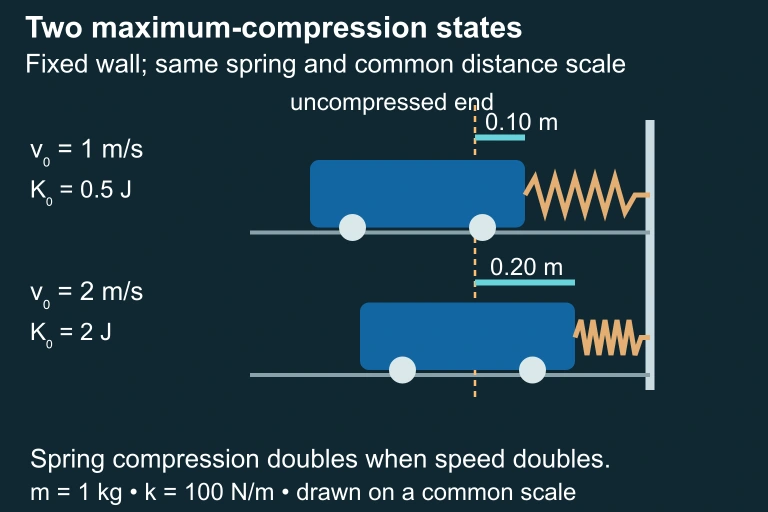
Kinetic energy depends on the square of velocity. This means doubling speed does not merely double the energy: it quadruples it.
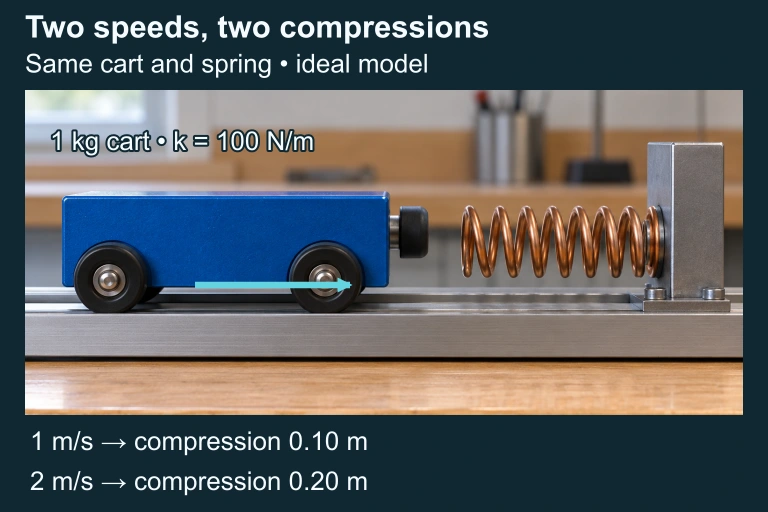
Supplementary Physics C model
This illustration presents a separate Physics C model; compare its stated assumptions and values with the example already shown.
Deriving \( K \) from Newton's Laws
The kinetic energy formula emerges naturally from Newton's Second Law and kinematics. Starting from \( F = ma \) and \( v^2 = v_0^2 + 2a\Delta x \):
The Calculus Derivation
For AP Physics C, we derive \( K \) using integration. The net work done on an object equals the integral of force over displacement:
This is the Work-Energy Theorem: the net work done on an object equals the change in its translational kinetic energy.
The Work-Energy Theorem
Kinetic vs Potential Energy
| Kinetic Energy | Potential Energy | |
|---|---|---|
| Depends on | Mass and speed | Position or configuration |
| Formula | \( K = \frac{1}{2}mv^2 \) | \( U_g = mgh \), \( U_s = \frac{1}{2}kx^2 \) |
| Zero when | Object is at rest | At the reference point |
| Sign | Always \( \geq 0 \) | Can be positive or negative |
| Frame dependent? | Yes | Depends on reference |
Translational vs Rotational
Energy of the center of mass moving through space. Depends on total mass and speed of the center of mass.
Energy due to spinning about an axis. Depends on moment of inertia \( I \) and angular velocity \( \omega \).
How to Solve KE Problems
Example 1: Direct Calculation
A 0.145 kg baseball is thrown at 40 m/s. What is its translational kinetic energy?
Example 2: Work-Energy Theorem
A 1200 kg car accelerates from 10 m/s to 25 m/s. How much net work was done on the car?
Example 3: Finding Speed from Work
A 5.0 kg block starts from rest. A net force does 200 J of work on it. What is the block's final speed?
Reading Force-Displacement Graphs
The area under a force vs. displacement graph equals the work done, which equals the change in kinetic energy:
Common Mistakes
Summary of Key Relationships
| Concept | Formula | Key Insight |
|---|---|---|
| Kinetic Energy | \( K = \frac{1}{2}mv^2 \) | Quadratic in \( v \) |
| Work-Energy Theorem | \( W_{\text{net}} = \Delta K \) | Net work = change in KE |
| Work (calculus) | \( W = \int \vec{F} \cdot d\vec{x} \) | Area under F vs. x curve |
| Speed from work | \( v_f = \sqrt{v_i^2 + \frac{2W}{m}} \) | Solve KE equation for \( v \) |
| Power | \( P = \frac{dK}{dt} = Fv \) | Rate of KE transfer |
Question 1 of 5
A 2.0 kg ball moves at 6.0 m/s. What is its translational kinetic energy?
Question 2 of 5
If you triple the speed of an object, by what factor does its kinetic energy change?
Question 3 of 5
A 4.0 kg object initially at rest has 50 J of net work done on it. What is its final speed?
Question 4 of 5
A 1500 kg car decelerates from 20 m/s to 10 m/s. What is the net work done on the car?
Question 5 of 5
Which statement about translational kinetic energy is always true?