01 / 21

Torque and Work

Explore how rotational forces do work on objects, connecting torque, angular displacement, and energy transfer in rotational systems.

AP Physics C: Mechanics

What is Torque?

Torque is the rotational analogue of force. While a force causes linear acceleration, torque causes angular acceleration. It measures how effectively a force can twist or rotate an object about an axis.

\( \vec{r} \)
Lever arm: distance from axis to force application point
\( \vec{F} \)
Applied force vector acting on the object
\( \theta \)
Angle between \( \vec{r} \) and \( \vec{F} \)

Visualizing Torque

Pivot \( r \) \( F \) \( \theta \) CCW \( \tau = rF\sin\theta \)

Work Done by Torque

Just as a linear force does work over a displacement \( W = \int F\,dx \), a torque does work over an angular displacement. This is the fundamental bridge between rotational dynamics and energy.

\( W > 0 \)
Torque and angular displacement in same direction: energy added
\( W < 0 \)
Torque and angular displacement in opposite directions: energy removed

Introductory torque model

This separate wrench model illustrates the torque relationship.
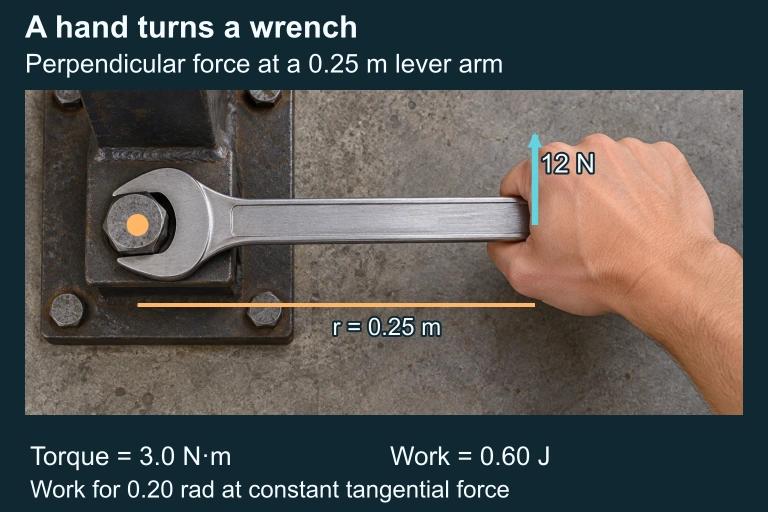
A 12 N perpendicular force on a 0.25 m wrench produces 3 N·m torque and does 0.60 J over 0.20 rad.

Supplementary Physics C model

This illustration presents a separate Physics C model; compare its stated assumptions and values with the example already shown.

A solid cylinder of mass M = 8.0 kg and radius R = 0.25 m is mounted on a frictionless axle. A cord wrapped around the cylinder exerts a constant tangential force of F = 12 N. Starting from rest, find (a) the torque about the axle, (b) the angular acceleration, (c) the work done by the torque after the cylinder has completed 5.0 revolutions, (d) the angular velocity at that point, and (e) the instantaneous power at that moment. M = 8.0 kg, R = 0.25 m, F = 12 N (tangential), ω₀ = 0 (starts from rest), Δθ = 5.0 rev = 5.0 × 2π = 10π rad ≈ 31.42 rad. The moment of inertia of a solid cylinder about its central axis is I = ½MR².

Show answer and explanation

Step 1 — Identify Given Values: M = 8.0 kg, R = 0.25 m, F = 12 N (tangential), ω₀ = 0 (starts from rest), Δθ = 5.0 rev = 5.0 × 2π = 10π rad ≈ 31.42 rad. The moment of inertia of a solid cylinder about its central axis is I = ½MR². Step 2 — Calculate the Torque: Since the force is tangential (perpendicular to the radius), the angle φ between r and F is 90°, so sin φ = 1. Therefore τ = RF = (0.25 m)(12 N). τ = 3.0 N·m Step 3 — Calculate the Moment of Inertia and Angular Acceleration: I = ½MR² = ½(8.0 kg)(0.25 m)² = ½(8.0)(0.0625) = 0.25 kg·m². From Newton's second law for rotation: α = τ/I = 3.0 N·m / 0.25 kg·m². α = 12 rad/s² Step 4 — Calculate the Work Done: Since the torque is constant, W = τΔθ = (3.0 N·m)(10π rad) = 30π J. W ≈ 94.2 J Step 5 — Find the Angular Velocity (via Work-Energy Theorem): By the work-energy theorem: W = ½Iω² − ½Iω₀². Since ω₀ = 0, we have 30π = ½(0.25)ω², so ω² = 2(30π)/0.25 = 240π. Therefore ω = √(240π). ω ≈ 27.4 rad/s Step 6 — Calculate the Instantaneous Power: P = τω = (3.0 N·m)(27.4 rad/s). P ≈ 82.3 W Step 7 — Verification: We can verify using kinematics: ω² = ω₀² + 2αΔθ = 0 + 2(12)(10π) = 240π, confirming ω = √(240π) ≈ 27.4 rad/s. Also, K = ½Iω² = ½(0.25)(240π) = 30π ≈ 94.2 J, matching the work calculated. ✓
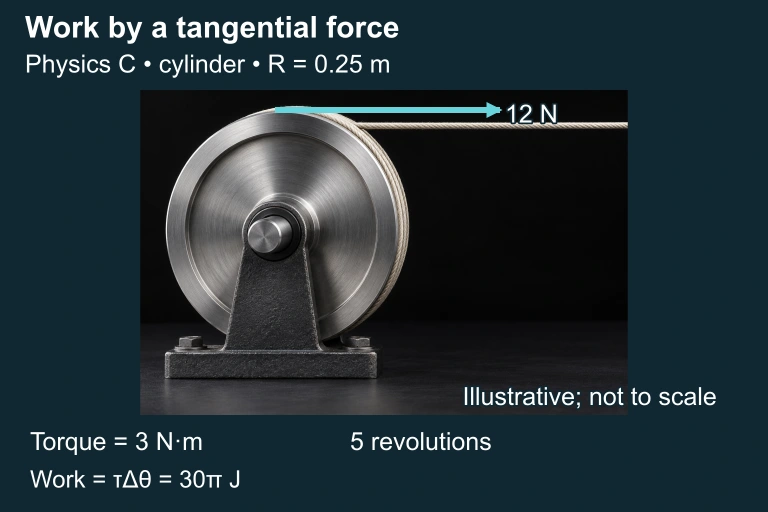
Physics C • cylinder • R = 0.25 m; illustrative apparatus not to scale.

Power entering and leaving a flywheel
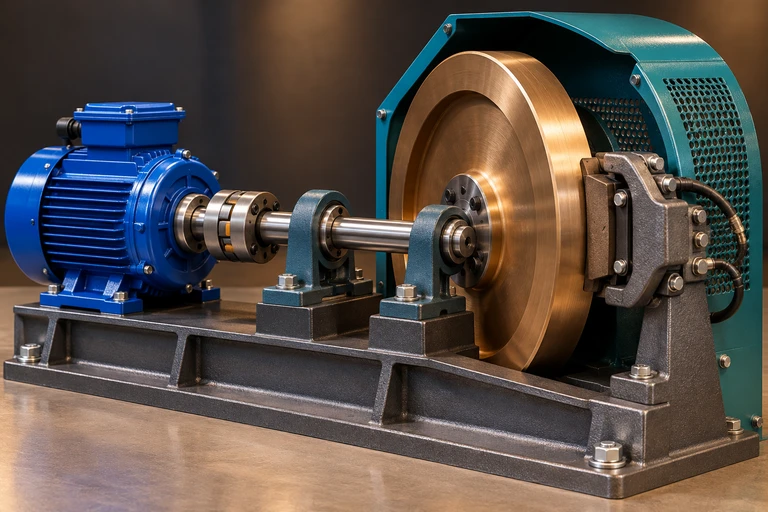
A blue motor drives a gold flywheel through a continuous horizontal shaft with two bearings. A fixed brake caliper contacts the wheel rim inside a partial protective guard.A flywheel stores kinetic energy as it rotates. Net torque changes that energy through rotational work, while drive and load torques can transfer power even at steady speed.

Work and angular speed
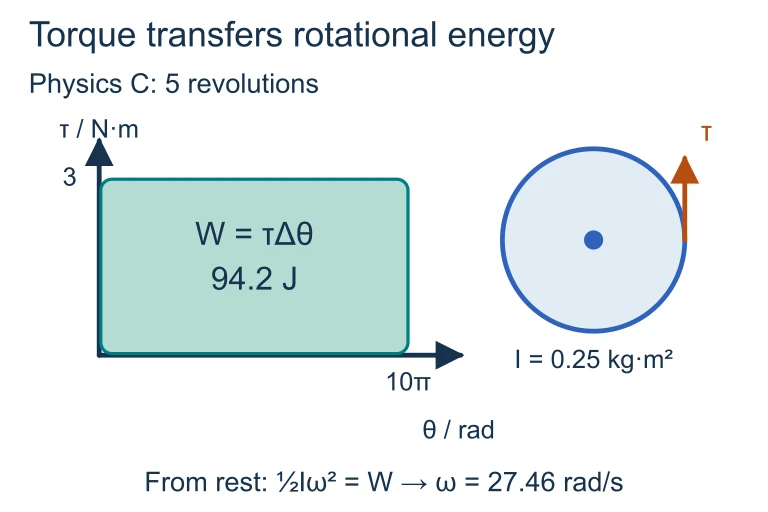
Work and angular speed. A constant 3 N·m net torque through 10π radians transfers 30π J. Starting from rest with I = 0.25 kg·m², the disk reaches about 27.46 rad/s.A constant 3 N·m net torque through 10π radians transfers 30π J. Starting from rest with I = 0.25 kg·m², the disk reaches about 27.46 rad/s.

Rotational Kinetic Energy

A spinning object has kinetic energy due to its rotation. The work-energy theorem applies to rotation just as it does to linear motion: net work equals change in kinetic energy.

Rotational Power

Power is the rate at which work is done. In rotational systems, power connects torque to angular velocity, just as \( P = Fv \) connects force to linear velocity.

Linear \( P = Fv \) Rotational \( P = \tau\omega \)

Linear vs. Rotational Analogues

Concept Linear Rotational
Inertia \( m \) \( I \)
"Force" \( F \) \( \tau \)
Displacement \( x \) \( \theta \)
Velocity \( v \) \( \omega \)
Work \( W = \int F\,dx \) \( W = \int \tau\,d\theta \)
Kinetic Energy \( \frac{1}{2}mv^2 \) \( \frac{1}{2}I\omega^2 \)
Power \( P = Fv \) \( P = \tau\omega \)

How to Solve Torque-Work Problems

1
Identify the axis of rotation and draw a free-body diagram showing all forces and their points of application.
2
Calculate each torque: \( \tau = rF\sin\theta \). Assign signs: choose a positive rotation direction (CCW is conventional).
3
Find the angular displacement \( \Delta\theta \) in radians. If given revolutions, convert: \( 1\text{ rev} = 2\pi\text{ rad} \).
4
Compute work: use \( W = \tau\,\Delta\theta \) for constant torque, or \( W = \int \tau\,d\theta \) if torque varies.
5
Apply the work-energy theorem if asked for final speed: \( W_{\text{net}} = \frac{1}{2}I\omega_f^2 - \frac{1}{2}I\omega_i^2 \).

Example 1: Constant Torque on a Wheel

A constant torque of \( \tau = 12\;\text{N}\!\cdot\!\text{m} \) is applied to a wheel. The wheel completes 5 full revolutions. How much work is done?

\( \tau = 12 \) 5 revolutions Solution \( \Delta\theta = 5 \times 2\pi \) \( = 10\pi\;\text{rad} \) \( W = \tau\,\Delta\theta \) \( = 12 \times 10\pi \) \( \approx 377\;\text{J} \)

Example 2: Work-Energy Theorem

A solid disk (\( I = \frac{1}{2}MR^2 \)) of mass \( M = 4\;\text{kg} \) and radius \( R = 0.3\;\text{m} \) starts from rest. A constant torque of \( 6\;\text{N}\!\cdot\!\text{m} \) is applied through 3 revolutions. Find \( \omega_f \).

1
Moment of inertia: \( I = \frac{1}{2}(4)(0.3)^2 = 0.18\;\text{kg}\!\cdot\!\text{m}^2 \)
2
Angular displacement: \( \Delta\theta = 3 \times 2\pi = 6\pi\;\text{rad} \)
3
Work done: \( W = \tau\,\Delta\theta = 6 \times 6\pi = 36\pi \approx 113.1\;\text{J} \)
4
Work-energy theorem: \( W = \frac{1}{2}I\omega_f^2 \Rightarrow \omega_f = \sqrt{\frac{2W}{I}} = \sqrt{\frac{2(36\pi)}{0.18}} \approx 35.4\;\text{rad/s} \)

Example 3: Variable Torque

A torque varies as \( \tau(\theta) = 4\theta + 2 \) (in N·m). Find the work done as the object rotates from \( \theta = 0 \) to \( \theta = 3\;\text{rad} \).

\( \theta \) (rad) \( \tau \) 1 2 3 2 6 10 14 \( \tau = 4\theta + 2 \) Area = Work

Example 4: Rotational Power

A motor applies a constant torque of \( \tau = 50\;\text{N}\!\cdot\!\text{m} \) to a flywheel spinning at \( \omega = 120\;\text{rad/s} \). What power is delivered?

Rolling: Combined Energy

An object rolling without slipping has both translational and rotational kinetic energy. The total work done on it changes both forms simultaneously.

Solid Sphere
\( K = \frac{7}{10}mv^2 \)
Solid Cylinder
\( K = \frac{3}{4}mv^2 \)
Hollow Sphere
\( K = \frac{5}{6}mv^2 \)

Net Work from Multiple Torques

When several torques act simultaneously, the net work equals the work done by the net torque. You can sum torques first, then compute work, or compute each torque's work separately and add.

\( F_1 \) \( f \) \( \omega \) \( W_{\text{net}} = (\tau_1 - \tau_f)\,\Delta\theta \)

Common Mistakes

✕ Degrees Instead of Radians
Using \( \Delta\theta \) in degrees in \( W = \tau\,\Delta\theta \). Angular displacement must be in radians for work to come out in joules.
✕ Forgetting Rotational KE
For rolling objects, only counting \( \frac{1}{2}mv^2 \) and ignoring \( \frac{1}{2}I\omega^2 \). Both contributions must be included.
✕ Wrong Angle in \( rF\sin\theta \)
Using the angle of rotation instead of the angle between \( \vec{r} \) and \( \vec{F} \). These are different angles serving different roles.

Key Formulas Summary

Quantity Formula Units
Torque \( \tau = rF\sin\theta \) N·m
Work (constant \( \tau \)) \( W = \tau\,\Delta\theta \) J
Work (variable \( \tau \)) \( W = \int \tau\,d\theta \) J
Rotational KE \( K = \frac{1}{2}I\omega^2 \) J
Work-Energy Theorem \( W_{\text{net}} = \Delta K_{\text{rot}} \) J
Power \( P = \tau\omega \) W

Question 1 of 5

A wrench applies a force of 40 N at the end of a 0.25 m handle, perpendicular to the handle. What is the torque about the bolt?

Question 2 of 5

A constant torque of 8 N·m acts on a pulley through 4 complete revolutions. How much work is done?

Question 3 of 5

A disk with \( I = 0.5\;\text{kg}\!\cdot\!\text{m}^2 \) starts from rest. After a net work of 100 J is done on it, what is its angular velocity?

Question 4 of 5

A motor delivers 3 kW of power to a shaft spinning at 150 rad/s. What torque does the motor exert?

Question 5 of 5

A solid sphere (\( I = \frac{2}{5}mR^2 \)) rolls down a hill without slipping, losing 70 J of gravitational PE. What is its translational kinetic energy at the bottom?