01 / 21

Torque
The Rotational Force

Explore how forces cause rotational motion, master the cross product formulation \(\vec{\tau} = \vec{r} \times \vec{F}\), and solve problems involving static and dynamic equilibrium.

AP Physics C: Mechanics

What Is Torque?

Torque is the rotational analog of force. Just as a force causes linear acceleration, torque causes angular acceleration about a pivot point. It depends not only on how hard you push, but also on where and at what angle you push.

Symbol
\(\tau\) (Greek letter "tau")
SI Unit
\(\text{N}\cdot\text{m}\) (newton-meter)
Type
Vector (has magnitude and direction)

Torque in Action

Pivot \(r\) \(\vec{F}\) \(\theta\) Rotation

Why Does Torque Matter?

Newton's second law for rotation states that the net torque on a rigid body equals its moment of inertia times its angular acceleration. This is the foundation of rotational dynamics.

Engineering
Bridge design, engine shafts, gear systems all require torque analysis
Everyday Life
Opening doors, using wrenches, riding bicycles: all torque in action

Measuring inertia through a revealed axle
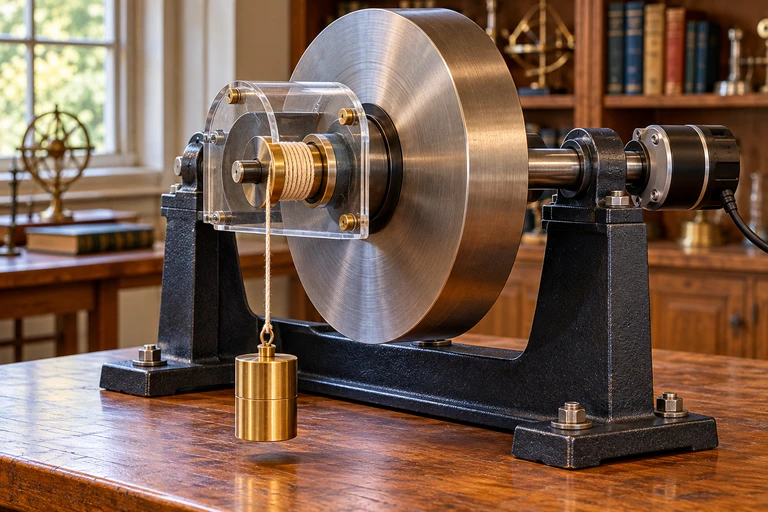
A hanging load turns a string-wound small axle attached to a larger supported rotor.A hanging load’s tension is less than its weight while it accelerates downward. With no slip, a = rα, so its axle torque is m(g − rα)r.

From falling load to axle torque
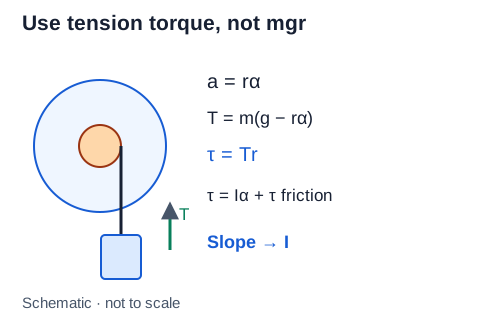
A string from a small axle supports a falling load; equations connect load tension, axle radius and angular acceleration to applied torque.For a load accelerating downward, mg − T = ma. With no slip, a = rα, so the applied axle torque is Tr = m(g − rα)r. If bearing friction opposes rotation, Tr = Iα + τfriction.Open full diagram

Finding inertia from torque and acceleration
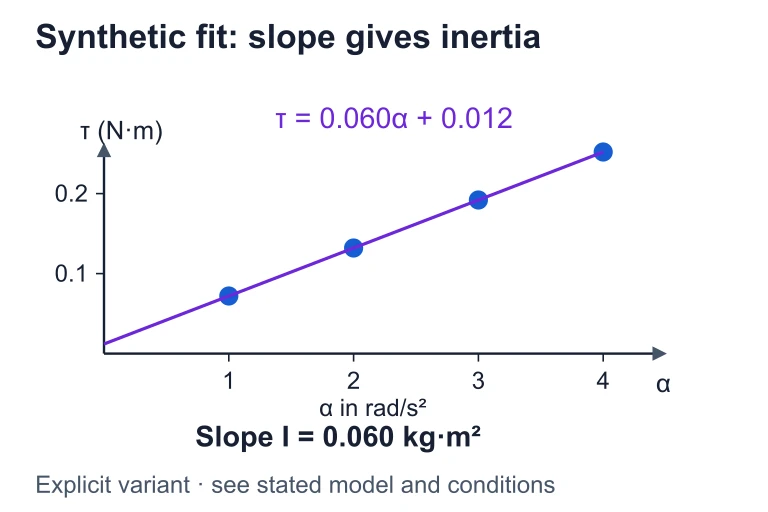
Finding inertia from torque and acceleration. For the displayed relationship τ = 0.060α + 0.012, the slope gives I = 0.060 kg·m² and the intercept gives a constant opposing friction torque of 0.012 N·m.For the displayed relationship τ = 0.060α + 0.012, the slope gives I = 0.060 kg·m² and the intercept gives a constant opposing friction torque of 0.012 N·m.

The Cross Product Formula

O \(\vec{r}\) \(\vec{F}\) \(\theta\) \(\vec{\tau}\) (out of page)

The Moment Arm Approach

Pivot \(r\) \(\vec{F}\) Line of action \(d = r\sin\theta\)

Both \(\tau = rF\sin\theta\) and \(\tau = Fd\) give the same result. Choose whichever is easier for the given geometry.

Introductory torque model

This separate wrench model illustrates the torque relationship.
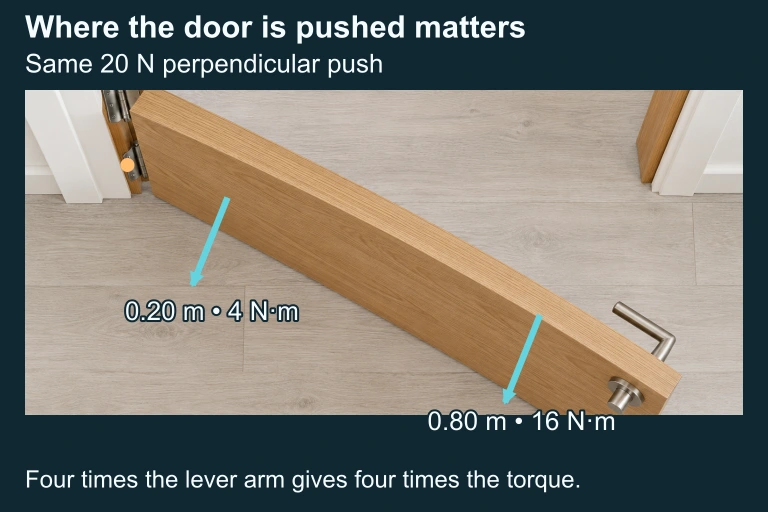
The same 20 N perpendicular force at lever arms 0.20 m and 0.80 m produces 4 N·m and 16 N·m.

Supplementary Physics C model

This illustration presents a separate Physics C model; compare its stated assumptions and values with the example already shown.

A uniform horizontal beam of mass M = 12 kg and length L = 4.0 m is attached to a wall by a hinge at its left end. A cable attached to the right end of the beam makes an angle of 30° with the beam and connects to the wall above the hinge. A block of mass m = 8.0 kg hangs from a point 3.0 m from the hinge. Find the tension in the cable and the force exerted by the hinge. The beam has four forces: the beam's weight Mg acting downward at its center (2.0 m from hinge), the block's weight mg acting downward at 3.0 m from the hinge, the cable tension T at the right end (4.0 m), and the hinge force FH at the left end. We choose the hinge as the pivot to eliminate FH from the torque equation.

Show answer and explanation

Step 1 — Draw the Free-Body Diagram & Choose a Pivot: The beam has four forces: the beam's weight Mg acting downward at its center (2.0 m from hinge), the block's weight mg acting downward at 3.0 m from the hinge, the cable tension T at the right end (4.0 m), and the hinge force FH at the left end. We choose the hinge as the pivot to eliminate FH from the torque equation. Step 2 — Write the Torque Equation (Στ = 0 about hinge): Taking counterclockwise as positive, the cable provides a CCW torque and the two weights provide CW torques. The perpendicular component of T relative to the beam is T sin 30°. Thus: T sin 30° × L − Mg × (L/2) − mg × (3.0 m) = 0. Substituting: T(0.50)(4.0) − (12)(9.8)(2.0) − (8.0)(9.8)(3.0) = 0. 2.0T = 235.2 + 235.2 = 470.4 → T = 235.2 N Step 3 — Resolve the Tension into Components: Tx = T cos 30° = 235.2 × 0.866 = 203.7 N (horizontal, toward wall). Ty = T sin 30° = 235.2 × 0.50 = 117.6 N (vertical, upward). Step 4 — Apply ΣF = 0 to Find Hinge Forces: Horizontal: FHx − Tx = 0 → FHx = 203.7 N. Vertical: FHy + Ty − Mg − mg = 0 → FHy = (12 + 8)(9.8) − 117.6 = 196 − 117.6 = 78.4 N (upward). F_H = √(203.7² + 78.4²) ≈ 218 N at 21° above horizontal
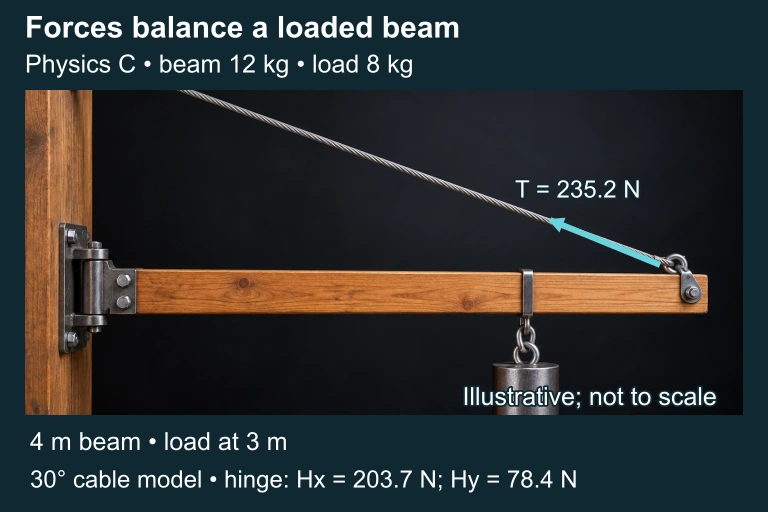
Physics C • beam 12 kg • load 8 kg; illustrative apparatus not to scale.

Torque vs Force

Torque \(\tau\) Force \(F\)
Causes Angular acceleration \(\alpha\) Linear acceleration \(a\)
Equation \(\sum\tau = I\alpha\) \(\sum F = ma\)
Units \(\text{N}\cdot\text{m}\) \(\text{N}\)
Depends on Force, distance, angle Mass and acceleration
Inertia analog Moment of inertia \(I\) Mass \(m\)
Type Pseudovector Vector

Sign Convention & Direction

\(+\tau\) Counterclockwise \(-\tau\) Clockwise
+ Positive
Counterclockwise (CCW) rotation, by convention pointing out of the page (\(\hat{k}\))
\(-\) Negative
Clockwise (CW) rotation, by convention pointing into the page (\(-\hat{k}\))

How to Calculate Torque

1
Identify the pivot point. This is the axis of rotation or the point about which you compute torques.
2
Draw \(\vec{r}\). Find the position vector from the pivot to the point where the force is applied.
3
Measure angle \(\theta\). Determine the angle between \(\vec{r}\) and \(\vec{F}\). Often it is easier to find the moment arm \(d\).
4
Compute magnitude: \(\tau = rF\sin\theta\) or \(\tau = Fd\).
5
Assign sign. CCW = positive, CW = negative (or use the right-hand rule for 3D).

Example 1: Wrench

Bolt \(0.30 \text{ m}\) \(50 \text{ N}\) \(90^\circ\)

Example 2: Angled Force

Hinge \(2.0 \text{ m}\) \(100 \text{ N}\) \(30^\circ\) \(F_\perp\)

Example 3: Balancing a Beam

Fulcrum \(200 \text{ N}\) \(2.0 \text{ m}\) \(F_2 = ?\) \(1.0 \text{ m}\)

Net Torque and Equilibrium

A rigid body is in rotational equilibrium when the net torque about any axis is zero. This condition, combined with \(\sum \vec{F} = 0\), gives static equilibrium.

Static Equilibrium
\(\sum \vec{F} = 0\) and \(\sum \tau = 0\): the object is at rest and stays at rest.
Dynamic Equilibrium
\(\sum \vec{F} = 0\) and \(\sum \tau = 0\): the object moves with constant velocity and constant angular velocity.

Torque in 3D: The Cross Product

i
\(\tau_x = r_yF_z - r_zF_y\)
j
\(\tau_y = r_zF_x - r_xF_z\)
k
\(\tau_z = r_xF_y - r_yF_x\)

For 2D problems (forces in the \(xy\)-plane), only the \(\hat{k}\) component survives: \(\tau_z = r_xF_y - r_yF_x\).

Common Mistakes

✕ Confusing N·m with Joules
Although \(1 \text{ N}\cdot\text{m} = 1 \text{ J}\) dimensionally, torque is not energy. They are physically distinct quantities: never use "joules" for torque.
✕ Using the Wrong Angle
The angle \(\theta\) must be between \(\vec{r}\) and \(\vec{F}\), not between the force and the horizontal. Redraw carefully.
✕ Wrong Pivot Point for \(\vec{r}\)
\(\vec{r}\) is measured from the pivot to the point of force application, not from an arbitrary origin. Changing pivots changes \(\vec{r}\).

Summary of Key Formulas

Concept Formula When to Use
Torque (scalar) \(\tau = rF\sin\theta\) When you know the angle
Moment arm \(\tau = Fd\) When \(d\) is easier to find
Cross product \(\vec{\tau} = \vec{r}\times\vec{F}\) 3D problems, component form
Newton's 2nd (rot.) \(\sum\tau = I\alpha\) Rotational dynamics
Static equilibrium \(\sum\tau = 0\) Statics, balance problems

Question 1 of 5

A force of \(40 \text{ N}\) is applied at the end of a \(0.50 \text{ m}\) wrench, perpendicular to it. What is the torque about the bolt?

Question 2 of 5

A \(120 \text{ N}\) force is applied at the end of a \(0.80 \text{ m}\) lever arm at \(30^\circ\) to the lever. What is the magnitude of the torque?

Question 3 of 5

A uniform beam of mass \(10 \text{ kg}\) and length \(4 \text{ m}\) is supported at one end. What is the torque due to gravity about the support point? (Use \(g = 10 \text{ m/s}^2\).)

Question 4 of 5

If \(\vec{r} = (3\hat{i} + 0\hat{j}) \text{ m}\) and \(\vec{F} = (0\hat{i} + 5\hat{j}) \text{ N}\), what is \(\vec{\tau}\)?

Question 5 of 5

A door of width \(0.9 \text{ m}\) requires \(18 \text{ N}\cdot\text{m}\) of torque to open. If you push perpendicular to the door at a point \(0.3 \text{ m}\) from the hinges, how much force must you apply?