Systems and
Center of Mass
Master how to locate the center of mass of particle systems and continuous bodies, and understand why it governs the motion of entire systems.
What Is a System?
In physics, a system is any collection of objects that we choose to analyze together. Everything outside the system is the surroundings. The boundary you draw is your choice: it determines which forces are internal (between objects inside) and which are external (from the surroundings).
Defining the Center of Mass
The center of mass (CM) is the mass-weighted average position of all particles in a system. It is the single point where the entire mass of the system can be considered to be concentrated for translational motion.
Visualizing Discrete Particles
Center of Mass for Continuous Bodies
When mass is distributed continuously, sums become integrals. We replace \(m_i\) with a differential mass element \(dm\), and the summation with an integral over the entire body.
The CM Motion Theorem
The center of mass moves as if all external forces acted on a single particle of mass \(M\) located at the CM. Internal forces have no effect on CM motion.
Projectile Breakup: CM Follows the Parabola
Center of Mass vs. Center of Gravity
| Center of Mass | Center of Gravity | |
|---|---|---|
| Definition | Mass-weighted average position | Point where gravity effectively acts |
| Formula | \(\frac{1}{M}\sum m_i \vec{r}_i\) | \(\frac{\sum m_i g_i \vec{r}_i}{\sum m_i g_i}\) |
| Same point? | Yes, when \(\vec{g}\) is uniform. Different in non-uniform fields. | |
| Depends on | Mass distribution only | Mass distribution + gravitational field |
| AP Physics C | Used for dynamics, momentum | Used for torque, equilibrium |
How to Find the Center of Mass
Example 1: Three Particles
Find the center of mass of three particles: \(m_1 = 2\) kg at \((0, 0)\), \(m_2 = 3\) kg at \((4, 0)\), and \(m_3 = 5\) kg at \((2, 3)\).
Example 2: Non-Uniform Rod
A rod of length \(L\) has linear mass density \(\lambda(x) = \lambda_0 \frac{x}{L}\), where \(x\) is measured from one end. Find \(x_{\text{cm}}\).
Example 3: CM Velocity
A 4 kg block moving at \(6\) m/s collides with a stationary 2 kg block. What is the velocity of the center of mass before (and after) the collision?
Using Symmetry and Subtraction
A density gradient and a missing piece you can see
 Center of mass weights each mass element by position, while rotational inertia weights it by squared distance from the axis. A removed region is subtracted from the original body with its own mass and location.
Center of mass of a nonuniform rod
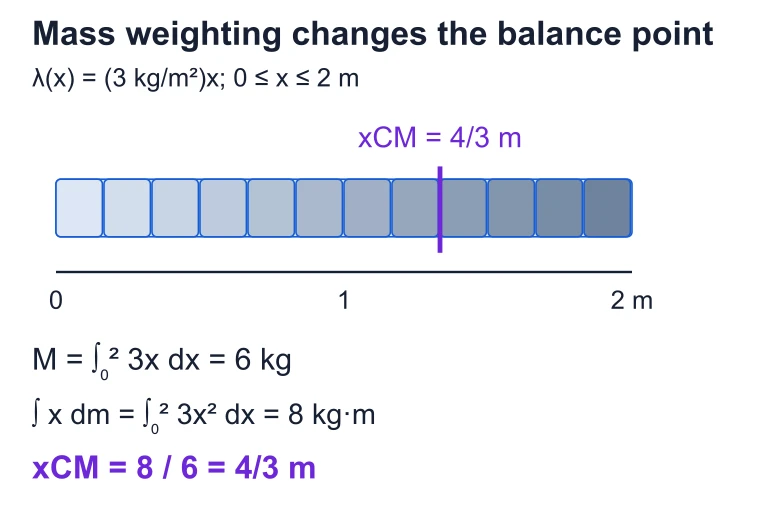 For λ(x) = (3 kg/m²)x on 0 ≤ x ≤ 2 m, integrating gives mass 6 kg and first moment 8 kg·m. The center of mass is at x = 4/3 m.
Center of mass after removing a hole
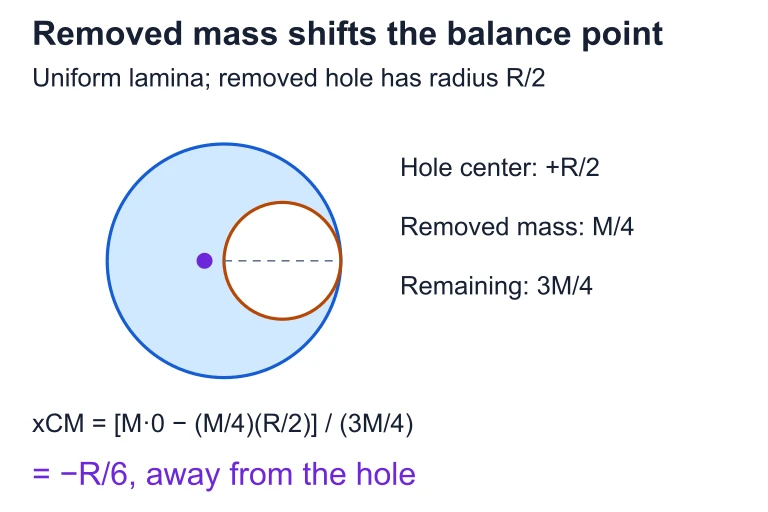 Removing a radius-R/2 hole centered at +R/2 from a uniform radius-R disk removes one-quarter of its mass. The remaining center of mass shifts to −R/6, away from the hole.
Momentum and the Center of Mass
The total linear momentum of a system is intimately connected to the CM velocity. This connection is what makes the CM so powerful in dynamics.
Common Mistakes
Summary of Key Formulas
| Quantity | Discrete System | Continuous Body |
|---|---|---|
| Position | \(\frac{1}{M}\sum m_i \vec{r}_i\) | \(\frac{1}{M}\int \vec{r}\, dm\) |
| Velocity | \(\frac{1}{M}\sum m_i \vec{v}_i\) | \(\frac{d\vec{r}_{\text{cm}}}{dt}\) |
| Acceleration | \(\frac{1}{M}\sum m_i \vec{a}_i\) | \(\frac{\vec{F}_{\text{ext}}}{M}\) |
| Momentum | \(\vec{p}_{\text{total}} = M\vec{v}_{\text{cm}}\) | |
| Newton's 2nd | \(\vec{F}_{\text{ext}} = M\vec{a}_{\text{cm}}\) | |
Question 1 of 5
Two particles have masses \(m_1 = 3\) kg at \(x = 0\) and \(m_2 = 1\) kg at \(x = 8\) m. Where is the center of mass?
Question 2 of 5
A system of particles has zero net external force acting on it. Which statement is true about the center of mass?
Question 3 of 5
A uniform rod of length \(L\) has a linear mass density \(\lambda = 2\lambda_0 \frac{x}{L}\). The center of mass is at:
Question 4 of 5
A 60 kg astronaut and a 90 kg astronaut float at rest in space, 10 m apart. If the 60 kg astronaut pushes off, the CM of the two-astronaut system will:
Question 5 of 5
A firecracker at rest explodes into three pieces. Two pieces fly off as shown. What can we determine about the third piece?