Supplementary Physics C model
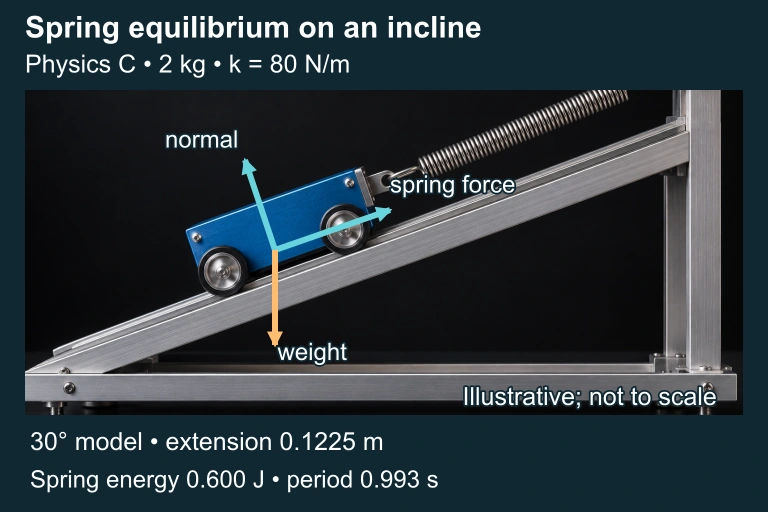
This illustration presents a separate Physics C model; compare its stated assumptions and values with the example already shown.
A 2.0 kg block rests on a frictionless 30° incline and is attached to a spring with spring constant k = 80 N/m, anchored at the top of the incline. The spring is aligned along the surface of the incline. Find (a) the spring's equilibrium extension, (b) the elastic potential energy stored at that extension, and (c) the period of small oscillations about this new equilibrium. Choose x positive down the incline, measured from the block position at the spring’s natural length. Positive x is extension of the spring anchored uphill. The spring force along the incline is −kx and the gravitational component is +mg sin θ. The normal force balances the perpendicular component of gravity.
Show answer and explanation
Step 1 — Draw the Free-Body Diagram & Choose Coordinates: Choose x positive down the incline, measured from the block position at the spring’s natural length. Positive x is extension of the spring anchored uphill. The spring force along the incline is −kx and the gravitational component is +mg sin θ. The normal force balances the perpendicular component of gravity. Step 2 — Find Equilibrium Extension: At equilibrium, mg sin θ − kx₀ = 0. Therefore x₀ = mg sin θ/k = (2.0)(9.8)(sin 30°)/80 = 9.8/80 = +0.1225 m. The stretched spring pulls uphill with 9.8 N, balancing gravity’s downhill component. x₀ = +0.1225 m ≈ +0.12 m (extended 12.25 cm) Step 3 — Calculate Elastic Potential Energy: Using U = ½kx₀²: U = ½(80)(0.1225)² = 40 × 0.01501 = 0.600 J. U ≈ 0.60 J Step 4 — Determine Period of Oscillation: For small oscillations about the new equilibrium on an incline, gravity shifts the equilibrium position but does not change the restoring force's dependence on displacement from that equilibrium. With ξ = x − x₀, the equation of motion is mξ̈ = −kξ. The effective spring constant remains k = 80 N/m. Therefore T = 2π√(m/k) = 2π√(2.0/80) = 2π√(0.025) = 2π(0.1581). T ≈ 0.993 s ≈ 1.0 s Step 5 — Physical Interpretation: Gravity on the incline shifts where the block sits at rest (the equilibrium point moves down the incline) and stores energy in the extended spring, but it does not alter the oscillation frequency. This is a hallmark of Hooke's law: a constant external force shifts equilibrium without changing the dynamics around that equilibrium — a principle tested frequently on AP Physics C.
The spring has mass too
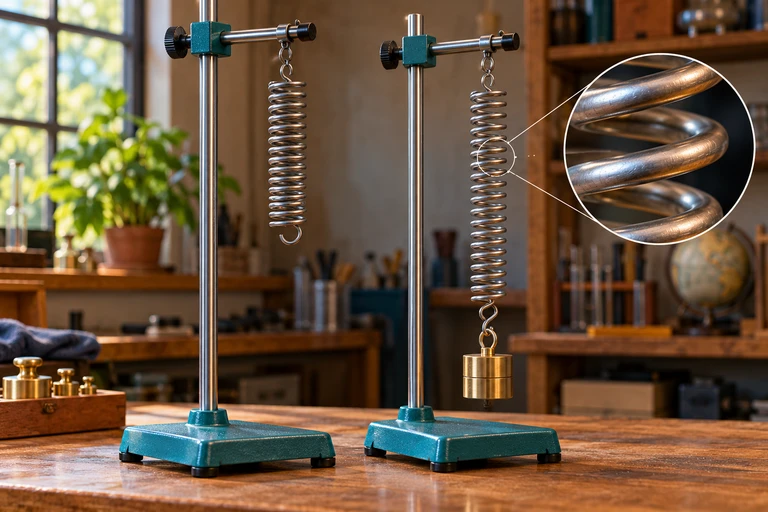 Connecting springs in series or parallel changes their effective stiffness. Series connections carry the same force; parallel connections impose the same extension.
Springs in series and parallel
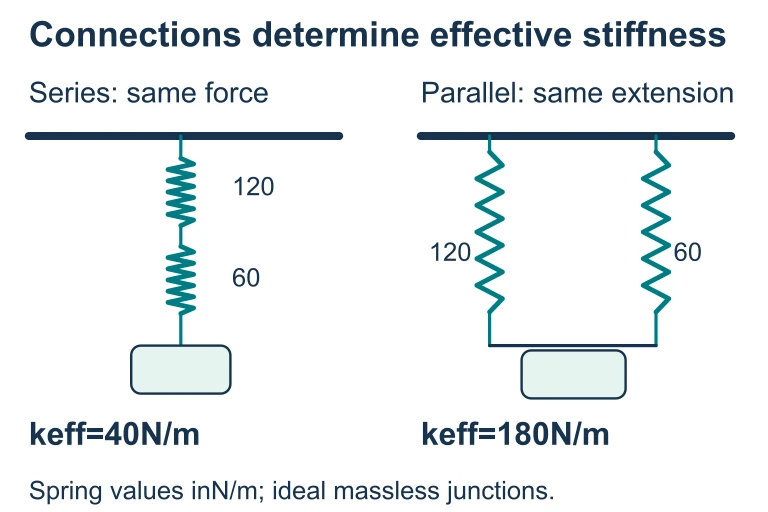 Springs of 120 and 60 N/m have effective stiffness 40 N/m in series and 180 N/m in parallel. Series springs carry the same force; parallel springs attached to a rigid crossbar have the same extension.