01 / 20
\(\theta\)

Simple & Physical
Pendulums

Master the oscillatory motion of pendulums: from the idealized point mass to extended rigid bodies, with full derivations using torque and small-angle approximation.

AP Physics C: Mechanics

What Is a Pendulum?

A pendulum is any object that swings back and forth about a fixed pivot point under the influence of gravity. When displaced from its equilibrium position and released, the restoring torque due to gravity drives oscillatory motion.

Simple Pendulum
A point mass \(m\) on a massless, inextensible string of length \(L\).
Physical Pendulum
An extended rigid body pivoting about a point that is not at the center of mass.

The Restoring Torque

\(\theta\)
\(L\)
\(mg\)
\(mg \sin \theta\)
\(m\)

The Small-Angle Approximation

For small angles (typically \(\theta < 15^\circ\)), we can write:

1
At 5°: \(\sin(0.0873) = 0.0872\) : error ≈ 0.13%
2
At 10°: \(\sin(0.1745) = 0.1736\) : error ≈ 0.5%
3
At 15°: \(\sin(0.2618) = 0.2588\) : error ≈ 1.1%

Deriving the Simple Pendulum Period

1
Newton's second law for rotation: \(\tau = I\alpha\), where \(I = mL^2\) for a point mass at distance \(L\).
2
Substitute torque: \(-mgL\sin\theta = mL^2\,\ddot{\theta}\).
3
Apply small-angle: \(\ddot{\theta} = -\dfrac{g}{L}\,\theta\). This is the SHM equation \(\ddot{\theta} = -\omega^2\theta\).
4
Identify \(\omega\): \(\omega = \sqrt{g/L}\), so:

Simple Pendulum: Key Relations

\(t\)
\(\theta\)
\(\theta_0\)
\(-\theta_0\)
\(T\)
Angular Frequency
\(\omega = \sqrt{g/L}\)
Period
\(T = 2\pi/\omega = 2\pi\sqrt{L/g}\)
Solution
\(\theta(t) = \theta_0\cos(\omega t + \phi)\)

The Physical Pendulum

A physical pendulum is any rigid body free to oscillate about a pivot that does not pass through its center of mass. Unlike the simple pendulum, we must account for the body's rotational inertia about the pivot.

CM
\(d\)
\(\theta\)
\(Mg\)
P

Deriving the Physical Pendulum Period

1
Torque about pivot P: \(\tau = -Mgd\sin\theta\), where \(d\) is the distance from P to the center of mass.
2
Newton's second law: \(I_P\,\ddot{\theta} = -Mgd\sin\theta\).
3
Small-angle: \(\ddot{\theta} = -\dfrac{Mgd}{I_P}\,\theta\). This is SHM with \(\omega^2 = Mgd/I_P\).

Simple vs. Physical: Key Distinction

Property Simple Pendulum Physical Pendulum
Model Point mass on massless string Extended rigid body
Moment of Inertia \(I = mL^2\) \(I_P = I_{\text{cm}} + Md^2\)
Torque Arm \(L\) (string length) \(d\) (pivot to CM distance)
Period \(T = 2\pi\sqrt{L/g}\) \(T = 2\pi\sqrt{I_P/(Mgd)}\)
Mass Dependence Independent of \(m\) Independent of \(M\) (cancels)

Supplementary Physics C model

This illustration presents a separate Physics C model; compare its stated assumptions and values with the example already shown.

A thin, uniform rod of mass M = 0.80 kg and length L = 1.2 m is pivoted at one end and allowed to swing freely under gravity. We need to find the period of small oscillations. Since the rod is an extended body, this is a physical pendulum problem.

Show answer and explanation

Step 1 — Identify the System and Given Values: A thin, uniform rod of mass M = 0.80 kg and length L = 1.2 m is pivoted at one end and allowed to swing freely under gravity. We need to find the period of small oscillations. Since the rod is an extended body, this is a physical pendulum problem. Step 2 — Determine d (Pivot-to-CM Distance): For a uniform rod, the center of mass is at its geometric center, so d = L/2 = 1.2/2 = 0.60 m. d = 0.60 m Step 3 — Compute I About the Pivot: Using the parallel-axis theorem: I = Icm + Md² = ML²/12 + M(L/2)² = ML²/12 + ML²/4 = ML²(1/12 + 1/4) = ML²(1/12 + 3/12) = ML²/3. Numerically: I = (0.80)(1.2)²/3 = (0.80)(1.44)/3 = 0.384 kg·m². I = ML²/3 = 0.384 kg·m² Step 4 — Apply the Physical Pendulum Formula: T = 2π√(I / Mgd) = 2π√(0.384 / (0.80 × 9.8 × 0.60)) = 2π√(0.384 / 4.704) = 2π√(0.08163) = 2π × 0.2857 = 1.795 s. T ≈ 1.80 s Step 5 — Verify with the Equivalent Length: As a check, compute Leq = I/(Md) = (ML²/3)/(ML/2) = 2L/3 = 2(1.2)/3 = 0.80 m. Then T = 2π√(Leq/g) = 2π√(0.80/9.8) = 2π√(0.08163) = 1.80 s. ✓ This matches, confirming the result. Note that the equivalent simple pendulum length (0.80 m) is shorter than the rod's full length (1.2 m), as expected—the distributed mass makes the rod oscillate faster than a simple pendulum of length L. L_eq = 2L/3 = 0.80 m — Confirmed: T ≈ 1.80 s
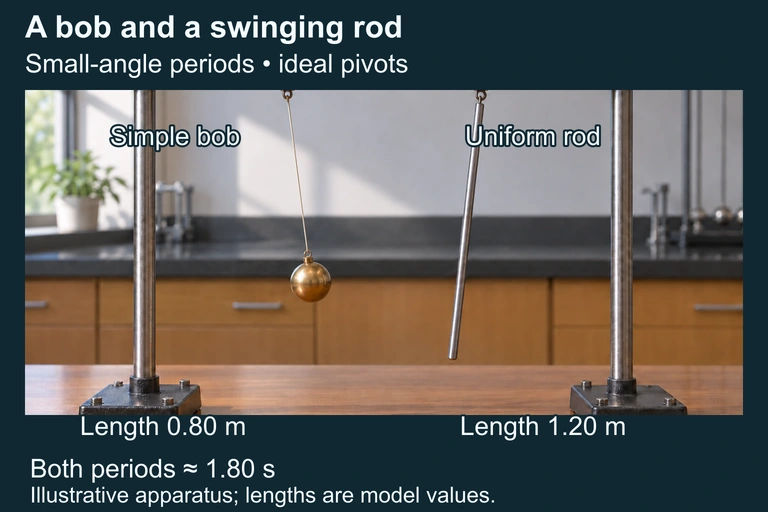
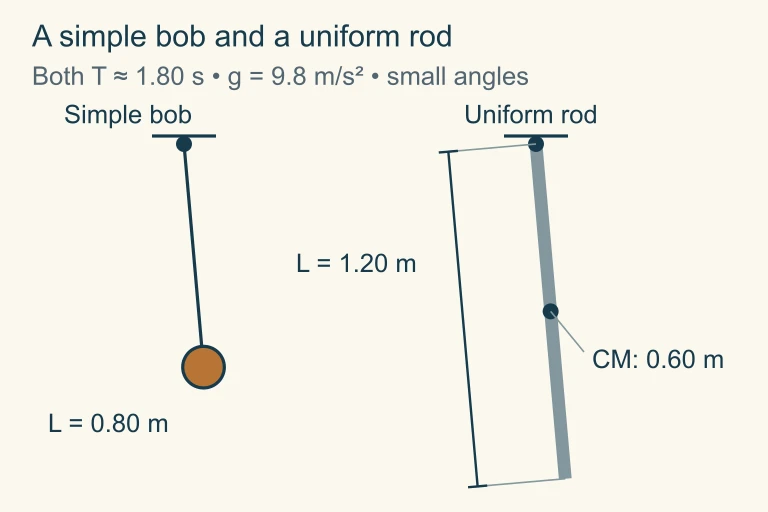
Illustrative physical and simple pendulums. The required exact schematic shows a uniform 1.20 m rod with its center of mass 0.60 m from the pivot and a 0.80 m bob pendulum, both with small-angle period about 1.80 s.
For the uniform rod, L = 1.20 m, d = L/2 = 0.60 m and I_pivot = ML²/3 = 0.384 kg·m² for M = 0.80 kg. Its equivalent simple-pendulum length I/(Md) = 0.80 m gives the same small-angle period, approximately 1.80 s. The photograph is illustrative; the schematic labels define the model.

How to Solve Pendulum Problems

1
Identify the type: Is it a point mass on a string (simple) or an extended body (physical)?
2
Find the pivot-to-CM distance \(d\): For a simple pendulum, \(d = L\). For physical, locate the center of mass.
3
Determine \(I_P\): Use the parallel axis theorem: \(I_P = I_{\text{cm}} + Md^2\).
4
Apply the period formula: \(T = 2\pi\sqrt{I_P/(Mgd)}\).
5
Verify: Check that \(\theta\) is small. If asked for frequency: \(f = 1/T\). For \(\omega\): \(\omega = 2\pi f\).

Example 1: Simple Pendulum

A pendulum of length \(L = 0.80\) m swings with small amplitude on Earth. Find its period and frequency.

Example 2: Uniform Rod Pendulum

A uniform thin rod of length \(L = 1.2\) m and mass \(M\) is pivoted at one end. Find its period of small oscillations.

CM
\(L/2\)
\(L\)
P

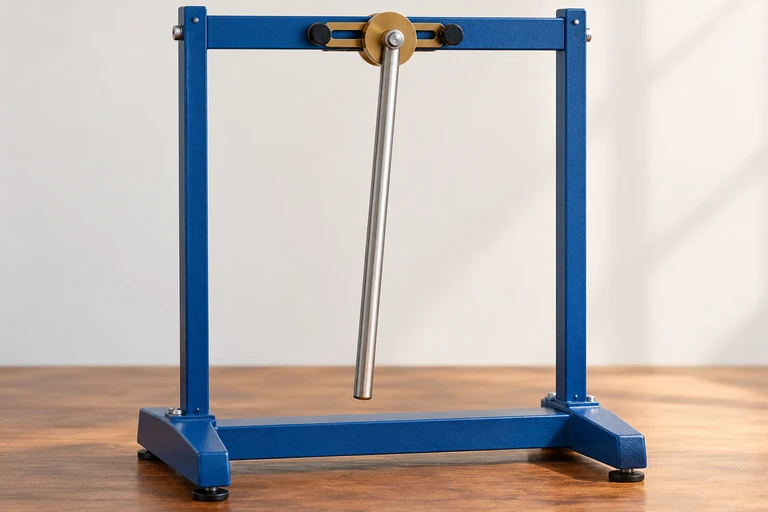
Moving the pivot changes the period

Metal rod suspended near its end from a horizontal axle in a rigid support frame.The rod hangs near its end. Moving the pivot along a uniform rod changes both its rotational inertia and the gravitational restoring torque.

The fastest pivot is off-center
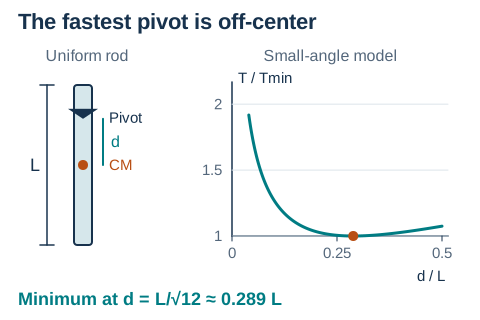
Uniform rod with pivot above its center of mass; normalized period curve reaches a minimum at pivot distance 0.289 times the rod length.For small oscillations of a uniform rod, I = M(L²/12 + d²). The minimum period occurs at d = L/√12 ≈ 0.289L; the period grows without bound as d approaches zero from above.Open full diagram

Example 3: Disk Pendulum

A uniform disk of radius \(R = 0.25\) m and mass \(M\) is pivoted at a point on its rim. Find its period.

CM P
\(R\)
\(R\)

Energy in Pendulum Motion

As a pendulum swings, energy continually converts between kinetic and gravitational potential. At maximum displacement the energy is entirely potential; at the bottom of the swing it is entirely kinetic.

\(\theta = \theta_0\)
\(\theta = 0\)
\(\theta = -\theta_0\)
PE KE PE PE → KE KE → PE E total

Common Mistakes to Avoid

✕ Using \(I_{\text{cm}}\) Instead of \(I_P\)
For a physical pendulum, you must use the moment of inertia about the pivot, not about the center of mass. Apply the parallel axis theorem: \(I_P = I_{\text{cm}} + Md^2\).
✕ Forgetting Small-Angle Condition
The SHM formulas \(T = 2\pi\sqrt{L/g}\) and \(T = 2\pi\sqrt{I_P/(Mgd)}\) are only valid when \(\theta\) is small. For large angles, the period increases.
✕ Thinking Mass Affects the Simple Pendulum Period
Mass cancels out for both simple and physical pendulums. The period depends on geometry (\(L\) or \(I_P/d\)) and \(g\), not on \(M\).
✕ Confusing \(d\) with \(L\)
In the physical pendulum formula, \(d\) is the distance from the pivot to the CM, not the total length. For a rod pivoted at one end: \(d = L/2\), not \(L\).

Question 1 of 5

A simple pendulum has a period of \(T\) on Earth. If its length is quadrupled, what is the new period?

Question 2 of 5

A uniform rod of length \(L\) is pivoted at one end. Which expression gives the moment of inertia about the pivot?

Question 3 of 5

Two simple pendulums have the same length but different masses. Pendulum A has mass \(m\) and Pendulum B has mass \(3m\). How do their periods compare?

Question 4 of 5

A uniform disk of radius \(R\) is pivoted at a point on its rim. What is the period of small oscillations?

Question 5 of 5

A simple pendulum is taken from Earth to the Moon, where \(g_{\text{Moon}} \approx g/6\). How does the period change?